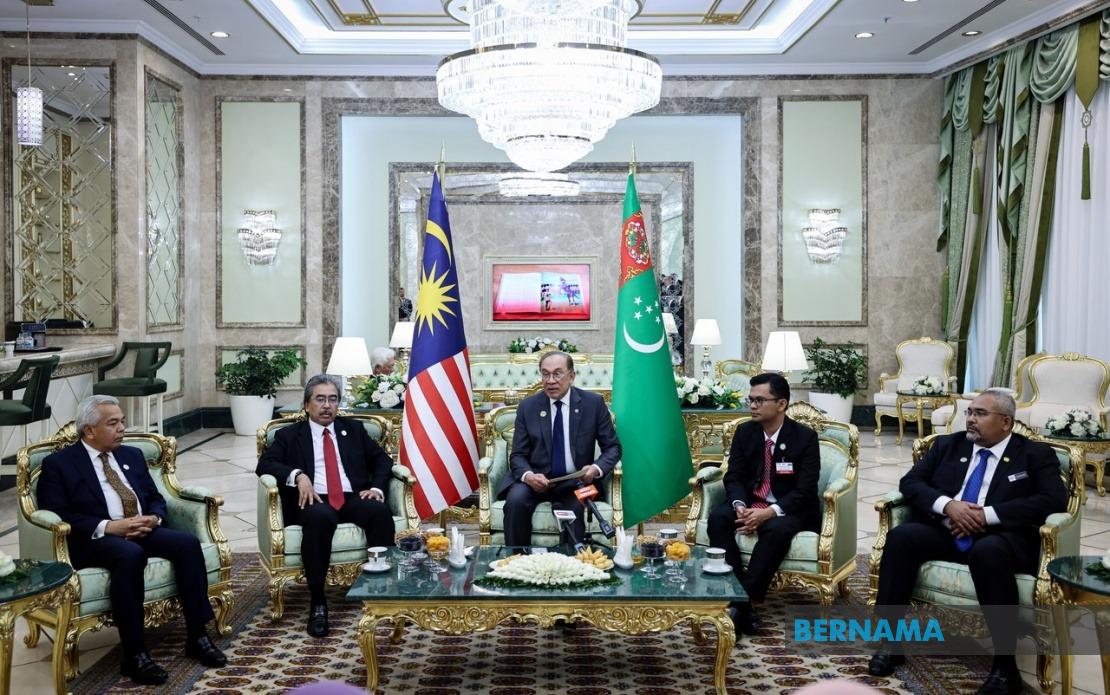
Prime Minister Datuk Seri Anwar Ibrahim has characterised his official working visit to Turkmenistan as a meaningful diplomatic engagement that has fulfilled its core objectives of enhancing bilateral relations and establishing a firmer foundation for strategic cooperation. The two-day mission, which commenced on June 18, represents a significant milestone in Malaysia's engagement with the Central Asian nation, marking Anwar's inaugural official trip to Turkmenistan since his appointment as Malaysia's 10th prime minister in November 2022. The visit, undertaken at the formal invitation of Turkmenistan President Serdar Berdimuhamedov, underscores Malaysia's commitment to broadening its diplomatic footprint beyond traditional regional alliances.
The energy sector emerged as a central pillar of discussions during the visit, with both delegations recognising substantial untapped potential for mutually beneficial collaboration. Turkmenistan, one of the world's largest natural gas reserves holders, represents an important strategic partner for Malaysia as the nation pursues energy security and diversification strategies. The identification of the energy domain as a primary avenue for expanded cooperation suggests deliberate alignment with Malaysia's broader economic objectives, particularly as the country navigates global energy transitions and seeks stable supply arrangements to support industrial competitiveness and domestic consumption requirements.
Anwar acknowledged the pivotal role played by President Berdimuhamedov and broader Turkmenistan governmental structures in orchestrating a welcoming reception for the Malaysian delegation. This diplomatic courtesy carries significance beyond mere ceremonial protocol, reflecting Turkmenistan's willingness to elevate bilateral engagement and suggesting receptiveness to deepening economic ties with Malaysia. The warm reception extended to the delegation signals that both nations view this partnership through an optimistic lens, with potential for sustained cooperation extending across multiple sectoral domains.
The Prime Minister's delegation composition reflected the multifaceted nature of the visit's objectives. The inclusion of Minister of Investment, Trade and Industry Datuk Seri Johari Abdul Ghani and Minister of Economy Akmal Nasrullah Mohd Nasir demonstrates that discussions transcended traditional diplomatic pleasantries to encompass concrete economic considerations. These ministerial attendees brought expertise directly relevant to investment facilitation, trade mechanisms, and economic policy coordination, positioning the delegation to translate diplomatic goodwill into tangible commercial and institutional frameworks.
Supportive institutional representation further underscored the visit's substantive ambitions. Officials from the Prime Minister's Office and the Foreign Ministry accompanied the delegation, ensuring continuity with Malaysia's broader foreign policy architecture and enabling alignment of bilateral initiatives with national strategic priorities. The presence of PETRONAS representatives proved particularly significant, signalling direct private sector engagement in exploring commercial opportunities within the energy space. PETRONAS, as Malaysia's national petroleum corporation, brings technical expertise, operational capacity, and financial resources essential for translating bilateral energy cooperation frameworks into concrete investment projects.
The Malaysian Embassy in Ashgabat, along with accompanying security and media personnel, contributed essential logistical and communication infrastructure necessary for smooth visit execution. This administrative groundwork, whilst often overlooked, proves indispensable for transforming high-level diplomatic intent into substantive outcomes. Coordinated embassy engagement ensures implementation of agreements, maintenance of ongoing dialogue channels, and documentation of partnership developments for public understanding and parliamentary accountability.
Anwar's characterisation of the visit as opening a new chapter in bilateral cooperation suggests that prior engagement levels between Malaysia and Turkmenistan may have been relatively constrained. This framing indicates that the visit represents a qualitative escalation in diplomatic intensity and economic ambition rather than a continuation of established cooperation frameworks. The deliberate invocation of a new chapter implies both nations recognise untapped collaborative potential and demonstrate commitment to systematic relationship development moving forward.
The emphasis on areas of mutual interest carries implicit acknowledgement that bilateral partnerships function most durably when rooted in reciprocal benefit rather than asymmetrical advantage-seeking. Turkmenistan's vast hydrocarbon resources and Malaysia's technical expertise, capital availability, and established energy sector infrastructure create complementary capacities. This structural compatibility enhances prospects for sustainable cooperation mechanisms that address legitimate interests of both nations simultaneously.
For Malaysia specifically, deepening energy partnerships with Central Asian suppliers diversifies the nation's energy sourcing geography beyond traditional Middle Eastern and Southeast Asian arrangements. Such diversification reduces vulnerability to supply disruptions concentrated in any single region and potentially improves Malaysia's negotiating position within broader energy markets. Regional energy stability contributes directly to industrial competitiveness and consumer welfare, making energy diplomacy a substantive economic policy tool rather than peripheral diplomatic exercise.
The timing of this visit reflects Malaysia's broader foreign policy orientation toward expanding engagement across geographic regions beyond immediate Southeast Asian proximity. As Malaysia positions itself as a significant Asian economy with global commercial aspirations, cultivation of partnerships with resource-rich nations in Central Asia aligns with long-term strategic interests. Turkmenistan's geographic location, positioned as a bridge between Asia and Europe, offers additional significance as Malaysia considers infrastructure and connectivity initiatives that potentially enhance regional trade and investment flows.
Looking forward, the visit's success depends substantially on translation of expressed intentions into concrete institutional arrangements and commercial transactions. Bilateral cooperation frameworks require establishment of formal mechanisms for ongoing dialogue, regular high-level consultations, and structured processes for addressing implementation challenges as they emerge. The visit's achievements ultimately will be measured by subsequent developments in energy trade, investment flows, and institutional partnerships rather than immediate diplomatic pronouncements.