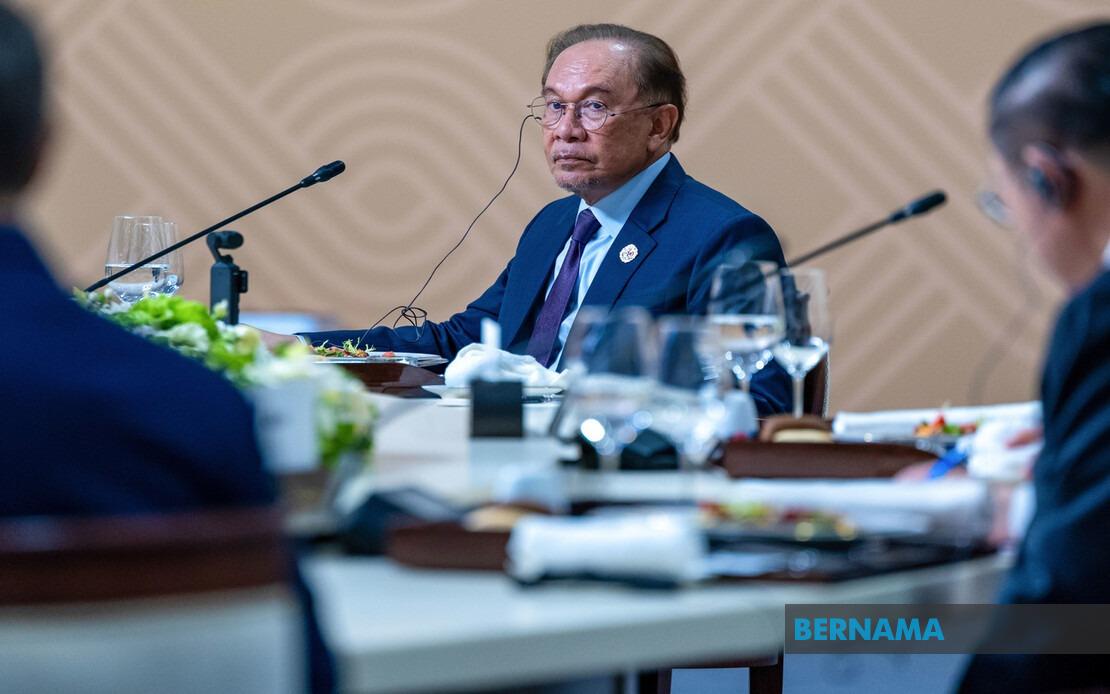
Prime Minister Datuk Seri Anwar Ibrahim has called for ASEAN and the Shanghai Cooperation Organisation to consolidate their institutional strengths in jointly addressing the growing threat of cross-border organised crime and advancing collective energy security initiatives. Speaking during an ASEAN-Russia working lunch in Kazan on June 18, Anwar stressed that both regional groupings possess complementary capabilities and established legal foundations that remain largely untapped, representing a significant opportunity to strengthen regional stability and prosperity across Asia and beyond.
The foundation for enhanced cooperation already exists through a 2005 memorandum of understanding between the two organisations, which explicitly acknowledges mutual interests in counter-terrorism, drug control, money laundering prevention, and energy development including hydroelectric power and biofuels production. Rather than creating entirely new mechanisms, Anwar advocated for deepening and operationalising commitments that have remained largely dormant or underutilised since their inception. This pragmatic approach reflects growing recognition within ASEAN capitals that institutional frameworks proliferate far more readily than genuine implementation, necessitating a strategic shift toward delivering measurable outcomes on priority issues.
The challenge of transnational organised crime presents perhaps the most urgent case for intensified cooperation. Anwar highlighted how criminal networks engaged in online fraud schemes, illicit financial transfers, and human trafficking operate with remarkable speed and sophistication, frequently exploiting gaps between national law enforcement agencies. The digital dimension of modern crime means that detection, investigation, and prosecution require real-time intelligence sharing and coordinated responses that transcend traditional bilateral arrangements. ASEAN nations, many serving as transit points or source countries for trafficking victims and illicit funds, face particular vulnerability to these threats. The SCO, encompassing major regional powers with significant security apparatus capabilities, brings considerable investigative and intelligence resources that could be systematically deployed through formal working groups and regular operational coordination meetings.
Beyond security considerations, Anwar, who also holds the Finance Ministry portfolio, articulated a compelling vision for energy cooperation drawing on the SCO's substantial production capacity and technological expertise. The organisation brings together major petroleum and natural gas producers, renewable energy innovators, and nuclear power operators whose combined knowledge base could accelerate the region's transition toward sustainable energy systems. For Malaysia and other ASEAN members heavily dependent on energy imports or seeking to diversify their energy portfolios, such cooperation offers pathways to improved supply security, technology access, and cost efficiency that bilateral arrangements cannot typically provide.
The energy cooperation agenda extends across multiple interconnected domains requiring coordinated action. Energy efficiency improvements in industrial and residential sectors demand capacity building and technology transfer facilitated through structured programmes rather than ad hoc commercial negotiations. Grid modernisation and reliability, particularly as renewable energy sources increasingly disrupt traditional load management patterns, benefits from shared operational experience and standardised approaches. Liquefied natural gas development, a critical component of Asia's energy transition, requires coordinated investment frameworks and transparent pricing mechanisms. Integration of renewable energy sources into existing infrastructure necessitates technical cooperation on storage solutions, demand management, and system balancing. These practical initiatives, Anwar emphasised, should be pursued through knowledge-sharing platforms that bring together government agencies, state enterprises, and private sector players across member nations.
Anwar extended the framework for enhanced multilateral cooperation to encompass ASEAN's relationship with the Eurasian Economic Union, arguing that existing trade and investment protocols require activation and practical implementation. The EAEU, comprising Russia, Belarus, Kazakhstan, Kyrgyzstan, and Tajikistan, represents a significant economic bloc with which ASEAN's engagement remains underdeveloped relative to strategic opportunity. The Prime Minister identified three concrete priorities warranting immediate attention to unlock commercial potential and deepen economic interdependence. First, regular business dialogue mechanisms between private sector actors from both regions require strengthening and expansion beyond their current ad hoc nature, with formal participation in major trade and investment conferences serving as catalysts for relationship building and market discovery.
Second, the capacity constraints facing small and medium enterprises in both regions demand targeted support programmes addressing market access barriers, technological capability gaps, and skills development deficits. ASEAN's SME sector, which comprises the majority of registered businesses across member states, often lacks information about trading opportunities in Central Asia and Russia, while simultaneously struggling to meet quality and certification standards demanded by larger commercial partners. Similarly, Eurasian enterprises seeking to penetrate ASEAN markets confront regulatory complexity, unfamiliar business practices, and logistical challenges that can only be overcome through systematic capacity building initiatives funded and managed collaboratively. Such programmes might include trade missions, standardisation workshops, digital platform development for supplier identification, and mentoring arrangements pairing experienced exporters with emerging market entrants.
Third, Anwar identified emerging domains of overlapping interest where ASEAN and the EAEU require collaborative frameworks rather than competitive approaches. The digital economy and artificial intelligence development represent transformative forces reshaping economic structures across both regions, yet present significant risks around data sovereignty, algorithmic transparency, and workforce displacement. Establishing common principles, standards, and regulatory approaches early in the adoption cycle could prevent the fragmentation and incompatibility challenges that have plagued other technology transitions. Cybersecurity cooperation assumes heightened importance as digital infrastructure integration deepens, with coordinated threat assessment, incident response protocols, and capacity building becoming prerequisites for resilient systems. Food security, meanwhile, concerns both regions acutely, with ASEAN dependent on import diversification and the EAEU possessing substantial agricultural production capacity alongside interests in accessing Southeast Asian markets for grain, dairy, and processed food products.
Anwar's remarks during his two-day working visit to Kazan for the ASEAN-Russia Commemorative Summit reflected a sophisticated understanding of how regional organisations can move beyond declaratory statements toward substantive cooperation yielding tangible benefits for member states. The Shanghai Cooperation Organisation, established in 2001, currently comprises ten full members including China, India, Russia, Kazakhstan, Kyrgyzstan, Tajikistan, Uzbekistan, Pakistan, Iran, and Belarus, alongside observer states Afghanistan and Mongolia, positioning it as arguably Asia's most institutionally complex security organisation. Similarly, ASEAN's eleven members bring diverse capabilities, interests, and constraints requiring careful orchestration to achieve consensus on ambitious initiatives.
The practicality of Anwar's proposals lies in their grounding in existing institutional relationships and legal instruments rather than calls for wholesale reorganisation or creation of parallel structures. ASEAN's chronic capacity constraints, evident in implementation gaps across multiple agreed frameworks, suggest that the organisation benefits from focused, measurable objectives pursued through defined timeframes with allocated resources and clear accountability mechanisms. The Prime Minister's emphasis on "a few areas where measurable progress can be made within a defined timeframe" reflects this institutional realism, contrasting with the tendency in regional forums toward expansive agendas that typically remain unimplemented. For Malaysia, a middle power within ASEAN with substantial interests in both regional stability and economic development, championing practical cooperation mechanisms in security and energy domains serves important strategic objectives while positioning the country as a bridge between Asia's major power blocs during a period of great power competition.