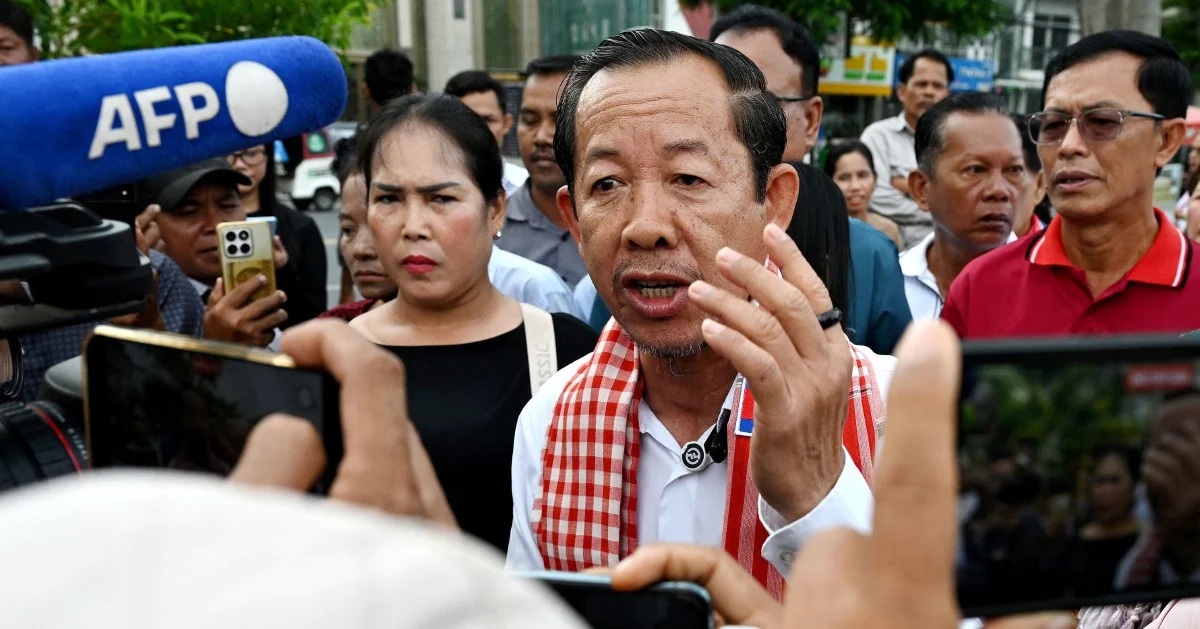
Cambodia's Supreme Court has delivered a mixed ruling on the case of opposition politician Rong Chhun, suspending his prison sentence while retaining restrictions that prevent him from seeking public office. The decision, announced through his legal team, maintains a significant barrier to Rong Chhun's political participation even as it provides some relief from incarceration. The ruling exemplifies the complex and contested legal landscape facing Cambodia's opposition figures, who face multiple legal obstacles to their political engagement.
Rong Chhun, a prominent opposition voice in Cambodian politics, had been convicted under circumstances that opposition groups and international observers argue reflect the judiciary's treatment of government critics. The suspension of his prison term marks a technical adjustment to his legal status, yet the persistence of the electoral ban underscores how such bans function as a more enduring constraint on political involvement than custodial sentences. In practical terms, Rong Chhun cannot stand as a candidate in upcoming elections regardless of his imprisonment status, limiting his ability to contest elections and represent constituents through parliamentary channels.
The timing of Cambodia's court decision arrives amid ongoing scrutiny of the country's democratic institutions from regional and international observers. Cambodia has faced repeated criticism regarding the independence of its judiciary and the treatment of political opponents, with human rights groups documenting patterns they characterise as judicial harassment of government critics. The maintenance of Rong Chhun's election ban, even as his prison sentence faces suspension, illustrates how legal mechanisms can restrict political competition whilst maintaining the appearance of judicial flexibility on incarceration matters.
For Malaysian observers watching Southeast Asian political dynamics, Cambodia's case represents broader regional patterns in which formal democratic structures coexist with significant constraints on opposition participation. Several Southeast Asian countries employ election bans, disqualification rules, and conviction-based restrictions to shape electoral outcomes, mechanisms that function distinctly from simple electoral defeat. These legal tools operate across the region's diverse political systems, from democracies with strong institutions to more contested governance environments, creating varying degrees of impact on electoral competition and representation.
The opposition figure's legal battles reflect deeper tensions within Cambodia's political system regarding power distribution and electoral access. Rong Chhun has previously led campaigns addressing labour rights and worker protections, positioning himself as an advocate for vulnerable populations often marginalised in formal political processes. His disqualification from electoral participation therefore extends beyond individual consequence, affecting constituencies and social movements that might have channelled demands through his political candidacy. The election ban thus removes one specific avenue through which workers and lower-income Cambodians might have sought parliamentary representation.
Cambodia's ruling party has dominated electoral competition since the 1990s, and opposition parties have struggled to consolidate support under restrictive legal frameworks. Previous elections witnessed major opposition parties facing disqualification, legal challenges to their candidates, and restrictions affecting party operations. The pattern of convictions and election bans affecting opposition figures has prompted international election observers and regional democracy advocates to question the neutrality of Cambodia's electoral administration and judicial processes. The Rong Chhun decision continues this documented pattern.
The suspension of Rong Chhun's prison sentence may reflect internal judicial considerations or signalling of flexibility in specific cases, yet the maintained election ban indicates that his removal from electoral competition remains a settled matter within Cambodia's legal and political establishment. Prison term suspensions can later be revoked if an individual violates probation conditions, meaning the possibility of incarceration persists even absent immediate imprisonment. The election ban, by contrast, typically remains fixed for specified periods or indefinitely, functioning as permanent disqualification from candidacy regardless of other legal developments.
Regional human rights organisations have documented election bans as instruments affecting opposition political participation across Cambodia's recent electoral history. International observers monitoring Cambodian elections have flagged such restrictions alongside other factors—ballot access requirements, candidate nomination rules, party registration obstacles—that cumulatively shape electoral competition. The combination of legal mechanisms available to ruling authorities creates multiple layers through which opposition participation can be constrained, with individual restrictions like Rong Chhun's election ban constituting single elements within broader frameworks.
For Cambodia's civil society, labour movements, and grassroots political organisations, the sustained disqualification of prominent opposition figures represents ongoing limitations on formal political channels. Social movements and advocacy groups therefore navigate political engagement through protest, community organising, and issue-based campaigns rather than relying solely on electoral representation. The restriction of opposition electoral participation thus influences how Cambodian civil society develops strategies for political influence and social change outside parliamentary venues.
The Supreme Court's ruling demonstrates how judicial decisions in Cambodia often reflect political settlements rather than purely legal determinations. The selective suspension of incarceration while maintaining electoral restrictions suggests negotiation between different power centres rather than uniform application of legal principles. For regional observers, the decision illustrates how authoritarian or semi-authoritarian systems employ layered legal mechanisms to sustain political control whilst maintaining formal adherence to constitutional frameworks and judicial procedures. Cambodia's approach to managing opposition figures through conviction and disqualification rather than pure authoritarianism characterises much contemporary Southeast Asian governance across varying regime types.