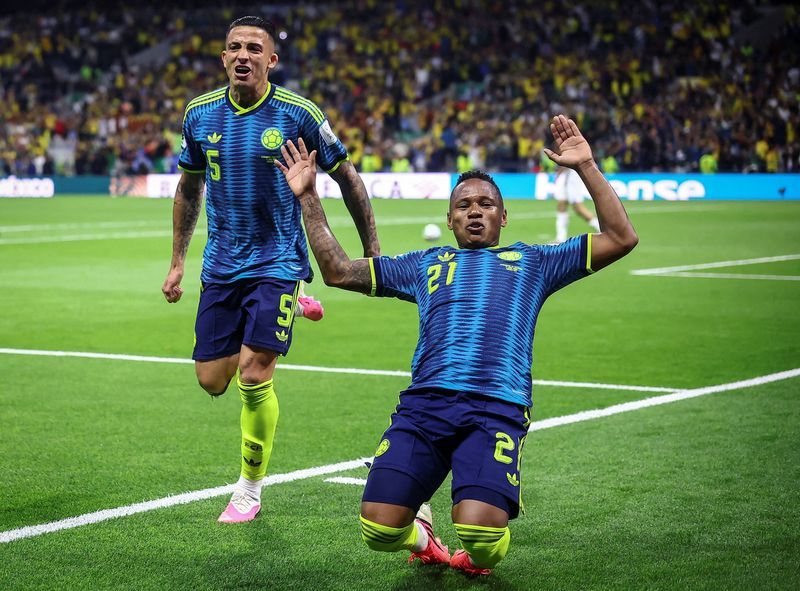
Colombia will attempt to maintain their unbeaten run at the World Cup when they encounter DR Congo on Tuesday, though coach Nestor Lorenzo acknowledges the challenge posed by an opponent who has already proven capable of frustrating tournament heavyweights. The South American side began their Group K campaign with a 3-1 triumph over Uzbekistan, yet that scoreline belied a fraught second half during which their Central Asian opponents exposed defensive vulnerabilities that remain a point of concern heading into their next fixture.
A victory against DR Congo would confirm Colombia's passage to the next round while potentially clinching top spot in Group K, depending on the outcome of Portugal's simultaneous match against Uzbekistan. The mathematical advantage is clear, but Lorenzo's focus extends beyond the mathematics of group-stage progression. The Argentine tactician has emphasised the need for greater cohesion and incisiveness in the final third, areas where Colombia showed inconsistency during their opening contest despite dominating possession for substantial periods.
The team will again rely heavily on Bayern Munich's Luis Diaz, whose electrifying performance against Uzbekistan—marked by a goal and an assist—earned him the player-of-the-match accolade. Yet Lorenzo hopes to coax a more influential display from captain James Rodriguez, who operated in relative anonymity during the Uzbekistan fixture as his teammates often bypassed the midfield to exploit Diaz's blistering pace and direct running. The balance between structured play and dynamic attacking thrust will be critical against an opponent designed to punish such imbalances.
DR Congo arrive in this encounter emboldened by an extraordinary opening result. Their 1-1 draw against Portugal represents not merely a respectable outcome but a statement of intent from an African nation competing in their first World Cup since 1974, when they appeared under the name Zaire. Yoane Wissa's goal provided profound symbolic significance as DR Congo's opening World Cup strike in fifty years, while the disciplined defensive shape orchestrated by coach Sebastien Desabre demonstrated how organised, compact football can neutralise even the most talented opponents.
Lorenzo has explicitly warned his squad about the tactical puzzle DR Congo will present. The Congolese favour a transition-based approach, launching lengthy passes to initiate rapid counterattacking movements that can expose spaces in an opponent's defensive structure. This contrasts sharply with the possession-heavy, positional style that Colombia attempted against Uzbekistan. Where Uzbekistan struggled to maintain shape and rhythm, DR Congo's structural discipline offers a more sophisticated test that Lorenzo believes demands tactical adjustment rather than mere tactical domination.
The Colombian coach identified a specific concern arising from their opener: excessive possession occasionally worked counterintuitively against his side, with the team recycling the ball sideways rather than driving forward decisively. He acknowledged a lack of clinical finishing in the final third, an area where the margin between advancement and elimination often proves wafer-thin in knockout football. These observations suggest Lorenzo views the DR Congo fixture not simply as an opportunity to accumulate points but as a necessary proving ground for Championship football, where efficiency supersedes territorial dominance.
Colombia will benefit substantially from the vocal support of their travelling support base, which transformed Mexico City's Estadio Azteca into an unofficial home venue during the Uzbekistan match. With their tournament base established in Guadalajara, a significant Colombian diaspora is expected to descend upon the venue again, providing psychological advantage and emotional uplift during critical moments. Such environmental factors, while intangible, historically carry measurable impact in international football, particularly when teams navigate the psychological challenges of group-stage football.
For DR Congo, the challenge lies in replicating the defensive discipline and structural cohesion that frustrated Portugal while avoiding the creative limitations that characterised their first-half showing. Desabre's side demonstrated admirable resilience, but sustained defensive excellence against Colombia's superior attacking resources demands unwavering concentration across ninety minutes. The presence of Wissa, whose athleticism and directness provide DR Congo's primary offensive threat, will be central to their strategy of punishing Colombia's defensive transitions.
The broader context enriches this fixture beyond group-stage mathematics. Colombia seek to re-establish themselves as serious tournament contenders following a disappointing campaign in Qatar, while DR Congo carry the aspirations of a football-mad nation returning to the world stage after five decades of absence. For Colombian football, progress through the group stage represents a minimum expectation; for Congolese football, merely competing credibly against elite opposition validates the enormous investment in infrastructure and player development. These contrasting narratives will unfold across ninety minutes of football that promises tactical depth and genuine uncertainty.
%22%2F%3E%3C%2Fpattern%3E%3C%2Fdefs%3E%3Crect%20width%3D%22100%25%22%20height%3D%22100%25%22%20fill%3D%22url(%23ph1nkgig)%22%2F%3E%3Crect%20width%3D%22100%25%22%20height%3D%22100%25%22%20fill%3D%22url(%23ph1nkgip)%22%2F%3E%3Ctext%20x%3D%2250%25%22%20y%3D%2250%25%22%20text-anchor%3D%22middle%22%20dominant-baseline%3D%22central%22%20fill%3D%22rgba(255%2C255%2C255%2C0.95)%22%20font-family%3D%22Georgia%2C%20'Times%20New%20Roman'%2C%20serif%22%20font-weight%3D%22700%22%20font-size%3D%22136%22%20letter-spacing%3D%22-0.02em%22%3ENetherlan%E2%80%A6%3C%2Ftext%3E%3C%2Fsvg%3E)
%22%2F%3E%3C%2Fpattern%3E%3C%2Fdefs%3E%3Crect%20width%3D%22100%25%22%20height%3D%22100%25%22%20fill%3D%22url(%23ph1epzlg)%22%2F%3E%3Crect%20width%3D%22100%25%22%20height%3D%22100%25%22%20fill%3D%22url(%23ph1epzlp)%22%2F%3E%3Ctext%20x%3D%2250%25%22%20y%3D%2250%25%22%20text-anchor%3D%22middle%22%20dominant-baseline%3D%22central%22%20fill%3D%22rgba(255%2C255%2C255%2C0.95)%22%20font-family%3D%22Georgia%2C%20'Times%20New%20Roman'%2C%20serif%22%20font-weight%3D%22700%22%20font-size%3D%22320%22%20letter-spacing%3D%22-0.02em%22%3EIran%3C%2Ftext%3E%3C%2Fsvg%3E)
%22%2F%3E%3C%2Fpattern%3E%3C%2Fdefs%3E%3Crect%20width%3D%22100%25%22%20height%3D%22100%25%22%20fill%3D%22url(%23ph3f29jg)%22%2F%3E%3Crect%20width%3D%22100%25%22%20height%3D%22100%25%22%20fill%3D%22url(%23ph3f29jp)%22%2F%3E%3Ctext%20x%3D%2250%25%22%20y%3D%2250%25%22%20text-anchor%3D%22middle%22%20dominant-baseline%3D%22central%22%20fill%3D%22rgba(255%2C255%2C255%2C0.95)%22%20font-family%3D%22Georgia%2C%20'Times%20New%20Roman'%2C%20serif%22%20font-weight%3D%22700%22%20font-size%3D%22272%22%20letter-spacing%3D%22-0.02em%22%3ETrump%3C%2Ftext%3E%3C%2Fsvg%3E)