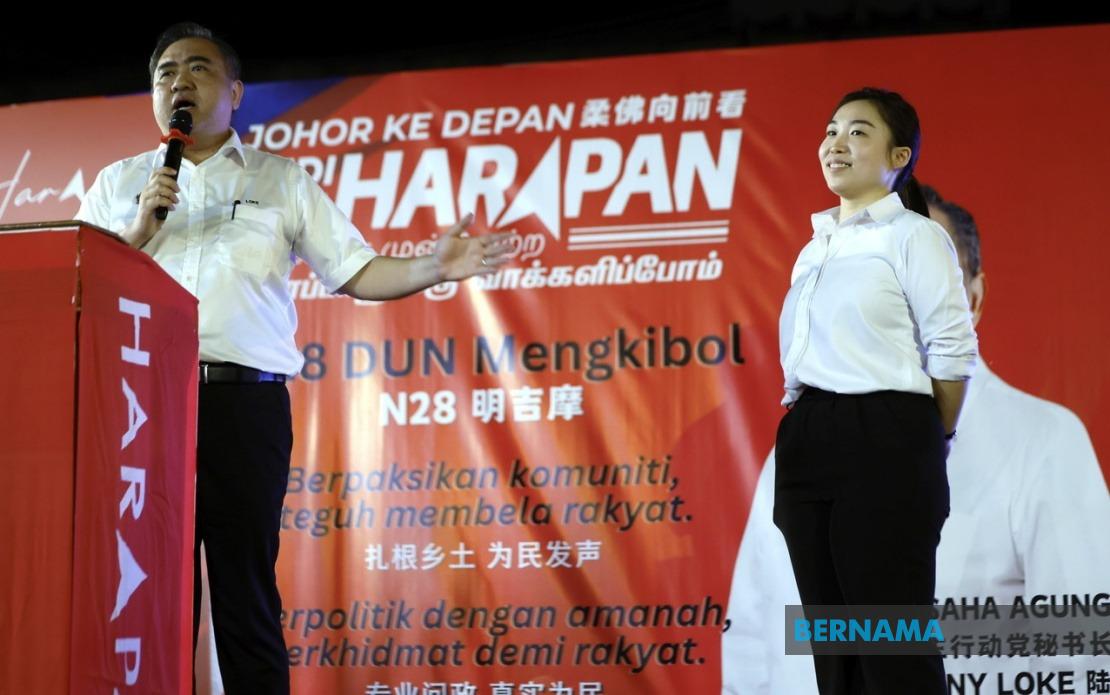
The Democratic Action Party has moved to strengthen its female representation in the upcoming Johor state election by nominating 33-year-old legal practitioner Chu Poh Yee as its candidate for the Mengkibol state seat. The announcement, made at a ceremony in Kluang on June 18, marks DAP's first public endorsement ahead of what is shaping into a consequential electoral contest for the Pakatan Harapan coalition in Malaysia's southernmost peninsula.
Party secretary-general Anthony Loke framed the candidacy announcement as both a generational transition and a strategic repositioning. The decision displaces incumbent assemblyman Chew Chong Sin, who has held the Mengkibol seat for two consecutive terms, though rather than facing retirement, Chew is being groomed for a potentially more prominent role. The party intends to nominate him for the Labis parliamentary constituency in the next general election, a seat that will become vacant after current Member of Parliament Pang Hok Liong decided against contesting again.
This manoeuvre reflects DAP's broader calculation about candidate placement across multiple electoral levels. By moving Chew upward to the federal arena, the party creates space to introduce fresh faces at the state level while retaining the experience and organisational strength of an incumbent who has already demonstrated electoral viability. The strategy minimises party vulnerability during a transition period and allows DAP to project continuity even as it pursues renewal.
Chu's selection carries particular significance within the Malaysian political landscape, where female representation remains proportionally limited despite growing demands for gender diversity in elected office. At 33 years old, she embodies the emerging profile of party candidates—young enough to represent generational change yet mature enough to carry professional credentials. Her legal background, specifically her track record assisting elected representatives with legal aid cases, provides a practical foundation for constituency work that extends beyond traditional campaign messaging.
Party leadership highlighted Chu's multilingual abilities and strong educational qualifications as decisive factors in the selection process. More substantially, they emphasised her established connections within the Mengkibol constituency itself, a detail suggesting DAP has invested time in identifying candidates with genuine roots in their proposed electoral areas rather than simply parachuting external party figures into races. This localism, when executed authentically, tends to resonate with voters sceptical of perceived carpetbagging.
The nomination of Chu also signals DAP's deliberate effort to expand opportunities for women within its electoral apparatus. Malaysian political parties have historically concentrated women candidates in unwinnable seats or secondary positions within party hierarchies. By placing Chu in a seat the party currently holds, DAP presents her as a genuinely competitive candidate rather than a symbolic gesture, a distinction that carries weight among voters and party activists observing how seriously the commitment to gender diversity actually operates in practice.
Loke confirmed that DAP's candidate selection process for the Johor state election has substantially concluded, with the party standing in 17 of the state's seats. This composition includes ten seats currently held by DAP—encompassing Mengkibol—alongside four constituencies previously lost that the party seeks to reclaim and three additional seats where DAP believes it can mount competitive challenges. The strategic concentration on winnable or previously held seats suggests the party is prioritising realistic electoral gains over symbolic campaigns across every available division.
The broader candidate announcement timeline indicates careful choreography within the Pakatan Harapan coalition. Additional DAP candidates for the seats of Tiram, Johor Jaya, Senai and Bukit Permai are scheduled for announcement on the Saturday following Chu's nomination, while the remaining state candidates will be unveiled alongside PH's full slate through a coordinated announcement by the Prime Minister the following Monday. This staggered approach allows each party within the coalition to generate distinct media attention for its candidates while maintaining unified messaging around coalition strategy.
The Mengkibol contest itself carries implications beyond a single state seat. Johor remains politically significant as Malaysia's largest manufacturing hub and home to substantial middle-class and working-class populations with diverse ethnic and religious compositions. The state election outcome will influence broader calculations about PH's electoral capacity and coalition stability ahead of the next general election. By fielding competitive candidates like Chu in strategically important seats, DAP is making a statement about its commitment to sustaining parliamentary strength in this crucial state.
Chu's candidacy also reflects evolving patterns in Malaysian legal practice and professional politics. As the legal profession has become increasingly feminised, particularly in younger cohorts, the pipeline for women moving from professional careers into electoral politics has broadened. Her background in legal aid—often positioned as socially conscious practice—aligns with voter preferences for candidates demonstrating genuine engagement with community welfare rather than purely partisan ambition.
The emphasis on Chu's constituent connections and professional standing carries broader resonance for Malaysian voters increasingly fatigued by political dynasties and insider appointment networks. Whether she ultimately prevails in Mengkibol will depend on numerous factors including opposition strength, local campaign dynamics, and broader state-level trends. Nonetheless, her nomination represents the DAP's calculated effort to blend generational renewal with proven electoral pragmatism, while advancing the ongoing conversation about women's political participation in Malaysia's competitive electoral environment.