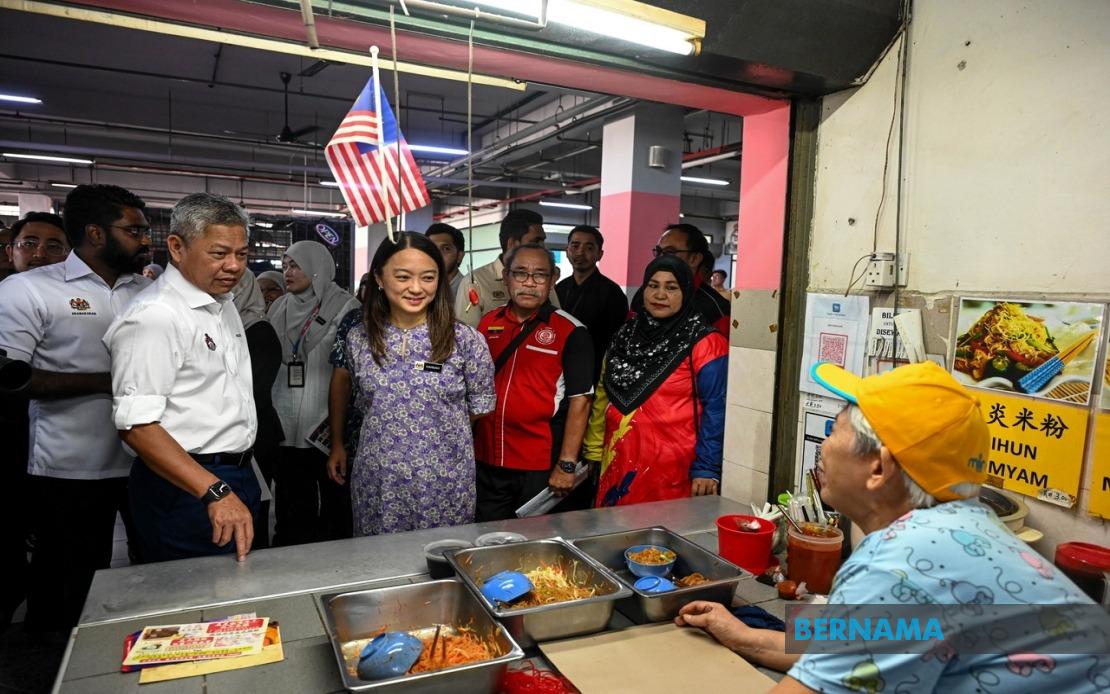
Kuala Lumpur's municipal authority has committed substantial resources to a comprehensive restructuring of the city's informal food and retail sector, pledging RM200 million towards the modernisation of hawker operations across 287 designated locations. The Lestari Niaga @ Kuala Lumpur 2026 programme represents one of the largest-scale interventions in the city's street trading infrastructure, with implications extending beyond the immediate 11,000 traders affected to encompass broader urban management and social cohesion strategies.
Minister in the Prime Minister's Department (Federal Territories) Hannah Yeoh framed the initiative as a balancing act among competing urban priorities. She acknowledged that successful implementation requires navigating the interests of multiple stakeholder groups—residents seeking unobstructed traffic flows, traders dependent on their existing locations and customer bases, and building proprietors with their own operational concerns. This multi-stakeholder approach underscores a recognition that top-down hawker management in Malaysian cities has historically generated friction when community perspectives have been marginalised.
The high-profile UTC Sentul project provides a concrete example of how the city hall is executing this strategy. Following public engagement sessions that generated significant online discussion, DBKL redesigned its redevelopment plans to incorporate trader feedback. The UTC Sentul phase involves a RM1.6 million investment to replace makeshift structures with 20 purpose-built modular kiosks, scheduled for completion before October. This particular project demonstrates the city's willingness to absorb higher upfront construction costs in exchange for modernised facilities that can improve operational efficiency and hygiene standards.
A notable innovation accompanying these physical upgrades is a direct financial assistance scheme. Traders at the UTC Sentul site and other priority locations will receive RM1,500 monthly during construction disruptions—a first-time intervention by DBKL designed to cushion the income loss that typically accompanies relocation and rebuilding work. Kuala Lumpur Mayor Datuk Seri Fadlun Mak Ujud justified this approach by contrasting it with temporary trading site alternatives, which frequently impose logistical disadvantages that depress customer visits and ultimately prove counterproductive to protecting livelihoods.
The broader Lestari Niaga framework encompasses considerable diversity among affected traders. Initial phases will focus on 224 locations, though the full scope extends to all 287 sites. Within this universe, over 4,000 practitioners operate as mobile street vendors, approximately 5,000 conduct business from municipal assets such as designated hawker centres, and roughly 1,000 remain in reapplication categories—individuals whose status relative to formal trading permits requires clarification or renewal. This compositional heterogeneity necessitates differentiated implementation strategies rather than uniform architectural solutions.
Expansion beyond UTC Sentul is already in motion, with simultaneous projects scheduled for Jalan Dato Senu, Pudu Ulu, and Bandar Tun Razak. These locations represent geographically dispersed clusters of informal commercial activity, suggesting that DBKL is pursuing a coordinated metropolitan approach rather than ad hoc site-by-site management. The rollout strategy deployed this year signals accelerating implementation, with the city hall apparently confident in its operational capacity to manage multiple concurrent upgrade projects.
For Malaysian policymakers and urban administrators elsewhere in the region, the Lestari Niaga initiative carries instructive implications. Street trading constitutes an essential economic function in Southeast Asian cities, providing livelihoods for hundreds of thousands and affordable consumer goods to millions. Yet informal vendor operations frequently clash with modernisation imperatives, traffic management objectives, and aesthetic urban planning ideals. Kuala Lumpur's investment in purpose-designed infrastructure rather than suppression or displacement suggests a pragmatic acceptance that formalising and upgrading informal sectors produces better outcomes than elimination attempts.
The financial assistance component merits particular attention as a replicable policy model. By providing direct income support during transition periods, DBKL addresses a fundamental implementation barrier that has historically undermined hawker improvement schemes. Traders facing construction disruption without compensation often resist relocation, create public opposition, or abandon their businesses entirely. The RM1,500 monthly stipend, while modest by absolute standards, likely represents meaningful income stabilisation for vendors operating on thin margins.
The programme's scale—affecting 11,000 traders across metropolitan Kuala Lumpur—positions it as a significant policy intervention within Malaysia's urban development framework. Investment of RM200 million reflects substantial municipal commitment, though the per-location average of approximately RM700,000 suggests that not all 287 sites will receive identical facility upgrades. Prioritisation mechanisms and phasing decisions will presumably direct the largest investments toward high-traffic, high-visibility locations generating the most pronounced urban management challenges.
Challenges remain embedded within the implementation pathway. Trader resistance to relocation, even with financial incentives and improved facilities, may persist at certain locations where customer loyalty to specific addresses proves stronger than infrastructure quality considerations. Community opposition from residents or adjacent businesses could trigger delays or redesigns. Supply chain interruptions affecting kiosk construction materials could extend timelines beyond stated completion targets. The city hall's capacity to manage 287 simultaneous or sequential upgrade processes without capacity constraints requires careful monitoring.
The Lestari Niaga initiative also reflects broader regional trends toward formalising and integrating informal sectors into municipal governance structures. Rather than treating street trading as a nuisance requiring suppression, Southeast Asian cities increasingly recognise its economic vitality and social importance. Kuala Lumpur's programmatic approach—combining infrastructure investment, direct financial support, and stakeholder engagement—represents a template that resonates with contemporary development thinking emphasising inclusive urban planning.
Successful execution of this RM200 million commitment will significantly reshape Kuala Lumpur's street trading landscape. Modernised, standardised kiosks with improved sanitation and safety features could elevate consumer confidence in informal food vendors, potentially expanding the customer base for participating traders. For the city administration, formalised infrastructure creates opportunities for systematic regulation, safety monitoring, and revenue collection that sprawling informal arrangements preclude. The balance struck between these institutional interests and trader welfare will substantially determine whether Lestari Niaga achieves its ambitious objectives or encounters the implementation difficulties that have challenged comparable schemes elsewhere in the region.