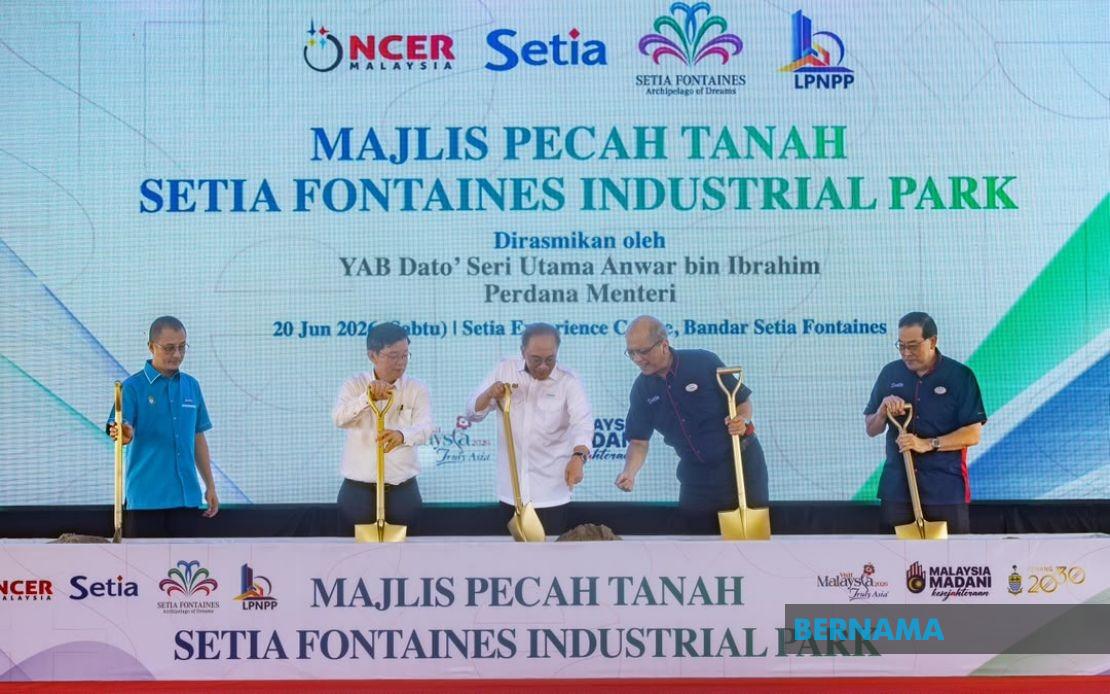
Prime Minister Datuk Seri Anwar Ibrahim has thrown down a challenge to Malaysia's largest government-linked entities and private sector players: development projects must actively create pathways for middle and lower-income communities, not merely generate headlines about economic expansion. Speaking at the groundbreaking ceremony for the Setia Fontaines Industrial Park in Bandar Setia Fontaines, Kepala Batas, Anwar underscored a fundamental concern gripping policymakers across Southeast Asia—that rapid capital investment and infrastructure growth, while economically necessary, risks hollowing out opportunity for ordinary citizens unless deliberately structured to include them.
The Prime Minister's remarks reflected a growing anxiety within Malaysia's governing circles that the country's push toward higher-value manufacturing and technology-driven sectors could inadvertently entrench class divisions rather than dissolve them. Without explicit mechanisms ensuring middle and lower-income Malaysians benefit from fresh investment opportunities, Anwar cautioned, economic gains will concentrate among already-privileged segments while opportunity for disadvantaged communities becomes ever more difficult to access. This concern carries particular weight in Malaysia, where income inequality has been a persistent policy challenge and where regional competition for manufacturing investment has intensified in recent years.
Anwar identified the major institutional players that shape Malaysia's development trajectory—Khazanah Nasional Berhad, Permodalan Nasional Berhad, and the Employees Provident Fund, alongside private corporations—as the key actors responsible for embedding inclusivity into their project approvals and structures. Each time government or major private entities unlock capital for a new development, Anwar suggested, they hold in their hands the capacity to determine whether benefits radiate outward to ordinary Malaysians or concentrate within existing power networks. The specificity of his language indicated this is not merely inspirational rhetoric but an operational expectation his administration intends to enforce.
The Prime Minister distinguished between headline economic metrics and tangible living standards improvements, a distinction that resonates deeply in Malaysia where GDP growth figures have sometimes masked stagnant wage growth for lower-income workers. Economic expansion measured purely through investment volumes or construction activity represents an incomplete picture of development success, Anwar argued. True progress materialises when those gains translate into sustainable employment, skill acquisition, and wealth-building opportunities accessible to Malaysians across income brackets. This framing shifts the conversation away from whether Malaysia is growing toward the more demanding question of whom that growth actually serves.
The Setia Fontaines Industrial Park exemplifies the type of project Anwar believes should embody this inclusionary approach. Located in Seberang Perai on mainland Penang, the industrial park is being positioned to address a regional imbalance in economic development that has historically concentrated investment and opportunity on Penang Island and in the state's southern zones. By ensuring this development delivers benefits beyond the immediate industrial operators and investors, policymakers aim to create a more geographically balanced prosperity narrative across Penang.
Crucially, Anwar highlighted the employment potential inherent in Malaysia's ongoing industrial evolution. As the country pivots from labour-intensive back-end manufacturing toward more sophisticated technology sectors, new categories of professional jobs emerge—roles that demand higher skills and command better compensation. The Setia Fontaines facility represents precisely this transition point, positioned to generate quality employment in advanced manufacturing and related sectors. However, Anwar's framing introduces a critical tension: such opportunities exist only if Malaysian workers possess the requisite skills to fill them, and historically, skills gaps have disproportionately disadvantaged lower-income populations with limited access to technical training.
This reality prompted Anwar's emphasis on enhanced collaboration among industry participants, technical and vocational education and training institutions, and universities including Universiti Sains Malaysia. Without coordinated effort to align worker training with actual industry demands, Malaysia risks importing foreign skilled labour while domestic workers remain unemployable for emerging opportunities—a pattern evident across parts of Southeast Asia. The responsibility extends beyond education institutions alone; industrial players themselves must communicate their evolving skills requirements clearly and participate actively in curriculum development.
Anwar underscored that technological change moves at an accelerating pace, with industry capabilities shifting fundamentally within twelve to twenty-four month cycles. This velocity creates severe challenges for traditional educational approaches that often lag market needs by several years. Universities and vocational institutes must establish much tighter feedback loops with industry, enabling them to adjust training content almost in real time as technological landscapes shift. For lower-income Malaysians to capture emerging opportunities, this alignment cannot remain aspirational; it must become operational standard practice.
The broader implication of Anwar's statements points toward an emerging governance philosophy in Malaysia that treats inclusive development not as charitable add-on but as structural imperative. Previous administrations framed equity considerations as secondary to investment attraction and economic growth maximisation. Anwar's formulation reverses that hierarchy: inclusive opportunity becomes a precondition for project approval rather than an afterthought. This represents a potentially significant recalibration of how Malaysia's development apparatus operates, with substantial downstream consequences for how projects are designed, financed, and implemented across the country.
For Southeast Asian neighbours observing Malaysia's development trajectory, Anwar's remarks also signal a regional conversation about whether growth itself remains the primary metric of successful governance. As middle-income countries across Southeast Asia confront similar tensions between expansion and equity, Malaysia's explicit commitment to ensuring development benefits extend beyond élite networks provides a potential template. Whether implementation will match rhetoric, however, remains the essential test—and one that Anwar's government will face repeatedly as major projects progress across the country over coming years.
%22%2F%3E%3C%2Fpattern%3E%3C%2Fdefs%3E%3Crect%20width%3D%22100%25%22%20height%3D%22100%25%22%20fill%3D%22url(%23ph6xupg)%22%2F%3E%3Crect%20width%3D%22100%25%22%20height%3D%22100%25%22%20fill%3D%22url(%23ph6xupp)%22%2F%3E%3Ctext%20x%3D%2250%25%22%20y%3D%2250%25%22%20text-anchor%3D%22middle%22%20dominant-baseline%3D%22central%22%20fill%3D%22rgba(255%2C255%2C255%2C0.95)%22%20font-family%3D%22Georgia%2C%20'Times%20New%20Roman'%2C%20serif%22%20font-weight%3D%22700%22%20font-size%3D%22170%22%20letter-spacing%3D%22-0.02em%22%3EMalaysia%3C%2Ftext%3E%3C%2Fsvg%3E)
%22%2F%3E%3C%2Fpattern%3E%3C%2Fdefs%3E%3Crect%20width%3D%22100%25%22%20height%3D%22100%25%22%20fill%3D%22url(%23ph6450g)%22%2F%3E%3Crect%20width%3D%22100%25%22%20height%3D%22100%25%22%20fill%3D%22url(%23ph6450p)%22%2F%3E%3Ctext%20x%3D%2250%25%22%20y%3D%2250%25%22%20text-anchor%3D%22middle%22%20dominant-baseline%3D%22central%22%20fill%3D%22rgba(255%2C255%2C255%2C0.95)%22%20font-family%3D%22Georgia%2C%20'Times%20New%20Roman'%2C%20serif%22%20font-weight%3D%22700%22%20font-size%3D%22136%22%20letter-spacing%3D%22-0.02em%22%3EGovernment%3C%2Ftext%3E%3C%2Fsvg%3E)
%22%2F%3E%3C%2Fpattern%3E%3C%2Fdefs%3E%3Crect%20width%3D%22100%25%22%20height%3D%22100%25%22%20fill%3D%22url(%23ph2ojpsg)%22%2F%3E%3Crect%20width%3D%22100%25%22%20height%3D%22100%25%22%20fill%3D%22url(%23ph2ojpsp)%22%2F%3E%3Ctext%20x%3D%2250%25%22%20y%3D%2250%25%22%20text-anchor%3D%22middle%22%20dominant-baseline%3D%22central%22%20fill%3D%22rgba(255%2C255%2C255%2C0.95)%22%20font-family%3D%22Georgia%2C%20'Times%20New%20Roman'%2C%20serif%22%20font-weight%3D%22700%22%20font-size%3D%22194%22%20letter-spacing%3D%22-0.02em%22%3EBercham%3C%2Ftext%3E%3C%2Fsvg%3E)