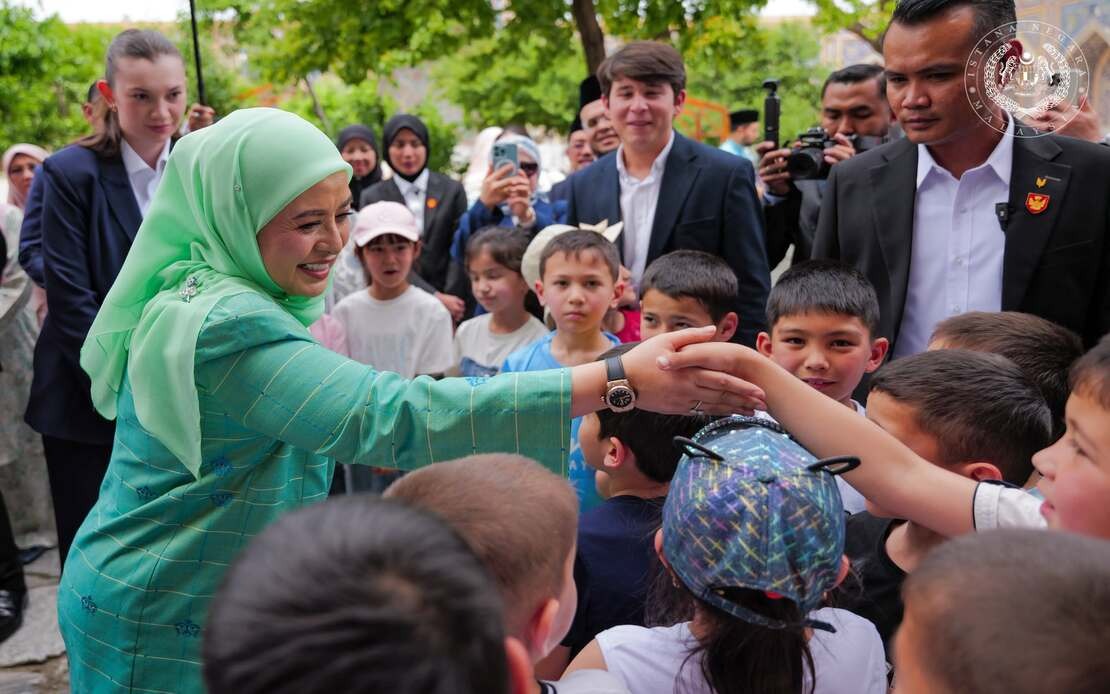
Malaysia's Queen, Raja Zarith Sofiah, has reaffirmed the centrality of mutual respect to the nation's enduring social cohesion, highlighting how this principle has long anchored the country's multicultural fabric. In remarks shared through the official Facebook page of Sultan Ibrahim Sultan Iskandar, Her Majesty stressed that respect between citizens remains instrumental not only to fostering harmony but also to sustaining the broader unity and prosperity that Malaysians have worked to build across generations. The intervention touches on a perennial theme in Malaysian governance: the delicate balance required to maintain peaceful coexistence in a society spanning multiple religions, ethnicities, and worldviews.
Her Majesty's emphasis on courtesy and reciprocal regard holds particular resonance at a time when social media discourse increasingly reveals friction between communities. By grounding her message in both contemporary social values and religious principle, the Queen sought to appeal across demographic lines. She specifically drew attention to the Muslim community in Malaysia, invoking a hadith transmitted through the renowned Islamic scholar Al-Bukhari. The passage, attributed to Abu Hurairah and traced to the teachings of Prophet Muhammad, articulates a tripartite ethical framework: believers must not cause harm to neighbours, must show generosity and honour to guests, and must speak only good words or maintain silence. This classical Islamic injunction carries implications well beyond religious doctrine, establishing behavioral norms that align broadly with secular principles of civility and restraint.
The hadith's emphasis on neighbour relations carries particular weight in Malaysian contexts, where residential proximity often brings together people of differing faiths and backgrounds. In urban condominium complexes, suburban housing estates, and village communities alike, the principle of non-harm toward one's neighbour provides a practical ethical framework for daily interaction. Likewise, the instruction to honour guests resonates with Malaysian hospitality traditions that predate Islam and cut across cultural communities, suggesting that respect for the other is a value woven throughout the nation's social inheritance rather than belonging exclusively to any single tradition. The final element—the discipline of silence or beneficial speech—addresses the contemporary challenge of verbal conflict, particularly relevant in an era of instant digital communication where thoughtless or malicious words can rapidly inflame tensions.
To illustrate the living practice of these ideals, the Queen's office recalled a February encounter at Istana Negara where Her Majesty spent time greeting and conversing with over 100 international tourists. The interaction demonstrated what the palace described as Her Majesty's inherent graciousness and genuine concern for both Malaysian citizens and foreign visitors. Such personal engagement carries symbolic weight in the constitutional monarchy, signalling that respect and warmth extend beyond national borders. For international visitors, such moments shape perceptions of Malaysia as a welcoming destination, a consideration relevant to the nation's tourism sector and its broader diplomatic standing. The incident also underscores that the Queen's promotion of mutual respect is not merely rhetorical but reflected in her public conduct and personal approach to engagement.
The timing of Her Majesty's remarks appears deliberate, coinciding with periods when Malaysia's social fabric has faced various pressures. Over recent years, incidents involving religious sensitivities, intercommunal disputes over land and resources, and polarising rhetoric on social platforms have periodically tested the nation's commitment to peaceful coexistence. By positioning mutual respect as a foundational principle—not a new initiative but rather something Malaysians have "always upheld"—the Queen invokes historical continuity and collective identity. This framing suggests that departures from respectful engagement represent departures from authentic Malaysian values rather than normal variation. Such messaging can be psychologically powerful in reinforcing norms, particularly when articulated by figures who stand above partisan politics.
Malaysia's approach to managing diversity has always relied heavily on constitutional and institutional frameworks, most notably Article 153 of the Federal Constitution and the social contract negotiated at independence. Yet institutional arrangements require complementary cultural practices and individual commitments to succeed. The Queen's emphasis on mutual respect speaks to this non-institutional dimension—the everyday choices individuals make in how they treat neighbours, welcome guests, and calibrate their speech. In societies that have experienced communal violence, such appeals to basic civility are not quaint or superfluous but rather essential maintenance of the implicit agreements that allow diverse populations to share space without coercion.
From a Southeast Asian perspective, Malaysia's experience with managing religious and ethnic pluralism holds lessons for the region, where many nations grapple with similar challenges. Thailand, Indonesia, and the Philippines all contend with questions of how to balance religious identity, state authority, and minority protections. Malaysia's relatively successful track record—though imperfect and periodically tested—offers a model rooted not in enforced uniformity but in mutual acknowledgement of the other's right to exist and be respected. The Queen's invocation of Islamic teaching that prioritises neighbour relations and virtuous speech demonstrates how religious frameworks themselves can anchor pluralistic values, a point relevant across the region's predominantly Muslim societies.
The dissemination of the Queen's message through digital platforms reflects recognition that such appeals must reach contemporary audiences where they congregate. By using the Sultan's official social media channels, the palace ensured broad circulation beyond traditional media gatekeepers. This approach acknowledges that harmony is not maintained through top-down decree alone but requires grassroots internalisation and peer reinforcement of shared values. When citizens encounter their peers, whether online or offline, reiterating principles of mutual respect, these norms gain cumulative weight.
Looking forward, the challenge for Malaysian society involves sustaining this commitment to mutual respect amid rapid social change, urbanisation, economic pressures, and generational shifts. Younger Malaysians, increasingly connected globally and exposed to diverse worldviews, may require fresh articulations of why respect for difference matters—not merely as tradition but as prerequisite for the inclusive prosperity that Malaysia aspires to achieve. The Queen's recent intervention provides a starting point for such conversations, anchoring them in both religious principle and demonstrated personal example.