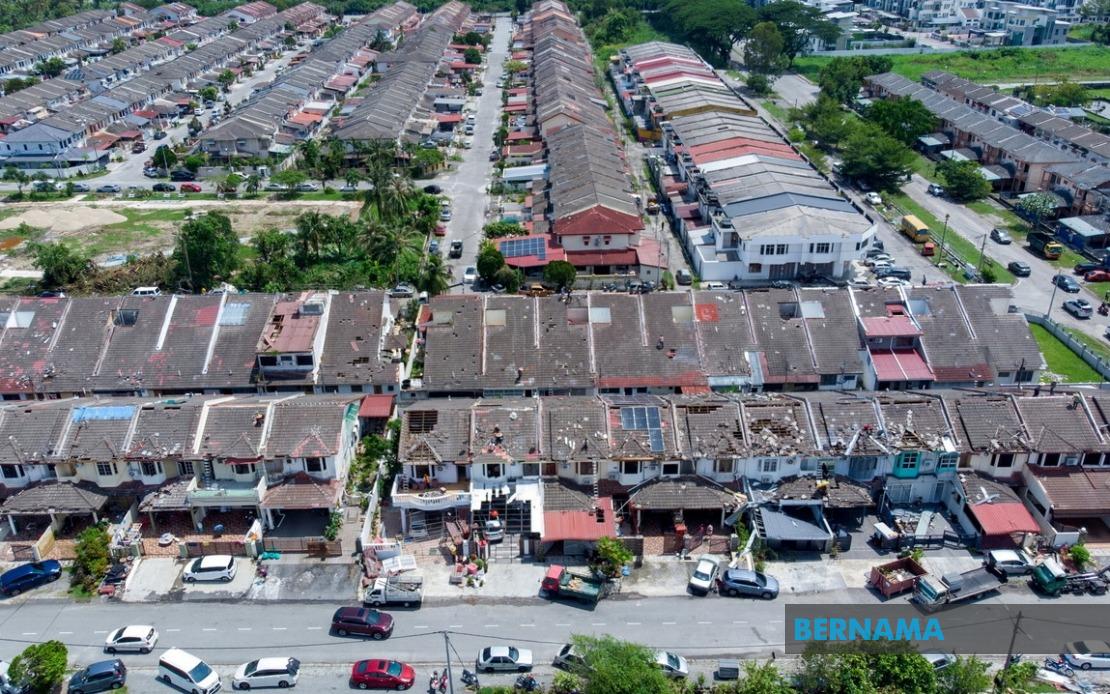
Authorities in Ipoh have implemented a security operation across five designated zones in the storm-ravaged Bercham residential area, enforcing movement restrictions to safeguard properties as residents begin the lengthy process of recovery and rebuilding. The Ipoh district police have taken this precautionary measure following the extraordinary weather event that struck the locality on Friday, leaving considerable damage across multiple neighbourhoods and displacing families from their homes.
ACP Muhammad Najib Hamzah, the Ipoh district police chief, outlined the security strategy during a press briefing held at the Bercham police station incident control centre. Whilst the authorities recognise the urgent need for residents to access their properties for cleaning and salvage operations, the police have adopted a graduated approach that balances community access with crime prevention. The strategy permits residents reasonable entry and exit from affected zones, particularly during daytime hours when visibility is optimal and verification of property ownership becomes straightforward.
The nocturnal security posture represents a marked tightening of enforcement protocols. As darkness falls across the damaged areas, police presence intensifies significantly, particularly in zones such as Anjung Bercham where electrical infrastructure remains non-functional following the storm. This approach reflects legitimate law enforcement concerns that the chaos of disaster zones creates opportunities for criminal elements to exploit the situation, with opportunistic burglaries and looting potentially masquerading as legitimate salvage activities by property owners.
Muhammad Najib explained that officers conducting night patrols will conduct verification procedures to confirm that individuals claiming to perform cleanup work actually reside in or own properties within the restricted zones. This verification mechanism serves as a deterrent to would-be thieves whilst accommodating genuine residents who require evening access to secure valuable items or assess structural damage when daylight hours prove insufficient. The police chief's remarks underscored an understanding that disaster situations demand flexibility from law enforcement, even as they maintain protective security measures.
The extent of the disaster became clearer through incident reporting statistics. As of 8 am on the day of the briefing, the Ipoh police had processed 492 reports related to the storm through the Op Bencana disaster response framework. Notably, authorities emphasised that victims face no temporal deadline for lodge formal reports, allowing residents and affected property owners to document losses and damages at their own pace as they navigate the immediate aftermath and begin developing recovery plans.
The affected neighbourhoods represent a broad swathe of residential Bercham, spanning from established residential subdivisions to organised housing programmes. The impact zone encompasses Anjung Bercham Utara, Taman Mujur, Kampung Bercham, Kampung Tersusun Tasek, Taman Pusat Bercham and Taman Indah Sakti, demonstrating that the storm's destructive footprint affected communities across various socioeconomic demographics and housing categories.
MP for Ipoh Barat M. Kulasegaran, who also serves as Deputy Minister in the Prime Minister's Department overseeing Law and Institutional Reform, characterised the meteorological event as extraordinary and unprecedented in its scale and intensity. His assessment indicated that the storm damaged or destroyed more than 200 residential units, making it a significant disaster event requiring coordinated responses across multiple government agencies and departments.
Meteorological analysis suggested the phenomenon responsible for the destruction bore the characteristics of a landspout—an atmospheric phenomenon distinct from conventional tornadoes. Landspouts develop from rotating columns of air that touch down from cloud bases without the organised mesocyclone structure associated with supercell thunderstorms. Their sudden formation and localised intensity can inflict severe damage across concentrated geographical areas, explaining the concentrated pattern of destruction observed across the Bercham neighbourhoods.
The quantification of total losses across the affected communities remained preliminary and incomplete at the time of the police briefing. Muhammad Najib acknowledged that comprehensive assessment of property damage and financial losses would require considerable time, as damage surveying teams work through multiple sites, documenting structural destruction, personal property losses, and infrastructure damage. Such assessments typically involve coordination between municipal authorities, utility providers, and insurance companies, with preliminary figures often adjusted substantially as detailed surveys progress.
The unfolding situation in Bercham presents a microcosm of disaster management challenges facing Malaysian communities. Beyond immediate security concerns, the recovery operation demands coordinated responses addressing housing, utilities restoration, financial assistance, and psychological support for displaced residents. For Malaysian readers observing these developments, the situation underscores the increasing frequency and intensity of severe weather events affecting residential areas, prompting broader questions about urban planning, building standards, and climate adaptation strategies across Southeast Asian communities grappling with escalating meteorological hazards.

%22%2F%3E%3C%2Fpattern%3E%3C%2Fdefs%3E%3Crect%20width%3D%22100%25%22%20height%3D%22100%25%22%20fill%3D%22url(%23ph2h5apg)%22%2F%3E%3Crect%20width%3D%22100%25%22%20height%3D%22100%25%22%20fill%3D%22url(%23ph2h5app)%22%2F%3E%3Ctext%20x%3D%2250%25%22%20y%3D%2250%25%22%20text-anchor%3D%22middle%22%20dominant-baseline%3D%22central%22%20fill%3D%22rgba(255%2C255%2C255%2C0.95)%22%20font-family%3D%22Georgia%2C%20'Times%20New%20Roman'%2C%20serif%22%20font-weight%3D%22700%22%20font-size%3D%22320%22%20letter-spacing%3D%22-0.02em%22%3EMUDA%3C%2Ftext%3E%3C%2Fsvg%3E)