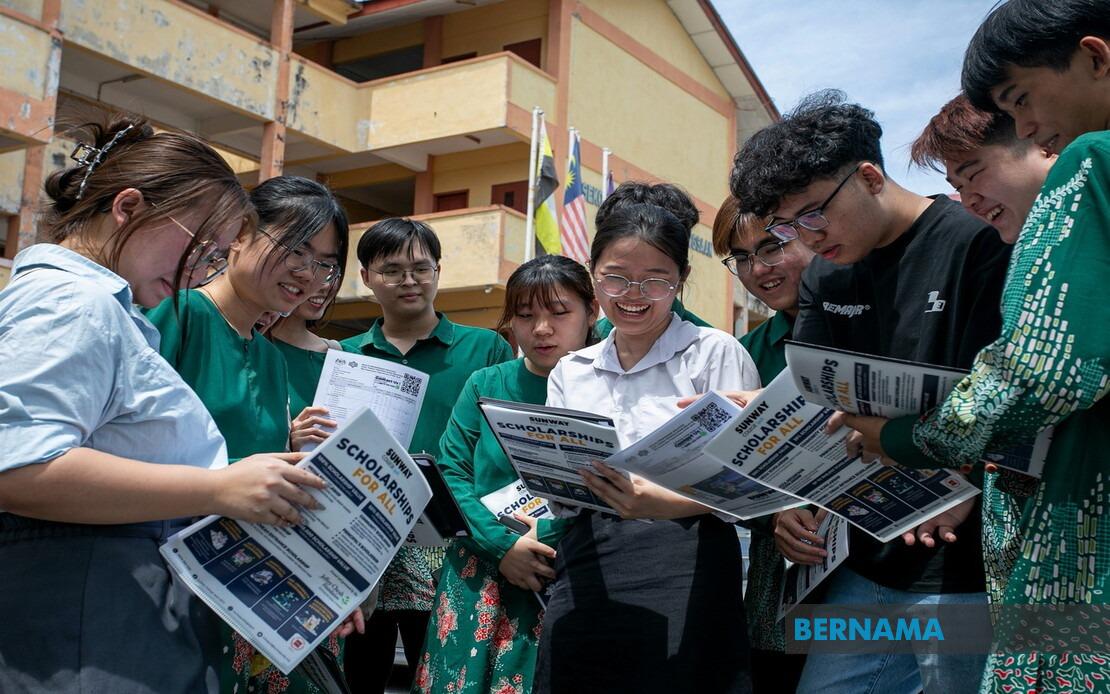
Malaysia's Sijil Tinggi Persekolahan Malaysia (STPM) qualification continues to establish itself as a credible and accessible alternative for secondary school leavers seeking entry into higher education, with this year's crop of top performers representing the programme's capacity to serve students from vastly different socioeconomic and demographic circumstances. The Malaysian Examinations Council today recognised several standout achievers who not only secured perfect 4.00 Cumulative Grade Point Averages but also embodied the programme's promise as a pathway that transcends traditional barriers to academic advancement.
Hazaril Hakimi Hassan, a student from Kampung Paya Mendoi in Kuala Krau, Pahang, stands out as a powerful testament to STPM's inclusive reach. Hailing from an Orang Asli community and attending SMK Temerloh, Hakimi's achievement of a flawless 4.00 CGPA represents a significant milestone both personally and symbolically. Speaking after receiving his excellence award at the Malaysian Examinations Council headquarters in Kuala Lumpur, he emphasised that his journey to success hinged upon recognising the tangible advantages that Form Six offers—advantages that, he acknowledged, have historically garnered less visibility compared to other post-secondary pathways. The turning point, he explained, came through patient guidance from his educators and unwavering family support, which collectively bolstered his confidence in committing to the Form Six route. Hakimi now intends to enrol in the Bachelor of Malay Language Education programme at Universiti Putra Malaysia, with aspirations to eventually establish himself as an academic lecturer in his field of study.
A distinct dimension of STPM's competitive advantage emerges from its cost-effectiveness relative to alternative pathways, a factor that resonates particularly strongly among middle and lower-income families. Ng Yu Yong, a student from SMK Tsung Wah in Kuala Kangsar, Perak, who likewise achieved a perfect 4.00 CGPA, placed considerable emphasis on this practical reality during his remarks to the Malaysian Examinations Council. He characterised Form Six as the superior option for students facing financial constraints, noting that the substantially reduced fees associated with the two-year programme compare favourably against other post-secondary routes. Beyond affordability, Ng underscored STPM's pedagogical rigour and its status as an internationally recognised qualification that facilitates seamless transitions to prestigious universities worldwide. His conviction in the programme's rigour stems from personal experience; securing five A grades across subjects including Physics and Biology, he deliberately selected Form Six specifically because he considered it the optimal platform for honing the academic excellence necessary to pursue medicine. Ng has set his sights on the Bachelor of Medicine and Bachelor of Surgery programme at Universiti Malaya, with his strategic choice of STPM reflecting his determination to maximise his competitive positioning in one of Malaysia's most selective disciplines.
The inclusivity dimension of STPM receives further validation through the experiences of students with additional learning requirements. Yeoh Chwen Yih, a visually impaired student from St John's Institution who also attained a perfect 4.00 CGPA, highlighted how technological accommodations embedded within the Form Six learning ecosystem have fundamentally expanded access to quality secondary education for persons with disabilities. Specifically, Yeoh credited screen-reading software as instrumental to his academic progress, enabling him to navigate learning materials with considerably greater speed and efficiency than traditional Braille-based methods would permit. This technological integration represents a practical manifestation of educational inclusivity, transforming theoretical commitment into tangible classroom support. For Yeoh and similar students with visual impairments, the range of viable educational pathways remains constrained by various systemic limitations; within this constrained landscape, however, Form Six emerged as offering a comparatively more accommodating and supportive environment. Yeoh's aspiration to pursue legal studies reflects his confidence that STPM provides an adequately inclusive foundation upon which to build advanced tertiary education.
The convergence of these three narratives illuminates a broader pattern within Malaysia's educational ecosystem. STPM has traditionally occupied an ambiguous position in the public consciousness, often overshadowed by the more widely publicised Unified Examination Certificate (UEC) pathway for independent schools and the various matriculation and polytechnic routes. Yet the quantum and calibre of this year's achievements among STPM candidates suggest that deliberate policy attention and institutional support have begun shifting perceptions and outcomes. The qualification's two-year duration, coupled with its relatively modest fees and internationally portable credentials, positions it as particularly attractive to first-generation university entrants, rural students, and families navigating economic precarity.
For Malaysian policymakers and educational administrators, the STPM success stories carry strategic implications. As the nation endeavours to broaden participation in higher education whilst managing fiscal constraints, Form Six represents a relatively cost-effective mechanism for identifying and nurturing academically exceptional students from populations historically underrepresented in tertiary institutions. The visible achievement of Orang Asli and disabled learners acquiring top STPM results challenges persistent stereotypes and signals genuine progress toward educational democratisation. Furthermore, STPM's international recognition strengthens Malaysia's competitiveness as a source of well-trained university entrants, supporting the nation's aspirations within regional and global knowledge economies.
%22%2F%3E%3C%2Fpattern%3E%3C%2Fdefs%3E%3Crect%20width%3D%22100%25%22%20height%3D%22100%25%22%20fill%3D%22url(%23ph3ph6xg)%22%2F%3E%3Crect%20width%3D%22100%25%22%20height%3D%22100%25%22%20fill%3D%22url(%23ph3ph6xp)%22%2F%3E%3Ctext%20x%3D%2250%25%22%20y%3D%2250%25%22%20text-anchor%3D%22middle%22%20dominant-baseline%3D%22central%22%20fill%3D%22rgba(255%2C255%2C255%2C0.95)%22%20font-family%3D%22Georgia%2C%20'Times%20New%20Roman'%2C%20serif%22%20font-weight%3D%22700%22%20font-size%3D%22320%22%20letter-spacing%3D%22-0.02em%22%3EPM%3C%2Ftext%3E%3C%2Fsvg%3E)