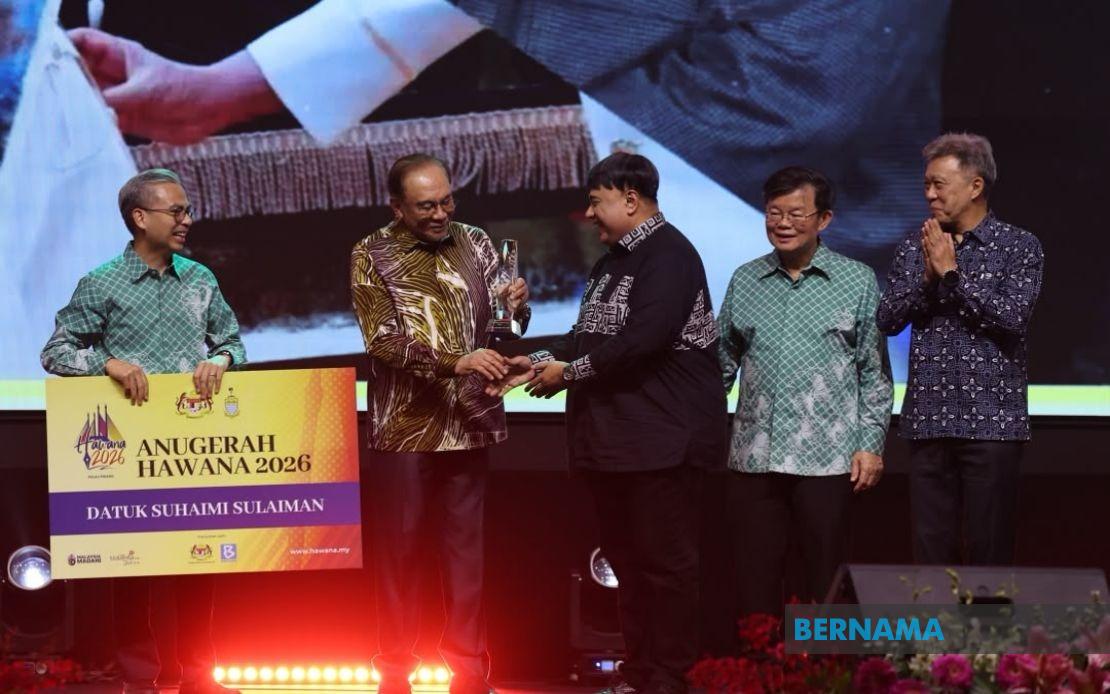
Datuk Suhaimi Sulaiman, the former director-general of Broadcasting Malaysia (RTM), has received the National Journalists' Day (HAWANA) 2026 Award in recognition of his extensive contributions spanning more than three decades within Malaysia's broadcasting and journalism sectors. The prestigious accolade was presented by Prime Minister Datuk Seri Anwar Ibrahim at the HAWANA 2026 Grand Finale held on June 20 at PICCA @ Arena Butterworth Convention Centre in Butterworth.
The ceremony drew a distinguished gathering of media and government figures, including Penang Chief Minister Chow Kon Yeow, Communications Minister Datuk Fahmi Fadzil, and Malaysian National News Agency (Bernama) chairman Datuk Seri Wong Chun Wai. Also attending were Bernama chief executive officer and HAWANA 2026 Working Committee chairman Datin Paduka Nur-ul Afida Kamaludin, alongside Bernama editor-in-chief Arul Rajoo Durar Raj. The presence of senior officials underscored the significance of Suhaimi's recognition within Malaysia's media ecosystem.
Suhaimi's career trajectory reflects a transformative period in Malaysian broadcasting, during which he navigated the industry through technological shifts and evolving news consumption patterns. His tenure at RTM coincided with the state broadcaster's evolution from traditional terrestrial programming to adapting to digital age demands. The award acknowledges not merely his longevity in the field but his substantive influence in shaping editorial standards and professional practices across Malaysia's public broadcasting landscape.
When accepting the award, Suhaimi characterised the honour as carrying both recognition and renewed obligation to the profession. He conveyed that the acknowledgment would energise his continued commitment to knowledge acquisition and mentoring within the media community. His remarks reflected a philosophical approach to career achievement, viewing accolades as catalysts for ongoing professional development rather than culminating acknowledgments of past accomplishments.
The timing of the award coincides with a critical juncture in global journalism as artificial intelligence increasingly influences newsroom operations, content curation, and audience engagement strategies. Suhaimi's emphasis on the AI era highlights contemporary challenges facing media practitioners worldwide, and particularly those in Southeast Asia where regulatory frameworks and technological adoption vary considerably. Malaysian newsrooms increasingly grapple with integrating AI tools while maintaining editorial integrity and workforce stability, issues that veteran journalists like Suhaimi are positioned to address through mentorship and institutional knowledge transfer.
Suhaimi's reflections on perpetual learning underscore a professional imperative often overlooked in discussions of media sector credentials. Rather than positioning three decades of experience as a completed achievement, he framed it as a foundation for navigating unfamiliar terrain. This perspective carries particular resonance for Malaysian media practitioners confronting simultaneous pressures including shifting advertising revenues, digital subscription models, regulatory scrutiny, and audience fragmentation across social platforms.
The HAWANA awards represent the Malaysian media industry's formal recognition system for journalistic excellence and professional contribution. By honouring individuals like Suhaimi, the awards mechanism reinforces institutional memory within newsrooms and signal to emerging journalists the values that the industry prioritises. In Malaysia's context, where journalism operates within a regulated environment, such formal recognitions also serve as professional validation for practitioners navigating complex editorial and political landscapes.
Suhaimi's recognition arrives as Malaysian broadcasting undergoes structural transformations. RTM's role as public broadcaster continues evolving amidst competition from streaming platforms and digital-native news outlets. Former leadership figures like Suhaimi embody institutional continuity and professional standards against which contemporary broadcasting decisions are measured. His award therefore functions symbolically, affirming the relevance of traditional broadcasting expertise even as the industry's technological and commercial foundations shift dramatically.
The award also contextualises Malaysia's media development within regional narratives of professional journalism. Southeast Asian broadcasting sectors collectively face challenges regarding media ownership consolidation, digital disruption, and regulatory environments. Suhaimi's three-decade career trajectory provides implicit commentary on the sustainability of journalism as a profession in the region, and his continued engagement with emerging technologies suggests institutional commitment to relevance rather than obsolescence.
Looking forward, Suhaimi's stated intention to continue learning and sharing experience may translate into formal or informal mentorship roles within Malaysian media institutions. The transfer of institutional knowledge from senior practitioners to emerging journalists represents a critical mechanism through which professional standards, ethical frameworks, and practical skills persist across generational cohorts. His willingness to engage with AI and technological change suggests that such knowledge transfer will encompass both traditional journalistic principles and adaptive strategies for digital environments.
The recognition of Suhaimi's contributions through the HAWANA award reaffirms that Malaysian journalism, despite contemporary challenges, maintains institutional structures for honouring professional achievement and preserving collective memory. As the media industry navigates transformations driven by technology, economic pressures, and audience behaviour shifts, veteran practitioners who bridge traditional and digital-era expertise become increasingly valuable repositories of institutional learning and professional continuity.
%22%2F%3E%3C%2Fpattern%3E%3C%2Fdefs%3E%3Crect%20width%3D%22100%25%22%20height%3D%22100%25%22%20fill%3D%22url(%23ph6xupg)%22%2F%3E%3Crect%20width%3D%22100%25%22%20height%3D%22100%25%22%20fill%3D%22url(%23ph6xupp)%22%2F%3E%3Ctext%20x%3D%2250%25%22%20y%3D%2250%25%22%20text-anchor%3D%22middle%22%20dominant-baseline%3D%22central%22%20fill%3D%22rgba(255%2C255%2C255%2C0.95)%22%20font-family%3D%22Georgia%2C%20'Times%20New%20Roman'%2C%20serif%22%20font-weight%3D%22700%22%20font-size%3D%22170%22%20letter-spacing%3D%22-0.02em%22%3EMalaysia%3C%2Ftext%3E%3C%2Fsvg%3E)
%22%2F%3E%3C%2Fpattern%3E%3C%2Fdefs%3E%3Crect%20width%3D%22100%25%22%20height%3D%22100%25%22%20fill%3D%22url(%23ph6450g)%22%2F%3E%3Crect%20width%3D%22100%25%22%20height%3D%22100%25%22%20fill%3D%22url(%23ph6450p)%22%2F%3E%3Ctext%20x%3D%2250%25%22%20y%3D%2250%25%22%20text-anchor%3D%22middle%22%20dominant-baseline%3D%22central%22%20fill%3D%22rgba(255%2C255%2C255%2C0.95)%22%20font-family%3D%22Georgia%2C%20'Times%20New%20Roman'%2C%20serif%22%20font-weight%3D%22700%22%20font-size%3D%22136%22%20letter-spacing%3D%22-0.02em%22%3EGovernment%3C%2Ftext%3E%3C%2Fsvg%3E)
%22%2F%3E%3C%2Fpattern%3E%3C%2Fdefs%3E%3Crect%20width%3D%22100%25%22%20height%3D%22100%25%22%20fill%3D%22url(%23ph2ojpsg)%22%2F%3E%3Crect%20width%3D%22100%25%22%20height%3D%22100%25%22%20fill%3D%22url(%23ph2ojpsp)%22%2F%3E%3Ctext%20x%3D%2250%25%22%20y%3D%2250%25%22%20text-anchor%3D%22middle%22%20dominant-baseline%3D%22central%22%20fill%3D%22rgba(255%2C255%2C255%2C0.95)%22%20font-family%3D%22Georgia%2C%20'Times%20New%20Roman'%2C%20serif%22%20font-weight%3D%22700%22%20font-size%3D%22194%22%20letter-spacing%3D%22-0.02em%22%3EBercham%3C%2Ftext%3E%3C%2Fsvg%3E)