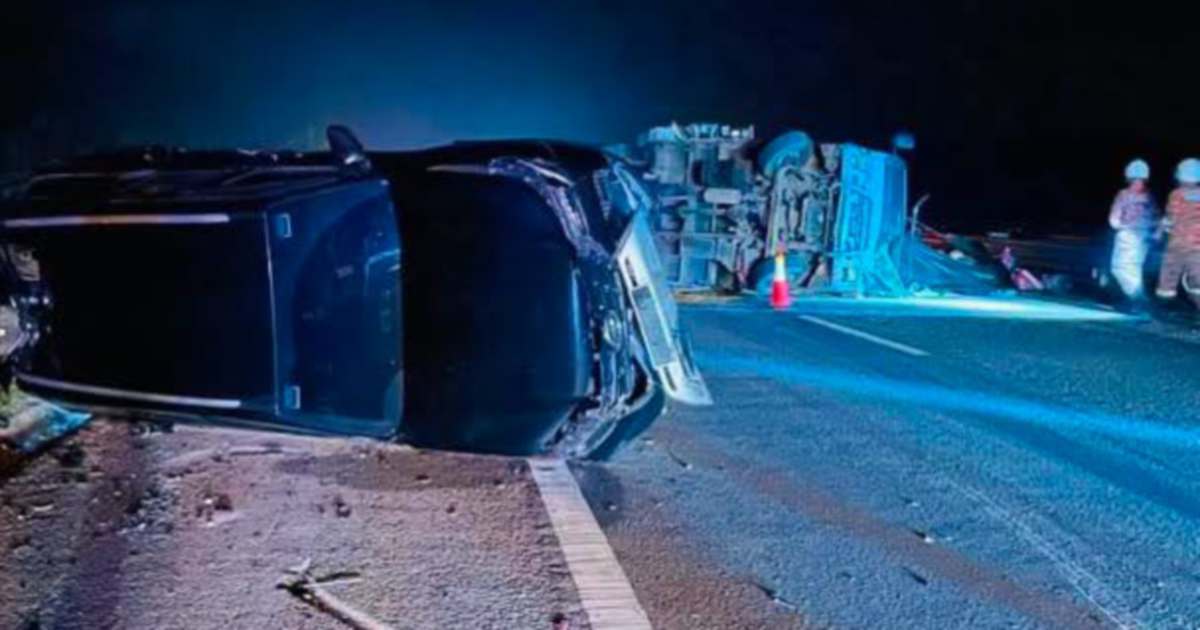
A three-vehicle collision on the East Coast Expressway near Maran left seven people injured early today, including three media personnel attached to Deputy Prime Minister Datuk Seri Dr Ahmad Zahid Hamidi. The accident occurred at the 144-kilometre mark of the expressway, a major north-south corridor frequently used by government officials, business executives, and holidaymakers traversing between Peninsular Malaysia's western and eastern regions.
The presence of media officers in the affected vehicles underscores the close coordination that typically accompanies high-level government travel. Media contingents accompanying senior ministers often travel in dedicated vehicles to document official activities, conduct interviews, and facilitate communication with news organisations. Their involvement in the Maran incident highlights the operational complexities and safety considerations inherent in large-scale government convoys, particularly during early-morning journeys when traffic patterns and road conditions can present additional hazards.
The East Coast Expressway, stretching over 650 kilometres from Kuala Lumpur to Kota Bharu, serves as a critical economic and logistical artery for Malaysia. The highway experiences substantial traffic volumes, particularly between dawn and mid-morning when vehicles from overnight journeys converge with early commuter traffic. Accidents at specific bottleneck sections can rapidly compound into multi-vehicle incidents, as demonstrated by today's three-vehicle pileup. Understanding crash patterns on this route remains important for both highway authorities and travellers who depend on predictable transit times.
All seven injured individuals sustained injuries described as non-serious, indicating that none required emergency life-saving interventions or hospitalisation in critical condition. This outcome likely reflects modern vehicle safety features, including airbags, crumple zones, and electronic stability systems that have substantially reduced injury severity in comparable incidents over the past decade. Nevertheless, even non-serious injuries can necessitate medical assessment and temporary incapacity, potentially disrupting the schedules of affected individuals and their organisations.
The incident occurs within a broader context of highway safety management in Malaysia. The East Coast Expressway has implemented various safety infrastructure improvements, including enhanced lighting at critical sections, additional emergency rest areas, and integrated traffic monitoring systems. However, the frequency of multi-vehicle collisions during peak traffic periods continues to present challenges for the Road Safety Department and the expressway operating company. Early-morning accidents particularly warrant investigation, as factors including reduced visibility, driver fatigue, and inadequate vehicle spacing frequently contribute to such incidents.
Official response protocols for accidents involving government personnel typically involve immediate notification to relevant security and administrative structures. The Malaysian Police, working alongside the Road Safety Department, would have initiated standard accident investigation procedures, including scene documentation, witness interviews, and vehicle damage assessment. Such procedures generate data that inform broader highway safety initiatives and potentially trigger equipment maintenance or infrastructure reviews at affected locations.
The incident may prompt renewed emphasis on safety practices within government convoy operations. Standard procedures for high-level official travel typically include detailed route planning, vehicle spacing requirements, communication protocols, and driver briefings addressing road conditions and anticipated hazards. Convoy safety remains a technical discipline incorporating elements from defensive driving practices, vehicle maintenance standards, and real-time traffic management.
From a regional perspective, the Maran accident illustrates challenges facing Southeast Asian countries as traffic volumes and highway network sophistication increase. Malaysia's expressway system, among the region's most developed, continues expanding in tandem with economic activity. However, managing safety across increasingly complex road networks requires sustained investment in infrastructure, enforcement capability, and public awareness. The involvement of senior government figures' personnel in highway incidents inevitably attracts official attention and can catalyse policy reviews.
The injuries sustained by media personnel specifically merit consideration regarding occupational safety in journalism. News organisations routinely deploy staff to cover government activities, often requiring rapid travel under time constraints. Staff safety protocols, vehicle maintenance standards, and insurance arrangements for journalism personnel engaged in such assignments reflect broader workplace safety obligations that news organisations increasingly formalise and review systematically.
Investigations into the Maran incident will likely focus on determining precise causation factors, including vehicle speed, road surface conditions, weather influences, and driver response patterns. Such investigations contribute to cumulative knowledge about accident causation on Malaysian expressways, informing future infrastructure improvements and driver education initiatives. The incident serves as a reminder that despite modern vehicle safety technology and comprehensive road management systems, highway travel inherently carries risks that sustained vigilance and continuous safety investment can only mitigate, not eliminate entirely.