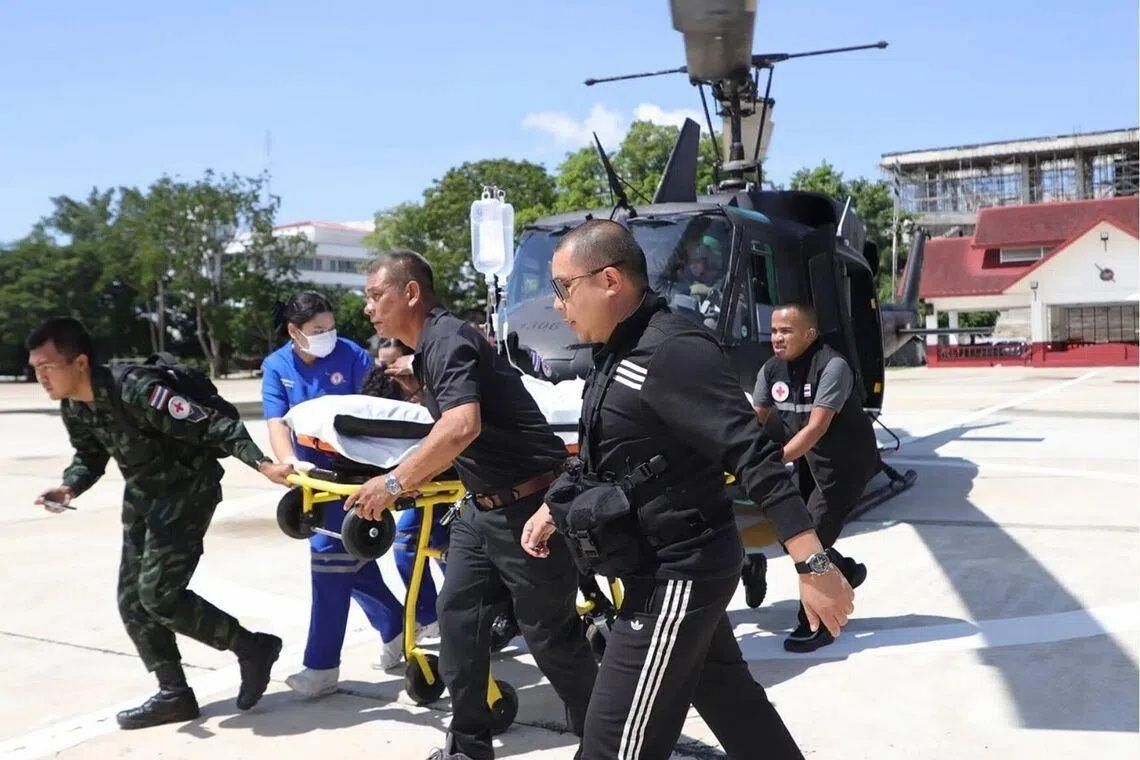
Thailand's violence-plagued southern border region saw two coordinated bomb attacks on Friday that left a dozen police officers wounded, reigniting concerns about the security situation in provinces where insurgent groups have operated for years. The first explosion occurred shortly after 8am in Yala province, followed by another strike in neighbouring Pattani less than three hours later, suggesting a possible orchestrated campaign against security forces.
The initial attack targeted a border patrol police team assigned to protect teachers, hitting their convoy as it travelled along the Ban Pulo Saniyae–Ban Sakai road in Yala's Thanto district. The blast wounded six officers, though the majority sustained what officials classified as minor to moderate injuries. However, two of the wounded faced life-threatening conditions immediately after the explosion: Corporal Kittisak Saksang suffered severe facial trauma from shrapnel fragmentation, while Corporal Poraphat Wongruaydee sustained significant chest injuries that left him unable to move despite remaining conscious.
The severity of Wongruaydee's injuries became apparent within hours, as medics discovered blood accumulating dangerously in his pleural cavity—the space surrounding the lungs. Regional hospital officials announced that the officer required emergency surgery to drain the fluid and repair damaged lung tissue, prompting an urgent appeal for blood donors of all types. This medical development highlighted the life-or-death stakes of attacks in Thailand's deep south, where major hospitals are sometimes hours away from remote border areas. Initial treatment occurred at Thanto Hospital before helicopter teams airlifted the two critically wounded officers to the better-equipped Yala Hospital for advanced care.
Less than three hours after the first blast, a second bombing targeted a police special operations unit operating in Pattani province's Mayo district. This attack struck as officers were returning from a checkpoint-setting operation in the Ban Khuan Yi area, suggesting attackers had monitored police movements and timed the assault accordingly. Five officers sustained injuries, each reporting chest tightness consistent with blast concussion injuries. Unlike the first incident, none of the Pattani casualties appeared to face life-threatening complications, though all were transported to Mayo Hospital for evaluation and observation.
The timing and coordination of the two attacks point toward tactical planning by whoever orchestrated the violence. Both strikes targeted operational police units engaged in frontline security work, and the sequencing across two provinces within a compressed timeframe suggests either a deliberate campaign or the involvement of multiple armed groups acting in concert. Thailand's deep south has long served as a theatre where various militant organisations, including the Barisan Revolusi Nasional (BRN) and splinter factions, pursue insurgent activities against state security forces and civilian targets.
Thailand's southern insurgency, rooted in historical ethnic and religious grievances, has claimed thousands of lives over the past two decades. The conflict remains characterised by cycles of violence that ebb and flow based on political conditions, military operations, and the strategic calculations of armed groups. Friday's bombings suggest that despite repeated government claims of progress, militant networks retain the capacity to mount simultaneous operations across multiple locations, highlighting the persistent organisational strength of such groups despite years of military operations in the region.
Autonomous security operations present acute vulnerability for police forces, as officers conducting checkpoint duties or mobile patrols operate in predictable patterns that insurgents can study and exploit. The location of Friday's attacks—along a known road route and at a police unit compound—indicates adversaries maintain sufficient intelligence capacity to anticipate police movements and position explosive devices in advance. This knowledge advantage compounds the challenge faced by under-resourced provincial police divisions attempting to provide security across sprawling territorial zones.
Explosive ordnance disposal teams and forensic personnel rapidly deployed to both attack sites to gather evidence and prevent secondary explosions, heightening security procedures in affected areas. However, authorities have not yet publicly identified specific militant organisations responsible or announced whether they have detained suspects. The investigation phase typically extends over weeks, and accountability in such cases has historically proven elusive, with conviction rates remaining relatively low despite significant investigative effort.
For Malaysia and neighbouring Southeast Asian nations, Thailand's ongoing instability carries strategic implications. The tri-border region involving Thailand, Malaysia, and Myanmar has long served as a transit zone for insurgent personnel, weapons, and finances, creating transnational security dynamics. Cross-border militant networks exploit the porous frontier to move operatives and resources, making internal Thai security directly relevant to regional stability and counterterrorism efforts throughout the Greater Mekong Subregion.
The casualty toll on Friday—while significant—remains relatively modest compared to major attack waves in previous years, when bombings sometimes killed dozens. This may reflect either improved police protective measures or reduced capabilities among militant groups, though the continued willingness of organisations to strike high-profile targets suggests continued operational potency. Thailand's central government has struggled to articulate a coherent long-term strategy addressing root causes of southern discontent, instead relying heavily on military and police operations that critics argue insufficient alone for achieving durable peace.
Meanwhile, the urgent call for blood donations underscores the cascade of collateral impacts extending beyond immediate military casualties. Hospital systems in remote provinces operate under chronic resource constraints, and mass casualty events rapidly exhaust emergency blood supplies. The medical emergency triggered by the Yala bombing illustrated how attacks reverberate across civilian infrastructure, placing additional burdens on already-stretched provincial health systems serving populations with limited economic resources.
%22%2F%3E%3C%2Fpattern%3E%3C%2Fdefs%3E%3Crect%20width%3D%22100%25%22%20height%3D%22100%25%22%20fill%3D%22url(%23ph3x05qg)%22%2F%3E%3Crect%20width%3D%22100%25%22%20height%3D%22100%25%22%20fill%3D%22url(%23ph3x05qp)%22%2F%3E%3Ctext%20x%3D%2250%25%22%20y%3D%2250%25%22%20text-anchor%3D%22middle%22%20dominant-baseline%3D%22central%22%20fill%3D%22rgba(255%2C255%2C255%2C0.95)%22%20font-family%3D%22Georgia%2C%20'Times%20New%20Roman'%2C%20serif%22%20font-weight%3D%22700%22%20font-size%3D%22272%22%20letter-spacing%3D%22-0.02em%22%3EAnwar%3C%2Ftext%3E%3C%2Fsvg%3E)