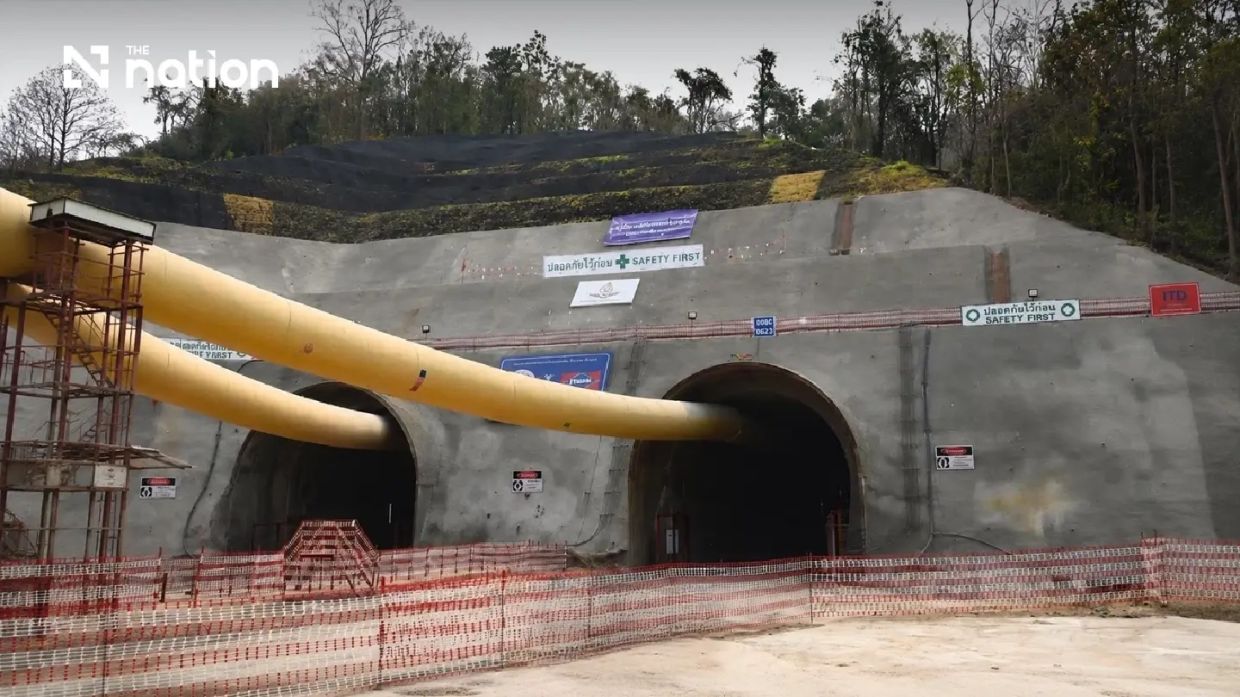
A construction accident at Thailand's Doi Luang railway tunnel claimed two lives and left seven workers injured on Saturday evening as scaffolding gave way during the installation of waterproofing systems inside the tunnel. The incident occurred at approximately 8.35pm at the worksite in Chiang Rai's Chiang Saen district, where crews were engaged in the construction phase of the State Railway of Thailand's Den Chai-Chiang Rai-Chiang Khong railway line.
Deputy Transport Minister Siripong Angkasakulkiat provided authorities with an early assessment indicating that rocks dislodged from the tunnel wall likely precipitated the collapse while workers were carrying out waterproofing operations. Initial reports had mentioned issues in the shotcrete work area, though investigators emphasised that the precise sequence of events and underlying causes remained under examination. The catastrophic nature of the accident necessitated immediate medical intervention, with all nine casualties rushed to hospital for treatment, including three individuals with critical injuries and four suffering minor wounds.
The immediate response to the crisis demonstrated coordinated action across multiple agencies. Transport Ministry officials sealed off the accident zone to prevent further incidents and establish a controlled environment for investigation and recovery operations. The project's dedicated safety unit assumed command of the site, implementing monitoring protocols to ensure no additional hazards threatened personnel working in adjacent areas. This rapid containment proved critical in preventing any escalation of the emergency during the chaotic hours following the collapse.
The Doi Luang tunnel represents a significant engineering undertaking in Thailand's ambitious infrastructure expansion programme. Stretching 3.4 kilometres through the mountains of Chiang Saen district, the tunnel had already been bored through at the time of the accident, with crews focused on finishing interior systems. This particular section forms part of Contract 3 under the broader Chiang Rai-Chiang Khong railway development initiative, valued at THB19.385 billion. The contract encompasses construction of both ground-level and elevated railway tracks spanning approximately 87 kilometres, alongside three full stations, three halts, one additional tunnel, and comprehensive signalling and telecommunications infrastructure.
The project consortium managing Contract 3 comprises three substantial construction firms: CH. Karnchang Public Company Limited, Sino-Thai Engineering & Construction Public Company Limited, and Chiangmai Construction Co., Ltd., operating jointly as the CKST-DC3 Joint Venture. These organisations collectively shoulder responsibility for delivering one of the most complex sections of the northern railway modernisation initiative. The accident raises inevitable questions about safety protocols and supervision mechanisms at what represents one of Thailand's major infrastructure investments.
The Den Chai-Chiang Rai-Chiang Khong railway line forms a crucial component of Thailand's strategy to enhance connectivity across its northern region, with implications extending throughout Southeast Asia. The project promises to strengthen transportation links between Chiang Rai and Chiang Khong, ultimately facilitating cross-border commerce with Laos and contributing to broader regional integration efforts. Such large-scale construction ventures inevitably carry inherent risks, and the Saturday incident underscores the persistent challenges facing Thailand's construction industry regarding worker protection and accident prevention.
The State Railway of Thailand's Special Projects and Construction Department moved swiftly to dispatch inspectors to the scene, initiating a comprehensive technical examination of the circumstances surrounding the collapse. This departmental-level intervention signals the serious nature of the incident and reflects the railway authority's commitment to understanding precisely what transpired. Detailed findings from this investigation will prove essential not merely for assigning responsibility but for identifying systemic weaknesses that might require rectification across other active construction sites throughout the railway project.
Construction fatalities remain a persistent concern within Thailand's development sector, where rapid project timelines and competitive bidding sometimes create pressure that compromises safety standards. The incident at Doi Luang tunnel exemplifies how even sophisticated, well-funded projects managed by established contractors can encounter deadly accidents. Ongoing investigations will examine whether this particular collapse resulted from isolated negligence, design deficiencies, material failures, or systemic safety management shortcomings. Each determination carries different implications for how future projects must operate.
For Malaysian observers and investors monitoring regional infrastructure developments, the Chiang Rai railway project holds strategic significance as part of broader Southeast Asian connectivity enhancements. Accidents of this scale inevitably trigger scrutiny of contractor performance and project management practices, particularly when international firms participate. The incident also raises awareness among Malaysian construction companies bidding on similar projects regarding safety investment requirements and the reputational costs of inadequate worker protection protocols. Thailand's commitment to investigating these incidents thoroughly will ultimately determine whether such tragedies catalyse meaningful improvements in safety culture or represent episodic crises that do not fundamentally alter industry practices.
%22%2F%3E%3C%2Fpattern%3E%3C%2Fdefs%3E%3Crect%20width%3D%22100%25%22%20height%3D%22100%25%22%20fill%3D%22url(%23ph1l5c2g)%22%2F%3E%3Crect%20width%3D%22100%25%22%20height%3D%22100%25%22%20fill%3D%22url(%23ph1l5c2p)%22%2F%3E%3Ctext%20x%3D%2250%25%22%20y%3D%2250%25%22%20text-anchor%3D%22middle%22%20dominant-baseline%3D%22central%22%20fill%3D%22rgba(255%2C255%2C255%2C0.95)%22%20font-family%3D%22Georgia%2C%20'Times%20New%20Roman'%2C%20serif%22%20font-weight%3D%22700%22%20font-size%3D%22226%22%20letter-spacing%3D%22-0.02em%22%3ERussia%3C%2Ftext%3E%3C%2Fsvg%3E)