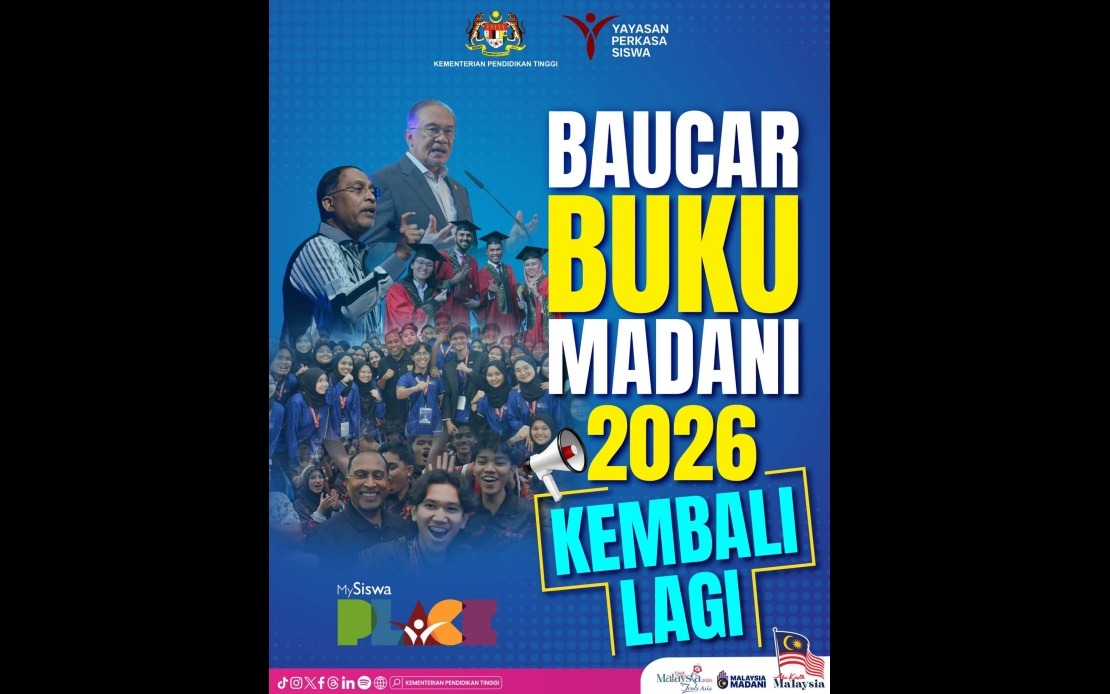
The Ministry of Higher Education announced on July 14 that roughly 1.18 million students enrolled at Malaysian institutions of higher learning will be able to claim RM100 Madani Book Vouchers beginning July 15 at 11 am, using the MySiswaPlace digital platform. The initiative represents a continuation of government support designed to reduce financial barriers when acquiring educational reading materials and to strengthen Malaysia's reading culture among the tertiary education population.
Students wishing to participate in the scheme can manage the entire process through MySiswaPlace, a centralised online portal that permits them to verify their eligibility, generate their voucher codes, and make purchases from the platform's merchant network. The system has been designed to provide a straightforward and secure transaction experience, eliminating the need for physical voucher collection and allowing learners to shop for materials at their convenience from home or campus.
The breadth of available materials through the platform reflects a deliberate effort to serve diverse academic and intellectual needs. MySiswaPlace connects users with more than 300 participating business partners, predominantly comprising Malaysian publishers and independent bookstores that have registered to accept the vouchers. This merchant ecosystem supplies a comprehensive inventory spanning academic textbooks, reference works, peer-reviewed scholarly publications, digital e-books, and popular titles that support both formal coursework and broader intellectual development.
The Ministry of Higher Education framed the continued allocation of these vouchers as an expression of the MADANI government's fundamental commitment to fostering a knowledge-centred society. Officials emphasised that reducing the cost of acquiring reading materials serves multiple policy objectives simultaneously: it directly alleviates financial pressure on students and families, encourages sustained engagement with reading throughout tertiary education, and creates economic stimulus for Malaysia's domestic publishing and bookselling sectors.
Supporting local publishers and booksellers through increased consumer spending represents an often-overlooked dimension of this voucher programme. By channelling government resources toward the purchase of locally-produced publications, the initiative strengthens the viability of Malaysia's knowledge industry ecosystem and reduces dependence on imported educational materials. This approach aligns with broader efforts to develop competitive local publishing capabilities and ensure that Malaysian voices and perspectives feature prominently in the reading materials available to students.
The sustainability of Malaysia's knowledge industry depends partly on consistent demand for published materials, a sector that has faced structural pressures from digital disruption and changing consumer habits. The Madani Book Voucher programme addresses this challenge by guaranteeing a substantial purchasing baseline among the student population, thereby providing publishers and retailers with predictable revenue and incentive to maintain diverse inventories and continue operations across the country.
Prime Minister Datuk Seri Anwar Ibrahim's decision to continue funding this initiative signals the government's prioritisation of education and intellectual development as central pillars of the MADANI framework. The Ministry's acknowledgement of his support underscores that expanding access to quality reading resources remains a policy priority despite broader fiscal constraints and competing budgetary demands.
For Malaysian students, the practical benefit of a RM100 annual voucher is substantial, particularly for those from lower-income households where educational expenses compete with living costs. While the amount may cover only a few university textbooks or a dozen general titles, it represents meaningful assistance that can be combined with institutional library systems and other educational resources to support coursework and research.
The timing of the July 15 launch aligns with the academic calendar transition, enabling students to acquire materials needed for upcoming semesters. The mid-July timing also allows sufficient preparation time for the ministry, merchant partners, and students to ensure smooth implementation across the MySiswaPlace platform.
Malaysian policymakers have long recognised that access to reading materials correlates with academic performance and lifelong learning outcomes. This voucher programme reflects recognition that cost remains a genuine barrier for some students, despite Malaysia's relatively developed education infrastructure. By removing or reducing that barrier, the government aims to create more equitable conditions for knowledge acquisition across socioeconomic lines.
The programme's emphasis on both academic and general publications reflects understanding that tertiary education encompasses intellectual development beyond narrow disciplinary study. General reading materials, literature, and non-fiction works contribute to the formation of well-rounded graduates equipped with broader contextual knowledge and critical thinking capabilities.
As Malaysian higher education continues to expand and evolve, initiatives like the Madani Book Voucher programme demonstrate commitment to ensuring that growth in student numbers translates into genuine improvements in educational quality and learning resources. For Southeast Asian observers, the approach offers a model for how governments can use targeted subsidies to support both students and cultural industries simultaneously, creating synergies that benefit multiple stakeholders across the education and publishing ecosystems.

