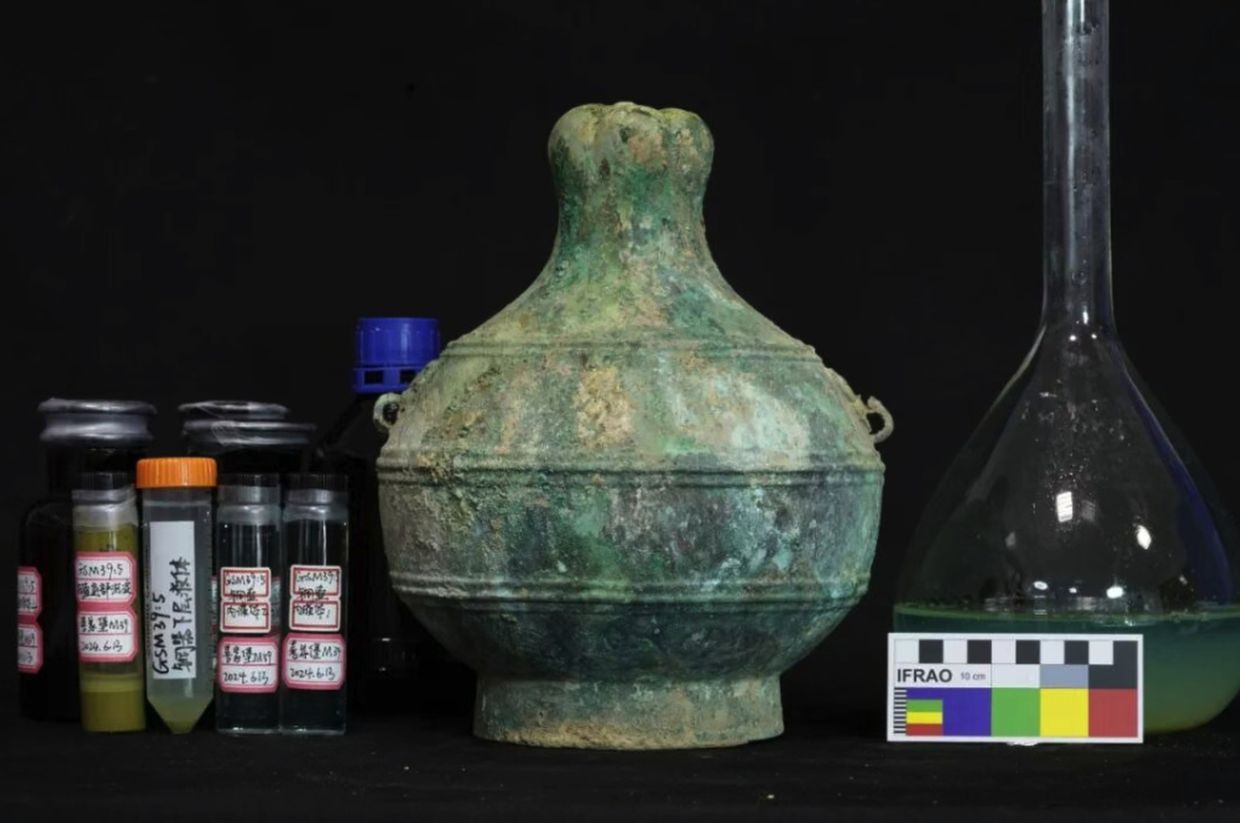
A remarkable archaeological find in northwestern China has illuminated the world of ancient wine production during the Qin period. Excavators working at the Shanjiabao cemetery, situated just two kilometres from the ruins of the Warring States Qin Great Wall in Gansu province, discovered an exceptionally well-preserved bronze vessel sealed with liquid that has been confirmed as wine dating back more than 2,300 years. The discovery, detailed in research published in the June issue of the Journal of Archaeological Science, represents one of the most intact and information-rich wine relics from the Qin state ever documented in China, according to Wang Xiaoyang, director of the Shanjiabao cemetery archaeological project at the Ningxia Institute of Cultural Relics and Archaeology.
The ancient wine pot, distinguishable by its characteristic garlic-head shape typical of Qin craftsmanship, was found in Tomb No 39 among a broader excavation effort that uncovered 183 burials from the Warring States period. Of these, 179 tombs exhibited clear Qin cultural markers, leading researchers to conclude that the cemetery likely served as a communal burial ground for soldiers stationed at the Great Wall fortifications and their families. The location itself tells a story of daily life during this period—the 170-kilometre stretch of the Qin Great Wall was dotted with forts, castles, and defensive outposts of varying sizes, each housing garrison troops and their dependents within fortified walls.
What makes this discovery particularly significant is the vessel's construction and sealing method. The bronze container employed an ingenious double-layer sealing technique that combined a textile inner lining with an outer coating of organic clay, a preservation approach that allowed the wine to remain largely chemically intact across more than two millennia. When archaeologists carefully extracted the contents, they retrieved approximately 3,740 millilitres of ancient liquid residue, which became the subject of detailed scientific analysis to unlock the secrets of ancient winemaking.
To understand precisely how ancient brewers crafted their beverages, researchers sent samples to Northwest University for comprehensive chemical analysis. The examination revealed the presence of 24 distinct compounds, including organic acids and their derivatives, amino acids and their derivatives, and various carbohydrates. This chemical fingerprint proved crucial in determining the wine's composition and origin. The distribution pattern of organic acids matched that of artificially aged yellow wine, definitively establishing that this was a grain-based alcoholic beverage rather than a fruit wine such as grape wine—a distinction that speaks to the brewing traditions of northern China during this era.
Starch residue analysis provided the most telling detail about the wine's raw materials. Researchers confirmed that over 92 per cent of the starch originated from broomcorn millet, a cereal grain that was abundant in northern China and represents a logical choice for brewers in the region. This finding underscores a significant geographical divide in ancient Chinese winemaking practices. While southern regions typically relied on rice as their primary brewing ingredient due to its availability in wet, agricultural zones, northern populations like those stationed at the Great Wall developed brewing techniques centred on millet varieties. Understanding these regional preferences offers insight into how ancient peoples adapted their technologies and practices to local agricultural resources and environmental conditions.
The discovery fills a notable gap in archaeological understanding of Ningxia's winemaking traditions during the Warring States period. Prior to this excavation, scholars possessed limited concrete evidence about how people in this region actually produced wine, what ingredients they preferred, and how their techniques compared to practices in other parts of China. This tomb, with its carefully sealed vessel and intact contents, provides tangible answers to those questions. The chemical composition reveals not merely what was in the wine, but also suggests the sophistication of fermentation and preservation methods that ancient Qin craftspeople had developed and refined.
The human story embedded within this archaeological discovery resonates across centuries. The careful placement of a full bronze wine vessel in the tomb suggests that an individual—possibly a soldier serving at this remote Great Wall garrison—held wine in such high regard that their family felt compelled to send this cherished possession along for the afterlife. The act of filling the pot before sealing it for burial indicates a deliberate, meaningful gesture, one that speaks to cultural values around hospitality, celebration, and comfort even beyond death. It transforms the discovery from merely a chemical curiosity into a window on the emotional and social dimensions of life during the Qin era.
China's prominence in the early history of alcoholic beverage consumption has long been established through archaeological evidence, with discoveries spanning several millennia. In recent years, the volume of ancient alcoholic beverage residues recovered across the country has increased substantially, generating considerable scholarly interest in understanding how brewing techniques evolved and how different regions developed distinctive approaches. The Shanjiabao discovery contributes meaningfully to this growing body of knowledge, providing concrete data about grain selection, fermentation chemistry, and preservation methods in a specific time and place.
For contemporary readers in Malaysia and Southeast Asia, this discovery offers broader lessons about how ancient societies innovated in response to their environments and resources. The Qin brewers' adaptation of available grains into fermented beverages parallels similar developments across Asia, where rice-based drinks like sake in Japan and various grain-based fermented beverages evolved to suit local agricultural and cultural contexts. The sophisticated sealing and preservation techniques employed by ancient Chinese craftspeople demonstrate that innovation in food and beverage production is hardly a modern phenomenon—knowledge about fermentation, storage, and chemistry has deep historical roots in civilisations across the region.
The archaeological work at Shanjiabao also illuminates the material culture and daily practices of frontier communities in ancient China. Garrison soldiers and their families living in remote border posts faced harsh conditions, yet they maintained cultural practices that included the consumption and appreciation of wine. The presence of this vessel, alongside other burial goods discovered at the cemetery, provides evidence that even in military outposts far from urban centres, people maintained connections to broader cultural traditions and valued quality craftsmanship. This suggests that the Qin state, despite being a militaristic empire focused on border defence and territorial consolidation, fostered a sophisticated material culture that extended to its most distant settlements.
Looking forward, this discovery will likely prompt additional research into the chemical composition of other ancient wine vessels held in museums and collections across China. Comparative analysis may reveal how brewing techniques varied not only geographically but also temporally, showing how innovations in winemaking spread and were adopted or adapted across different regions. Advanced analytical techniques, including isotopic analysis and DNA evidence from microbial residues, may eventually allow researchers to identify specific strains of yeast or bacteria involved in ancient fermentation—knowledge that could theoretically even inform modern brewing practices seeking to recreate historical beverages.

