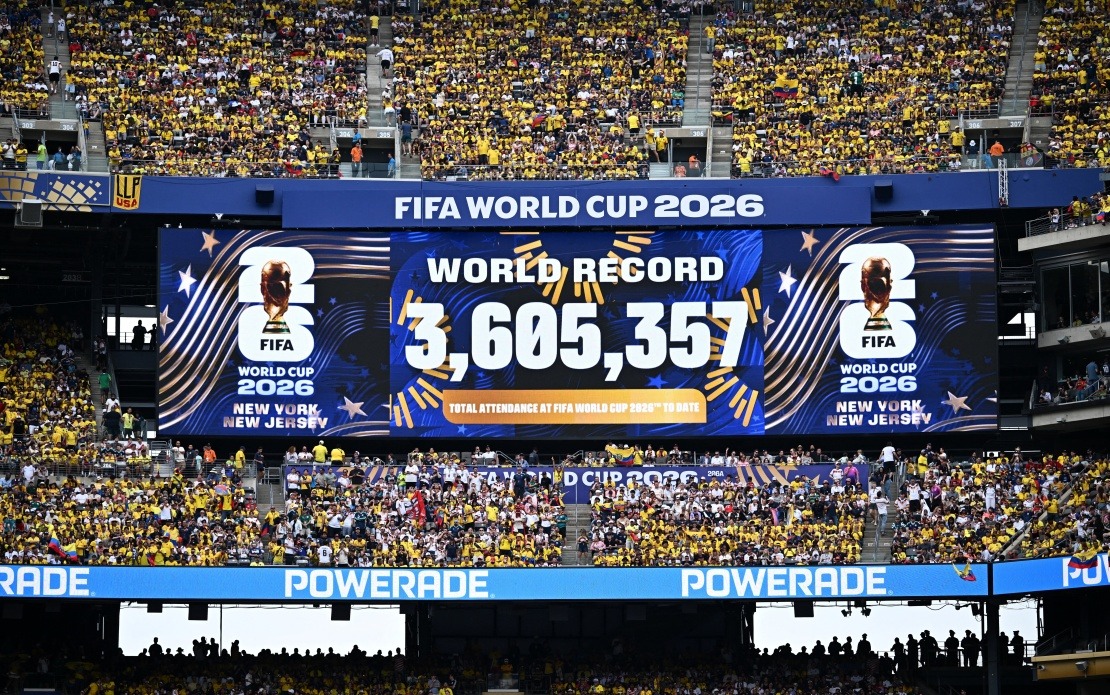
The 2026 FIFA World Cup has achieved a historic milestone, becoming the most-attended World Cup tournament ever staged. The record was officially surpassed on Thursday during Germany's match against Ecuador in East Rutherford, New Jersey, when the cumulative attendance crossed 3.6 million spectators. The announcement was broadcast across stadium screens to cheering crowds, marking a watershed moment in the tournament's narrative and underscoring the extraordinary appetite for international football across the host nations.
This achievement arrives with particular significance given the tournament's expanded format and geographic footprint. The 2026 World Cup is being jointly hosted across 16 cities spanning three countries—the United States, Mexico, and Canada—a distribution that has fundamentally altered how fans access matches and engage with the competition. The scale of this hosting arrangement, the largest in World Cup history, has created unprecedented opportunities for supporters to experience live football, contributing substantially to the record-breaking attendance figures now being recorded.
The previous attendance benchmark, set during the 1994 World Cup held in the United States, had stood for 32 years at nearly 3.6 million spectators. That tournament, however, featured only 52 matches across its duration. The current 2026 iteration operates under different parameters, with expanded group stages and additional matches creating more opportunities for fan engagement. Remarkably, with 48 matches still to be played, football analysts project that total attendance could potentially nearly double the 1994 record, suggesting a trajectory toward unprecedented figures in World Cup history.
The capacity utilisation across 2026 World Cup stadiums has been extraordinarily high, with venues operating at more than 99 percent capacity on average. This statistic reflects not merely strong demand but near-universal availability of tickets across matches, indicating that organisers have effectively managed supply and distribution to meet the phenomenal public interest. Such sustained high occupancy rates are virtually unheard of in major sporting tournaments, where attendance patterns typically fluctuate based on match significance, team popularity, and fixture timing.
For Malaysia and Southeast Asian nations, this record-breaking attendance carries particular relevance. As rapidly developing football markets where interest in the sport continues expanding, Southeast Asian observers can draw important lessons from the 2026 tournament's success in mobilising spectators across a vast geographic region. The multi-country hosting model demonstrates how football can transcend national boundaries and create shared enthusiasm across borders, a concept increasingly relevant as the region seeks to develop its own football infrastructure and international tournament hosting capabilities.
FIFA President Gianni Infantino characterised the record as validation of football's unique capacity to unite diverse populations. His comments emphasised the sport's transcendent appeal and its ability to generate collective joy and celebration, sentiments that resonate particularly strongly in multicultural societies like Malaysia where football serves as a unifying cultural force across different communities. The scenes Infantino referenced—occurring across the 16 host cities and their respective stadiums—suggest that the tournament has created memorable experiences well beyond the pitch itself, transforming host communities and generating broader social engagement with the sport.
The geographic distribution of hosting arrangements has played a crucial role in enabling this attendance surge. By spreading matches across multiple cities and countries, organisers eliminated the geographic barriers that might otherwise have restricted access for millions of potential supporters. This decentralised approach differs markedly from previous World Cups concentrated in single nations, allowing fans across wider regions to attend matches without undertaking extensive international travel or incurring prohibitive costs. The strategic placement of stadiums across densely populated areas has clearly facilitated record participation.
From a commercial standpoint, the attendance breakthrough carries significant implications for tournament revenues and the economic benefits accruing to host nations and host cities. Higher stadium attendance translates directly into ticket sales revenues while simultaneously boosting ancillary spending on accommodation, hospitality, and local services. The sustained high occupancy rates suggest that economic returns for host communities have exceeded initial projections, strengthening the financial case for similar multi-country hosting arrangements in future sporting competitions.
The achievement also reflects evolving consumer preferences regarding experiential spending. In an era where entertainment options proliferate across digital platforms, the live sporting experience commands a premium. Families and fans worldwide have demonstrated willingness to invest significant resources to attend World Cup matches in person, suggesting that the communal aspect and emotional resonance of live football remains irreplaceable despite technological alternatives. This preference bodes well for future major tournaments and indicates sustained demand for large-scale sporting events.
Looking forward, the 2026 tournament's attendance success establishes new expectations for World Cup organisation and execution. Organisers of future tournaments will face heightened pressure to replicate or exceed these figures, potentially driving continued evolution in hosting formats, stadium design, and fan experience infrastructure. For Southeast Asian nations contemplating future World Cup bids or major tournament hosting, the 2026 experience provides valuable case studies in managing large-scale, multi-venue sporting events while maintaining exceptionally high fan engagement and satisfaction levels throughout competitions.

