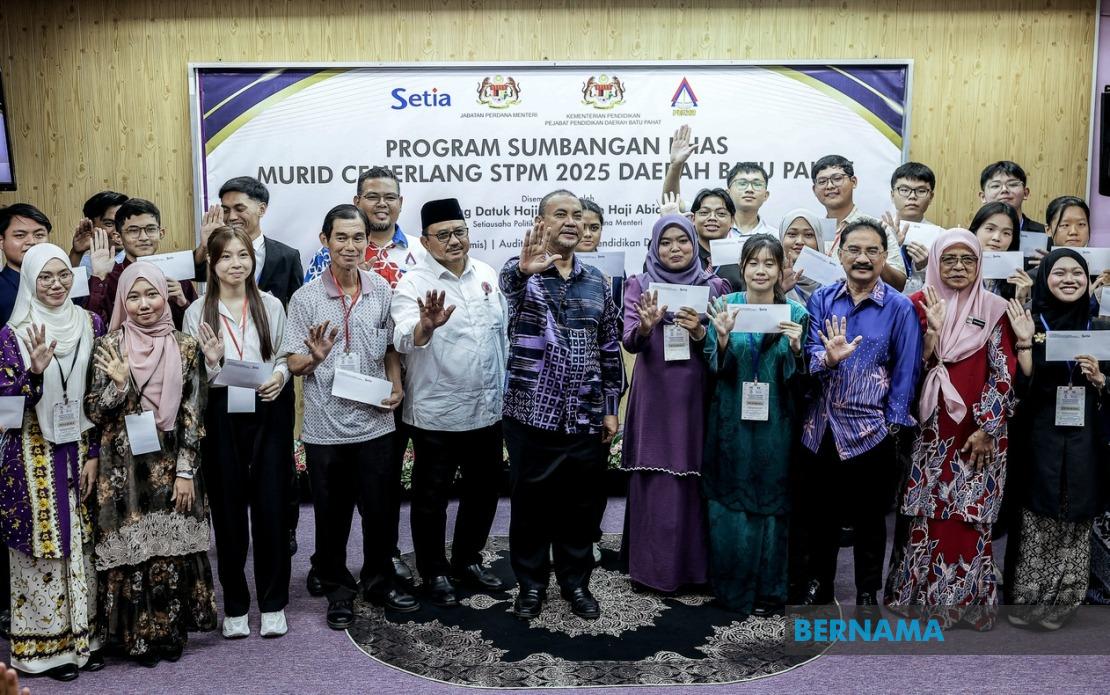
The Prime Minister's Office has distributed special contributions to 214 outstanding students from the 2025 Sijil Tinggi Persekolahan Malaysia (STPM) cohort in Batu Pahat district, marking a significant gesture toward recognising academic merit and supporting Malaysia's young scholars. The awards ceremony, held at the Batu Pahat District Education Office auditorium, brought together top achievers from 16 secondary institutions across the district, celebrating their accomplishments at a critical juncture in their educational journeys.
According to Datuk Azman Abidin, Political Secretary to the Prime Minister, the initiative represents the government's commitment to nurturing educational excellence while easing the financial pressures that often accompany the transition to higher learning. The contributions are designed not merely as recognition of past achievements but as tangible encouragement for recipients to maintain their academic standards and set positive examples within their peer groups and communities.
For Malaysia's education sector, such targeted recognition programmes hold particular significance in an ecosystem where financial constraints frequently force talented students to abandon aspirations or compromise on course selection. The distribution of contributions across 16 schools underscores an attempt to identify and reward excellence systematically rather than concentrating support in urban or privileged areas. This geographic spread reflects efforts to ensure that exceptional students in districts beyond major metropolitan centres receive equitable recognition.
The programme's scope suggests flexibility in government implementation of educational support initiatives. Datuk Azman indicated that continuation depends on budget availability, with expansion to other locations remaining contingent on fiscal capacity. This conditional approach reflects the realities of public financing while signalling that successful pilot initiatives may establish precedent for broader rollout across Malaysia's education system.
One recipient, 20-year-old Afida Auni Airulnizam from Sekolah Menengah Kebangsaan Tun Sardon in Rengit, characterised the award as validation of her efforts while reinforcing her motivation to persist in academic pursuits. Her aspiration to study sports science at tertiary level demonstrates how recognition resonates beyond immediate financial benefit, providing psychological encouragement at vulnerable transition points. The influence of her older brother's university experience illustrates how family role models and peer example within households shape educational trajectories.
Another beneficiary, Muhd Ammar Firdaus Mohd Fadzil, a former SMK Tun Ismail student, specifically noted that the contribution alleviates practical financial strain associated with preparing for tertiary education. The cost of university application processes, entrance examinations, accommodation searches, and initial orientation expenses represents a genuine burden for lower-income families. Direct contributions targeting this demographic gap represent more effective intervention than generic subsidy schemes that lack specificity.
The initiative emerges within Malaysia's broader context of ensuring talent development remains accessible across socioeconomic strata. High-achieving STPM graduates represent the nation's future professional, academic, and leadership cohorts. Any systemic bias that discourages talented students from disadvantaged backgrounds from pursuing tertiary education represents not only individual loss but collective societal cost through talent drain and underutilisation of human capital.
For Southeast Asian observers, Malaysia's approach reflects regional trends in recognising merit-based excellence while addressing equity gaps. Countries throughout the region increasingly recognise that formal qualification systems, while meritocratic in theory, often systemically disadvantage students from lower-income backgrounds unless deliberate compensatory mechanisms exist. Award programmes combining recognition with financial support address both the psychological and practical dimensions of educational barriers.
The expansion plans mentioned by the Political Secretary suggest appetite within government circles for scaling successful initiatives. Regional rollout would establish precedent for integrated recognition-and-support frameworks that identify high achievers while simultaneously removing financial obstacles to realising their potential. The programme's success may influence policy discussions regarding student financing, merit recognition, and equitable talent development strategies across Malaysian educational institutions.
Looking forward, the sustainability of such initiatives remains contingent on consistent budget allocation and institutional commitment beyond ceremonial recognition. The students receiving awards today occupy strategic positions to influence educational choices of younger cohorts. Their success stories, amplified through family and school networks, create demonstration effects that encourage excellence across wider student populations.
The Batu Pahat initiative represents incremental progress in aligning government rhetoric regarding educational excellence and equal opportunity with concrete resource allocation. While 214 students constitute a notable cohort, scaling considerations and systematic integration into education policy frameworks will determine whether this represents meaningful systemic change or temporary campaign gesture. The government's framing of the programme as potentially expandable suggests openness to evolution, though future implementation will test commitment to equitable talent development across Malaysia's diverse educational landscape.

