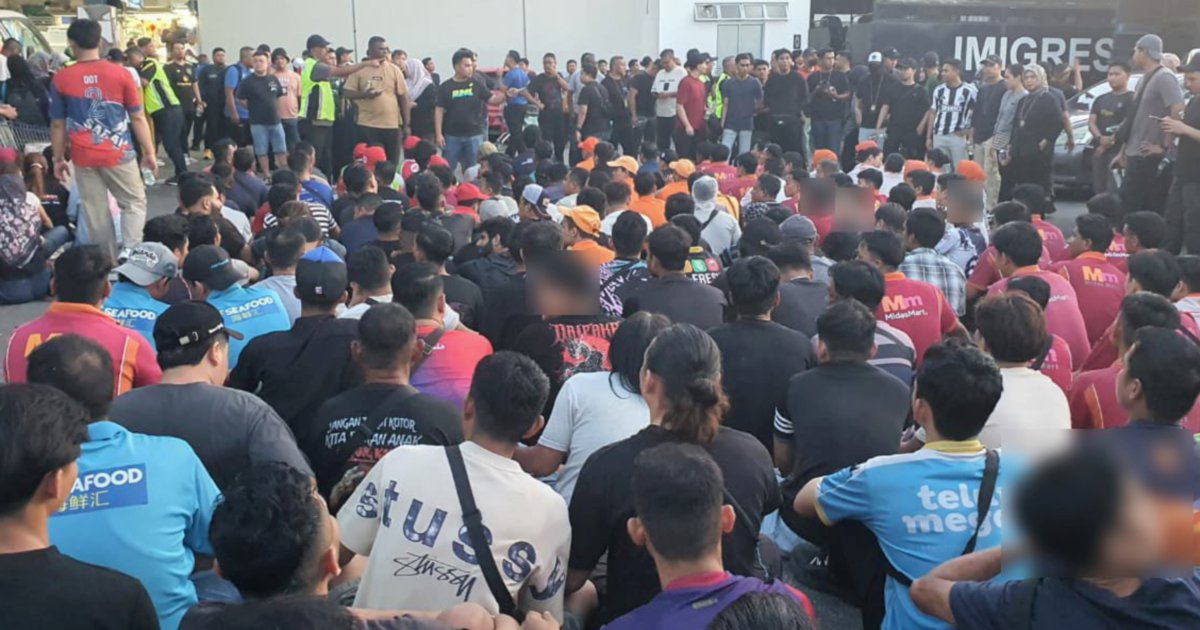
Immigration enforcement teams conducting coordinated raids across Johor Baru have apprehended 226 migrant workers in what officials describe as a significant breakthrough in combating irregular labour practices. The operation has revealed the inner workings of a sophisticated system that allowed undocumented workers to disguise their illegal status through a deceptive passport stamping arrangement that operated undetected for years.
At the heart of the bust lies a scheme of remarkable simplicity that nonetheless proved remarkably effective at circumventing border controls. An Indonesian fishmonger, who forms part of the case study presented by authorities, had repeated this pattern monthly for four consecutive years: crossing into neighbouring countries, obtaining a fresh passport stamp, and then returning to employment in Malaysia under the false presumption of legal entry. The arrangement allowed employers to maintain apparent compliance with immigration regulations while paying workers substantially below lawful wages and denying them baseline protections afforded to documented employees.
This discovery underscores a persistent vulnerability in Malaysia's migration management architecture. The scheme exploited the practice of regular border exits and re-entries, which can generate legitimate-appearing immigration records without detecting the underlying fraudulent intent. Workers would time their exits strategically, ensuring they accumulated enough stamped pages in their travel documents to withstand casual inspection by enforcement officers or employers seeking surface-level verification of legality.
The implications extend across Malaysia's labour-dependent sectors, particularly in fishing, agriculture, construction, and domestic service where migrant workers comprise a substantial portion of the workforce. Employers utilising such workers gain considerable cost advantages by avoiding mandatory contributions to social protection schemes, workplace safety standards, and minimum wage provisions applicable to legal employees. The arrangement essentially creates a shadow labour market operating beneath regulatory oversight, generating profits for traffickers and unscrupulous employers whilst exposing workers to systematic exploitation and abuse.
For Southeast Asia more broadly, this case exemplifies the sophistication of irregular migration networks. Malaysia, with its geographical proximity to Indonesia and the Philippines, combined with persistent wage differentials and labour demand, remains an attractive destination despite tightening enforcement. Criminal syndicates operating at borders have adapted their tactics continuously, responding to each new control measure with innovative alternatives. The passport stamping scheme represents merely one configuration among numerous methods deployed to maintain migrant flows whilst evading official detection.
The detained individuals now face processing through Malaysia's immigration system, which includes potential prosecution, detention pending deportation, and possible asset seizure for those identified as scheme organisers or facilitators. The economic consequences for deported workers can be severe, as they lose earnings immediately and face barriers to future formal employment. However, from a systemic perspective, individual deportations address symptoms rather than underlying drivers of irregular migration.
This operation arrives as Malaysia continues recalibrating its approach to migrant management following years of concerning reports regarding detention centre conditions, exploitation of vulnerable populations, and the intersection between immigration enforcement and human trafficking. Civil society observers have urged authorities to differentiate enforcement responses between migrant workers, typically driven by economic desperation, and trafficking organisers who profit from their exploitation. The distinction carries importance for both human rights compliance and effective anti-trafficking work.
The scheme's exposure also raises questions about employer accountability mechanisms. Whilst authorities frequently focus on workers, the employers and intermediaries who arrange such systems occupy positions of greater agency and culpability. Enforcement strategies that impose meaningful consequences on employers—including significant fines, business closure, and criminal prosecution—may create stronger deterrents than deportation alone, which simply returns workers to conditions motivating their original outbound migration.
Indonesia's government has noted the detention, reflecting broader diplomatic sensitivities around labour migration management. Bilateral arrangements between Malaysia and labour-sending countries theoretically provide frameworks for protecting workers whilst managing labour supply. However, implementation gaps persist, and informal networks often operate parallel to official channels. Strengthening these bilateral mechanisms requires not only enhanced enforcement capability but also genuine cooperation on worker protection standards and investigation of trafficking networks operating across borders.
The fishmonger's four-year operation demonstrates how persistent systematic vulnerability can remain invisible until sudden enforcement action illuminates its scope. Similar schemes likely continue operating in other sectors and regions, suggesting this operation captured merely a portion of Malaysia's irregular migration challenge. Sustainable solutions require addressing both immediate enforcement imperatives and structural factors—wage gaps, labour shortages in specific sectors, and limited legal pathways for lower-skilled workers—that generate demand for irregular migration in the first place.
As Malaysia implements renewed enforcement efforts, policymakers face a choice between enforcement-only approaches that temporarily disrupt migration flows and more comprehensive strategies incorporating worker protection, employer accountability, and addressing root causes of irregular migration. The 226 detained workers represent individuals now facing uncertain futures, but their cases also represent an opportunity to examine whether current policies genuinely protect labour standards or simply shuffle vulnerable populations between exploitation and deportation cycles that repeat predictably across the region.

