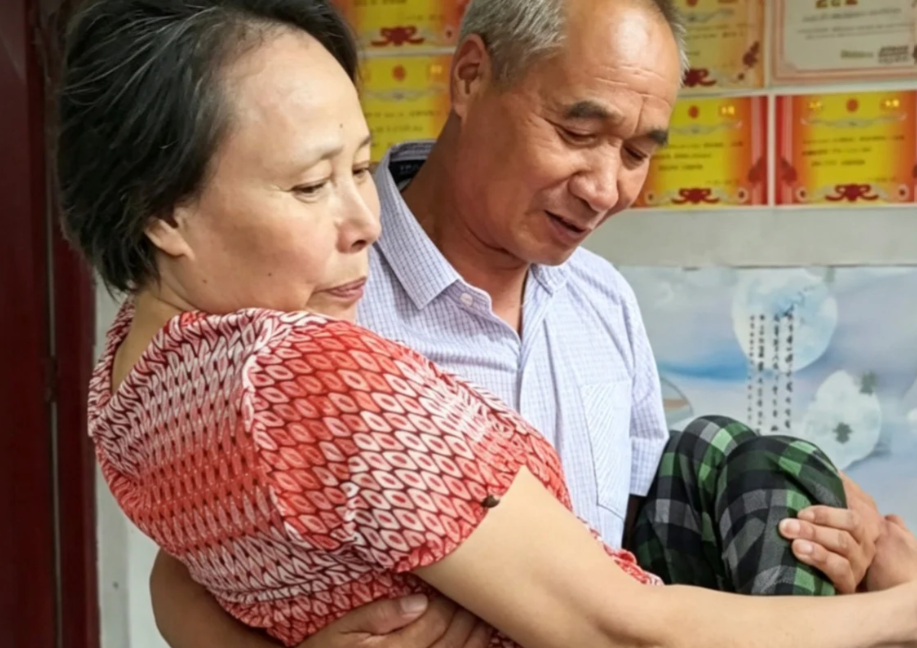
In the central Chinese city of Pingdingshan, Henan province, a marriage has endured one of life's harshest tests through the steadfast commitment of one man. Li Junliang has devoted the past quarter-century to caring for his wife, Jia Fang, who suffered a catastrophic fall from a cliff while riding a pedicab in 2001 that left her completely paralysed from the chest down. Their story has resonated deeply across mainland China's social media platforms, drawing admiration from millions who see in their relationship a reflection of the devotion often described in traditional marriage vows.
The accident that transformed their lives occurred when Jia, then 36 years old, suffered injuries that would permanently confine her to immobility. At that moment, the couple faced a crossroads that would define the remainder of their lives together. Their children were still young—only 10 and 13 years old—and required parental guidance through their formative years. Yet Li made a choice that would test his physical endurance, emotional resilience, and commitment to the promises he had made on their wedding day.
The demands placed upon Li have been extraordinary and relentless. In the earliest years following Jia's paralysis, he would reposition her body every two hours throughout day and night to prevent bedsores, one of the most serious complications faced by immobilised patients. This gruelling schedule meant that Li forgone the restorative sleep that most people consider essential to their wellbeing. As years passed and Jia's condition stabilised, he adjusted this routine to every four hours, yet this modification brought him little relief—two decades of interrupted sleep had already taken their toll, visible in the complete greying of his hair that Jia observed with wonder at how her own remains largely dark.
Beyond preventing pressure injuries, Li has undertaken the comprehensive physical therapy that keeps his wife's body functioning. He regularly massages her limbs to maintain muscle tone and prevent the atrophy that naturally occurs when the body cannot move. He transfers her from bed to a wheelchair, then carries her outside to experience sunshine and breathe fresh air—small gestures that might seem routine to most but represent profound acts of care for someone whose world has shrunk to the dimensions of a sickroom. He maintains their home with meticulous attention to cleanliness and order, a fact that neighbours have noted with genuine admiration.
The couple's adult children, who have since established their own families, were shaped by their father's example during their formative years. The certificates of achievement that line the walls of Li's home testify to the educational support and emotional nurturing he provided while simultaneously serving as his wife's full-time caregiver and sole provider. How he balanced these responsibilities remains somewhat unclear—the source material does not reveal his profession—yet the evidence of his success is written in his children's accomplishments and their own journeys to adulthood.
Jia's own perspective on her husband's sacrifice reveals the emotional dimension of their relationship. When speaking to media, she expressed wonder at the disparity between them: her husband's hair has turned completely white from the stress and labour, while her own remains largely black. She has articulated her gratitude explicitly, telling him "Junliang, thank you for taking care of me for 25 years," acknowledging that his commitment could have failed at any point but did not. Yet her most profound statement reveals her sense of identity within their marriage: "I believe I am the happiest person in the world; I've married the right man." This declaration suggests that despite her physical limitations, she has experienced a life enriched by genuine love and partnership.
Li's response to her gratitude offers insight into his motivations and the philosophical foundation of his commitment. He explicitly connects his present actions to the vows exchanged years earlier, recalling his promise on their wedding day: "Home is complete only with your presence." He has chosen to interpret this commitment not as metaphorical but as literal and binding, declaring his willingness to continue providing care for another 25, 35, or even 45 years. He frames his actions not as a burden heroically borne but as a debt repaid to a woman who gave him children and contributed immeasurably to their family's foundation.
The response from their community and the broader Chinese public has been one of admiration mixed with something approaching disbelief that such dedication remains possible in the modern world. An unnamed neighbour expressed surprise that despite Li's extraordinary caregiving responsibilities, his home maintains standards of cleanliness and order that most households would struggle to achieve. This observation suggests that Li's commitment extends beyond basic survival care into the realm of maintaining dignity and normalcy for both himself and his wife. The neighbour's assessment—"he truly is a remarkable man"—captures the sense that Li's behaviour represents something exceptional rather than expected.
Online commentary has elevated the story into a broader cultural conversation about marriage, commitment, and the human capacity for love under extraordinary circumstances. One observer wrote: "His loyalty and kindness will surely touch the heart of God, and his family will be blessed for a long time," invoking religious frameworks to express the sense that Li's actions possess transcendent moral significance. Another remarked: "I am moved by this kind-hearted man. Very few would do what he has done. This woman is truly fortunate!" These responses suggest a recognition that Li's choice places him outside ordinary human behaviour—that most people would not or could not sustain such a commitment over decades.
For Malaysian and Southeast Asian readers, the story offers a complex perspective on traditional values and contemporary life. In societies where extended family structures and filial piety remain important, the story of a husband assuming sole responsibility for his wife's care challenges the assumption that such caregiving would be distributed among family members. It also raises questions about the adequacy of social support systems and healthcare infrastructure in regions where family members must shoulder the entire burden of long-term care. The story's powerful resonance in China suggests that even in a rapidly modernising society, narratives of self-sacrifice and marital devotion retain profound emotional and moral significance.
The enduring nature of Li and Jia's commitment also invites reflection on the sustainability of caregiving in aging populations across Asia. As life expectancy increases and chronic conditions become more prevalent, the model of family-based care that Li exemplifies will face mounting pressure. Yet their story also demonstrates that within individual relationships, love and commitment can transcend the rational calculations of burden and benefit. The fact that this couple's relationship has become a widely shared story in digital spaces suggests that audiences recognise in their experience something both deeply human and increasingly rare in contemporary society.

