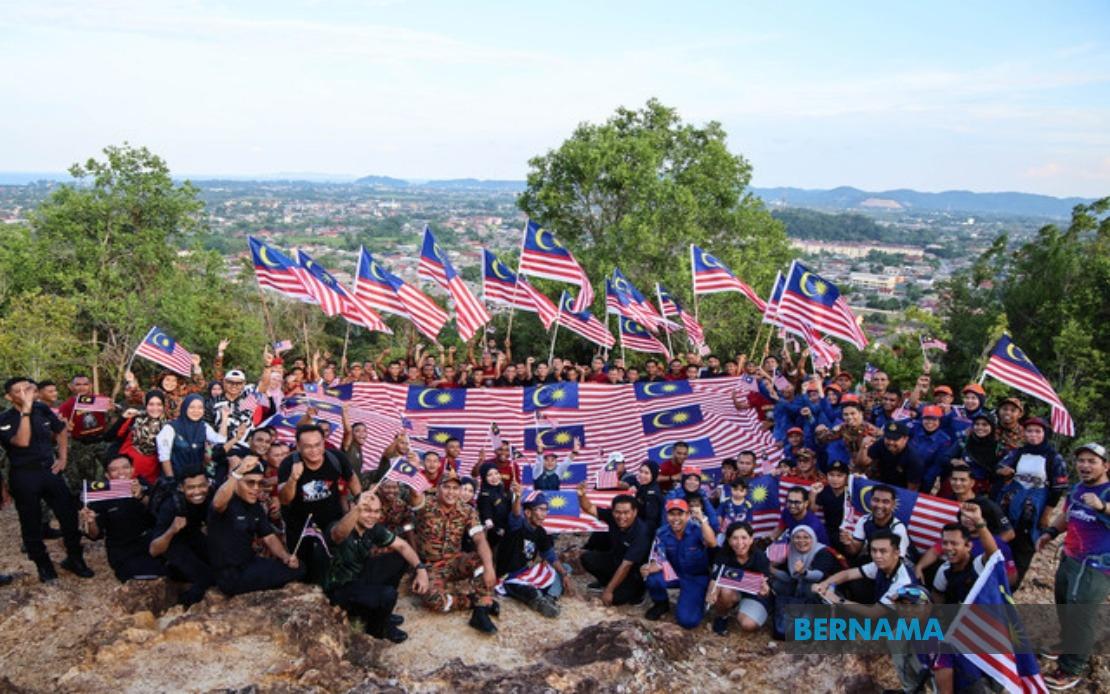
An inaugural patriotic event brought together three hundred participants across Kuala Terengganu on August 21, drawing uniformed personnel, government officials and members of the media to demonstrate national pride during the National Month celebrations. The gathering represented a coordinated effort to weave together multiple layers of Malaysian public service whilst infusing the occasion with community spirit and symbolic gestures of unity.
The organising body, METRA, orchestrated the summit hike as an expression of love for the nation, according to association president Mohd Zaid Mohd Noor. His vision extended beyond a simple outdoor activity, positioning the event as a deliberate platform for strengthening relationships between diverse government institutions that often operate in separate silos. Participants included representatives from the Terengganu Fire and Rescue Department (JBPM), Malaysian Armed Forces (ATM), Road Transport Department (JPJ), Malaysian Anti-Corruption Commission (MACC), Terengganu Ministry of Domestic Trade and Cost of Living (KPDN), Terengganu Royal Malaysian Customs Department (JKDM) and Malaysia Civil Defence Force (APM).
For media practitioners involved in organising the hike, the event carried particular significance. Mohd Zaid emphasised that journalists and communications professionals bear responsibility for channelling patriotic messaging across their various platforms, making this gathering an extension of that mission. By personally participating in the summit climb alongside uniformed officers and civil servants, media representatives demonstrated their commitment to fostering national consciousness within their reporting and editorial work.
The decision to unfurl a giant flag at the summit served as the culminating symbolic act of the day. This moment crystallised the underlying message of the entire exercise: that Malaysian institutions and their personnel, though operating across different sectors and hierarchies, share common purpose in advancing national interests and maintaining social cohesion. The flag deployment provided a visual anchor for the patriotic sentiment that participants carried throughout the physical challenge of ascending the mountain.
Beyond the immediate spectacle, the event functioned as a deliberate mechanism for building institutional relationships. Government agencies in Malaysia frequently coordinate on specific operational matters but rarely gather for collective activities that foster genuine human connection between personnel. By creating this informal setting where fire officers, soldiers, customs officials and journalists shared a physical experience, organisers aimed to lubricate the machinery of inter-agency cooperation that underpins effective governance.
The timing during National Month amplified the event's cultural resonance. August celebrations hold particular significance in the Malaysian calendar, marking the nation's independence and providing occasions for renewal of civic commitment. Rather than confining these observances to desk-bound ceremonies or formal speeches, the summit hike integrated patriotic expression with physical wellness, suggesting that national pride and personal health reinforce one another. This approach aligns with contemporary public health messaging whilst maintaining traditional nationalist rhetoric.
Mohd Zaid's framing of the initiative as promoting a healthy lifestyle interwoven with patriotic values reflects broader public administration trends across Southeast Asia. Malaysian officials increasingly recognise that institutional effectiveness depends partly on personnel wellness and morale. By organising collective recreational activities that simultaneously advance patriotic objectives, government bodies address multiple policy goals within a single initiative. This integrated approach generates efficiency gains whilst fostering workplace culture emphasising shared purpose.
The gathering of three hundred individuals represents substantial participation, suggesting either compelling messaging about the event or institutional encouragement for personnel to attend. For media practitioners particularly, the decision to prioritise attendance at such an event signals their perceived stake in nation-building activities. This positioning of journalists as partners in patriotic mobilisation rather than neutral observers reflects particular assumptions about media's role in Malaysian society.
Looking ahead, such initiatives could establish precedent for future inter-agency collaboration exercises. If successful in strengthening personal relationships between officials from different institutions, the summit hike model might be replicated during other national occasions or within specific clusters of agencies with functional overlap. The relatively low-cost nature of outdoor activities compared to formal workshops or conferences makes this approach scalable across Malaysia's thirteen states and federal territories.
For Southeast Asian observers, the Terengganu event exemplifies how middle-income nations balance institutional modernisation with cultural continuity. Rather than abandoning patriotic expression as bureaucratic or outdated, Malaysian organisers have repositioned it as compatible with contemporary wellness and team-building practices. This synthesis proves particularly valuable in multiethnic societies where shared institutional identity can counterbalance communal divisions. The summit hike thus represents not merely a celebration of independence, but an investment in the social capital required for plural societies to function effectively across government sectors and across ethnic and sectarian lines.

