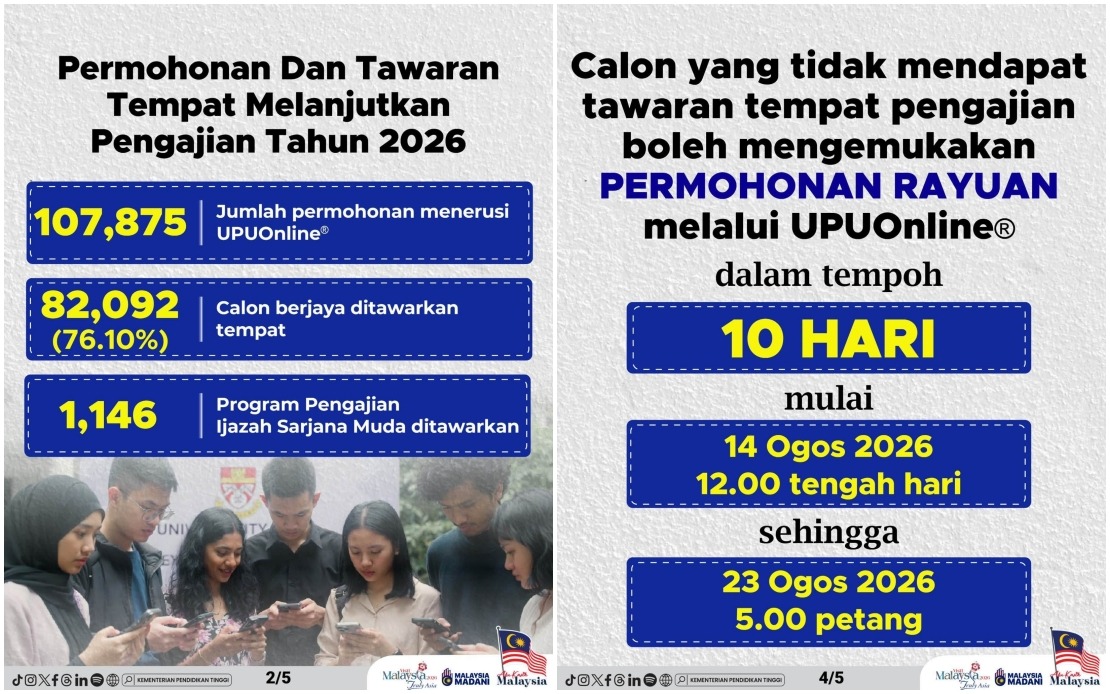
Malaysia's higher education intake has reached a significant milestone, with the Ministry of Higher Education announcing that 82,092 candidates have received offers for undergraduate studies at the nation's 20 public universities. This year's allocation represents a substantial component of the overall higher education landscape, accommodating nearly three-quarters of the 107,875 eligible applications that met the criteria for university-level study through the UPUOnline platform.
The scale of this intake underscores the continued demand for tertiary education among Malaysian school leavers. With 1,146 bachelor's degree programmes spanning diverse fields and disciplines now available across the public university system, the ministry has significantly expanded the breadth of educational pathways available to successful candidates. This expansion reflects efforts to align university offerings with evolving labour market demands and national development priorities across sectors ranging from engineering and medicine to social sciences and creative industries.
The ministry has emphasised that student selection adheres strictly to meritocratic principles, with all qualified applicants ranked according to their merit scores in descending order. This transparent, score-based system aims to ensure that university places are allocated based on academic achievement rather than other considerations, a cornerstone of Malaysia's higher education access philosophy. The approach provides predictability for candidates monitoring their application status and reflects broader commitments to fairness in education policy.
For the substantial cohort of successful candidates, the ministry has framed this university offer as a pivotal opportunity within their educational trajectories. Ministry officials have expressed optimism that these students will maximise their tertiary education experience, implicitly encouraging them to engage meaningfully with their studies, develop professional networks, and prepare for competitive labour markets upon graduation. This messaging reinforces the value proposition of university education in shaping career prospects and personal development.
However, a considerable portion of applicants will not receive immediate offers, creating frustration and uncertainty among families who have invested significant time and resources in supporting their children's academic advancement. With approximately 23.9 percent of eligible candidates not receiving offers at this stage, a secondary intake mechanism becomes crucial for broader inclusion. The ministry has therefore instituted an appeal process through which unsuccessful candidates can petition for reconsideration, a lifeline that extends participation opportunities beyond the initial selection round.
This appeal window operates under compressed timeframes, running for ten days from noon on August 14 through 5pm on August 23, 2026, creating an urgent deadline for candidates to submit appeals through the UPUOnline portal. The relatively short appeal period reflects logistical constraints within the admission system and the ministry's aim to finalise student placements efficiently. Prospective students and their families must act decisively during this window, as missing the deadline forecloses this avenue for consideration.
The appeal mechanism carries significance for equity and inclusion considerations within Malaysia's higher education system. Students who narrowly missed initial offers—often by small margins in merit scores—have opportunity to seek placement in programmes where vacancies emerge or where their credentials may be reconsidered. This two-stage process acknowledges that rigid single-round selection can exclude capable candidates based on marginal differences in performance, while balancing the need for administrative finality and institutional planning.
For Malaysian families and school-leavers, the annual undergraduate intake cycle remains a defining moment in educational advancement. The 82,092 offers represent success stories where students' academic efforts culminated in pathway access. Simultaneously, the intake ceiling reflects resource constraints and capacity limitations within the public university system, a persistent challenge as student demand continues outpacing available places. This tension between access aspirations and institutional capacity remains a perennial issue within Malaysian higher education policy discourse.
The announcement arrives as Malaysia continues navigating broader higher education transformation, including efforts to enhance university competitiveness internationally, diversify funding models, and align programmes with industry requirements. The scale of undergraduate recruitment demonstrated through this year's intake cycle sustains the pipeline of talent entering Malaysia's professional and knowledge-based sectors. Success in utilising these educational opportunities translates into workforce development outcomes affecting economic productivity and innovation capacity across the nation.
Prospective students not receiving offers should view the appeal process not merely as a final recourse but as an integral component of the selection system. Historical data suggests that places frequently become available during the appeal phase as some successful candidates defer entry, decline offers, or pursue alternatives. Encouragement to appeal recognises this reality while promoting persistence among determined students. The outcome of this intake cycle will shape higher education trajectories for an entire cohort of Malaysians, with ripple effects extending into the nation's professional landscape for decades to come.

