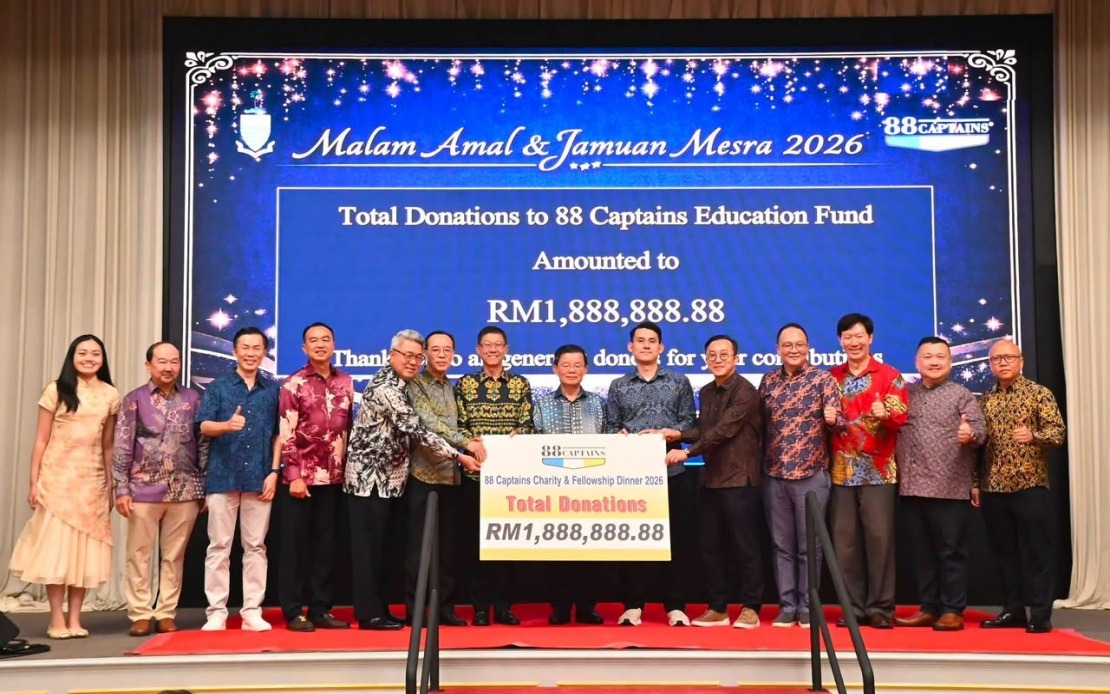
The Persatuan Kebajikan 88 Kapten Pulau Pinang, a charitable organisation dedicated to nurturing young talent in the state, has presented scholarships exceeding RM1 million to 44 deserving students across five educational institutions. The announcement, made at the group's annual fundraising dinner in George Town, reflects the organisation's commitment to alleviating educational barriers while fostering a generation equipped with both professional competence and ethical values.
Datuk Seri Dr Ooi Eng Hock, the organisation's chairman, emphasised that the scholarship initiative transcends mere financial relief. Rather, the funds are designed to inspire recipients to pursue ambitious goals, demonstrate greater determination in their studies, and ultimately contribute meaningfully to society with integrity and character. This philosophical approach distinguishes the 88 Captains initiative from transactional assistance programmes, positioning scholarships as catalysts for personal transformation rather than temporary solutions to economic hardship.
Central to the organisation's broader strategy is its Apprenticeship, Internship, Reskilling and Upskilling (AIRU) programme, launched the previous year at Universiti Sains Malaysia. This framework seeks to bridge the persistent divide between academic training and workplace readiness—a challenge that has long affected Malaysian graduates entering the labour market. By formalising pathways between higher education institutions and industry practitioners, the programme addresses a structural gap that frequently leaves young professionals unprepared for commercial realities.
The 88 Captain Young Fellowship, a dedicated taskforce comprising distinguished scholars from institutions including ViTrox College, Tunku Abdul Rahman University of Management and Technology, and INTI International University, drives the programme's implementation. These fellows are tasked with meeting corporate leaders and entrepreneurs to comprehend industry demands, while simultaneously representing the expectations and perspectives of contemporary graduates. Notably, discussions centre on establishing appropriate compensation benchmarks, with the fellowship advocating for a minimum starting salary of RM4,000 for degree holders—a figure reflecting growing pressure on employers to offer competitive packages in a competitive talent market.
The annual charity dinner, held in August, successfully mobilised RM1.89 million in total contributions, underscoring substantial community support for the organisation's mission. The event attracted prominent state leadership, including Penang Governor Tun Ramli Ngah Talib and Chief Minister Chow Kon Yeow, reflecting the initiative's alignment with government development priorities and its recognition across political and civil society circles.
Over the preceding four years, 88 Captains has orchestrated more than 50 community and educational events, extending its reach far beyond scholarship provision. The organisation has distributed smart televisions to primary and secondary schools, establishing technological infrastructure where it might otherwise be unavailable. More substantially, it has developed 5G Education Digital Libraries across 88 schools throughout Penang and the Northern Region, a significant undertaking that addresses digital divides in resource-constrained educational settings. The group has also championed the Special Education Integration Programme, recognising that inclusive education strengthens social cohesion and unleashes potential among students with diverse learning needs.
Chief Minister Chow Kon Yeow publicly commended the organisation's multifaceted approach to education and workforce development, particularly its integration of digital learning, institutional partnerships, and industry collaboration. He positioned the AIRU programme as strategically vital to Penang's economic ambitions, which centre on establishing competitive advantage in advanced manufacturing, semiconductor production, artificial intelligence, and digital economy sectors. By aligning talent development with these identified growth areas, 88 Captains supports broader state economic planning while ensuring that educational investments yield employment outcomes.
A recent collaborative initiative launched by 88 Captains—the Joint Mental Health Development in Schools with AI Early Education for Responsible Adoption—received commendation from the Chief Minister, who highlighted its timeliness given the recent introduction of the Anti-Bullying Act 2026. The programme recognises that legislative frameworks, while necessary, prove insufficient without sustained implementation and cultural change. By supporting schools and families in equipping educators, protecting vulnerable students, and promoting ethical artificial intelligence adoption, the initiative addresses the interconnected challenges of student wellbeing and technological literacy.
The Chief Minister's remarks underscore a broader shift in how policymakers conceptualise talent development and social welfare. Rather than viewing these as separate domains, contemporary approaches integrate mental health support, digital skills, ethical technology use, and economic readiness into comprehensive frameworks. This integration is particularly relevant for Malaysian societies navigating rapid technological change, economic competition, and evolving social pressures affecting young people.
Established in 2022, 88 Captains emerged as a response to identified gaps in talent development support across Penang and the Northern Region. The organisation's rapid expansion—from conception to distributing over RM1 million annually within four years—suggests both substantial philanthropic capacity and genuine community recognition of educational inequities. The group's effectiveness derives partly from its direct engagement with industry leaders, ensuring that its programmes remain responsive to actual employment market demands rather than hypothetical curriculum requirements.
For Malaysian readers, particularly those in the northern states, 88 Captains represents a model of strategic philanthropy that extends beyond direct financial assistance to encompass systemic educational improvements. The integration of digital infrastructure, mental health support, industry mentorship, and scholarship provision creates a comprehensive ecosystem supporting youth development. As Malaysia positions itself as a regional innovation and technology hub, similar integrated approaches become essential for developing human capital that matches both current and anticipated economic opportunities.
The success of such initiatives depends ultimately on sustained commitment from both philanthropic organisations and government bodies. The Chief Minister's public endorsement and Penang Governor's presence at fundraising events signal official recognition of 88 Captains' contribution to state development objectives. However, scaling such programmes nationally—and extending comparable support to underserved regions—remains a challenge requiring coordinated policy effort and expanded resource allocation across Malaysia's education and talent development systems.

