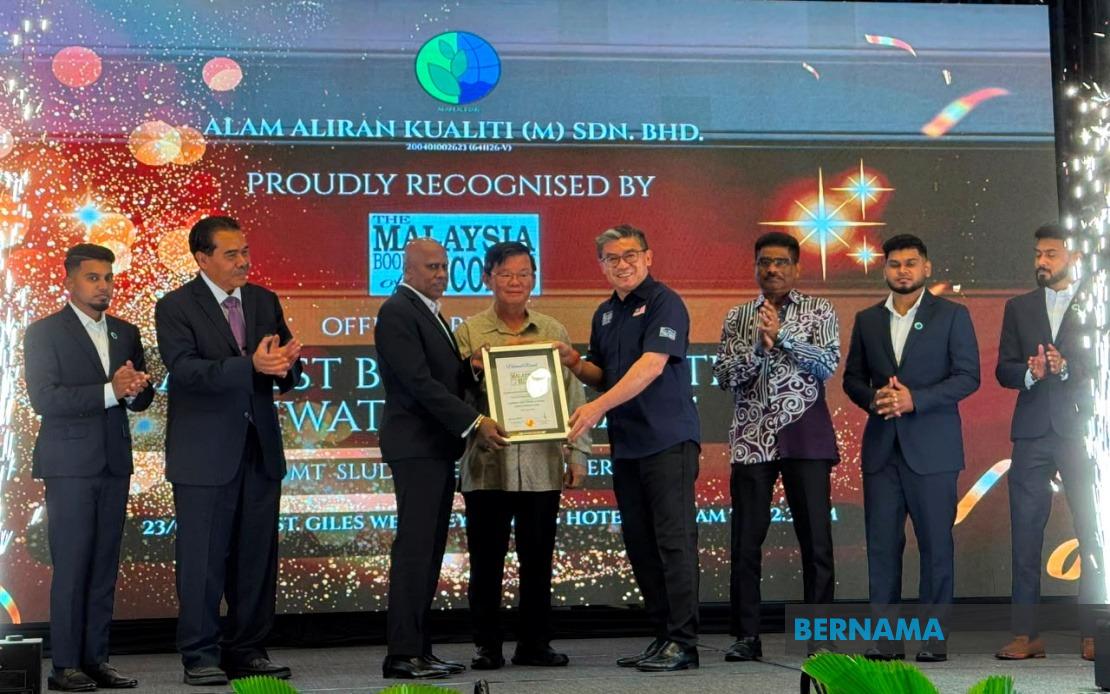
Alam Aliran Kualiti (M) Sdn Bhd secured a significant accolade on Wednesday when the Malaysian Book of Records formally recognised its Sungai Dua Dewatering Plant as the nation's largest belt press system dewatering facility. The honour, presented during a ceremony in George Town, underscores the growing momentum behind advanced environmental engineering solutions in Malaysia, particularly as water scarcity and waste management challenges intensify across Southeast Asia. Developed jointly with Perbadanan Bekalan Air Pulau Pinang, the facility represents a tangible demonstration of how Malaysian companies can innovate at scale to address critical infrastructure gaps.
The plant's operational specifications reflect the scale of its contribution to Penang's water management infrastructure. Operating at a treatment capacity of 10 million litres per day, the facility processes approximately 450 tonnes of water treatment sludge daily—volumes that would have traditionally overwhelmed conventional dewatering systems or burdened landfill sites with hazardous residue. This throughput capacity positions the installation firmly within the upper echelon of regional environmental infrastructure, comparable to facilities deployed in more industrialised economies. For Malaysian readers, the significance extends beyond Penang's immediate borders; as the country grapples with rapid urbanisation and the corresponding demand on water treatment networks, facilities of this calibre become essential components of national water security.
Company director Gokulaan Balan framed the recognition as a watershed moment rather than a final destination, emphasising that achieving the record catalysed renewed commitment to innovation and engineering excellence. His remarks reflected an understanding that records, while validating current achievement, must serve as springboards for sustained advancement. The characterisation is particularly relevant to Malaysia's broader development trajectory, where international recognition of homegrown technological competence bolsters investor confidence and encourages technology transfer relationships with foreign partners. When Malaysian firms demonstrate world-class capabilities in specialised fields, the ripple effects extend across supply chains and sectoral development.
The Sungai Dua Dewatering Plant embodies a circular economy philosophy that increasingly shapes policy discussions in Kuala Lumpur and across Southeast Asia. Rather than channelling treated water treatment residuals into landfills—a practice that consumes valuable land and creates environmental liabilities—the facility converts these materials into Eco Green Cement Bricks. This transformation achieves multiple policy objectives simultaneously: it reduces landfill dependency, creates secondary revenue streams from scheduled waste recovery, and generates construction materials suitable for infrastructure projects. Penang Chief Minister Chow Kon Yeow underscored this multiplier effect during the recognition ceremony, noting that such projects demonstrate how environmental stewardship and economic value creation are mutually reinforcing rather than contradictory.
The water recovery dimension of the facility merits particular attention for Malaysian stakeholders confronting persistent water loss in distribution networks. By treating water residuals and recirculating cleaned water back into the treatment process, the Sungai Dua plant mitigates losses that plague many municipal water systems regionally. In Penang, where aging infrastructure and climatic pressures compound supply vulnerabilities, this closed-loop approach delivers measurable benefits to long-term water security. The integration of recovery mechanisms within a dewatering facility represents an operational sophistication that many regional competitors have yet to achieve, positioning AAK's technology platform as a potential export product for other water-stressed markets.
Aalam Aliran Kualiti's corporate background illuminates the foundation upon which this achievement rests. Established in 2004, the company carved a specialised niche in environmental engineering and scheduled waste management—sectors that operate at the intersection of regulatory compliance, technological sophistication, and environmental responsibility. This two-decade operational history provided the technical foundation and stakeholder relationships necessary to conceive, design, and execute a facility of Sungai Dua's complexity. For Malaysian enterprises, the trajectory demonstrates that sustained focus on unglamorous but essential infrastructure sectors can yield both commercial success and national significance.
The collaborative architecture underpinning the facility reflects the institutional maturity of Malaysia's water sector. The partnership between AAK, PBAPP, Pengurusan Aset Air Berhad, and municipal authorities involved orchestrating technical expertise, regulatory oversight, and capital allocation across multiple organisations. This coordination capacity—bringing specialists, public agencies, and asset managers into productive alignment—represents an often-overlooked competitive advantage. Regional competitors lacking similar institutional depth frequently struggle to mobilise the combination of capital, expertise, and authority necessary for transformative infrastructure projects. Malaysia's demonstration that such coordination is achievable has implications for regional infrastructure development beyond Penang.
Chow's emphasis on sustainability as both an environmental and economic proposition reflects shifting perspectives on environmental infrastructure across Southeast Asia. The traditional framing—that environmental protection imposes costs that reduce competitiveness—increasingly yields to evidence that well-designed environmental systems generate competitive advantages, reduce long-term liabilities, and improve quality of life metrics that attract skilled workers and investment. The Sungai Dua facility instantiates this thesis by converting treated sludge into value-added products, reducing environmental externalities, and extending water security simultaneously. For policymakers across the region wrestling with sustainability imperatives, the facility offers a tangible blueprint for integration rather than trade-off.
The role of the Malaysian Book of Records in this recognition deserves consideration within Malaysia's broader innovation ecosystem. Official recognition of domestic achievement creates benchmarking points that calibrate ambition and communicate competitive standing to international audiences. When Malaysian firms receive formal documentation of world-class capability, the institutional validation carries weight in negotiations with multinational partners, government procurement processes, and technology licensing discussions. The MBOR recognition thus functions as both celebration and credential, amplifying the facility's significance beyond its immediate operational context.
Looking forward, the Sungai Dua precedent raises questions about replicability and scaling. Water treatment challenges affect virtually every urban centre across Southeast Asia; the technologies and operational approaches validated at Sungai Dua could address comparable problems in Bangkok, Jakarta, Ho Chi Minh City, and other rapidly urbanising regions. If AAK can productise and export both its dewatering technology and its circular economy integration model, the company potentially transforms from a regional service provider into a technology leader with continental reach. The Malaysian Book of Records recognition, by anchoring the facility's capabilities in official documentation, facilitates this scaling trajectory.
The recognition also invites reflection on the relationship between environmental infrastructure and national development narrative. Malaysia's aspirations toward high-income status and regional technology leadership require not only consumer-facing innovations but also the unglamorous but essential infrastructure systems that support urbanisation and economic complexity. Water treatment facilities, waste management systems, and resource recovery plants constitute the backbone of liveable cities and resilient economies. By celebrating AAK's achievement, Malaysia signals that such foundational infrastructure merits the same recognition and investment as more visible technological sectors. This recalibration of what constitutes national achievement carries subtle but significant implications for how resources are allocated and talent is directed within the economy.

