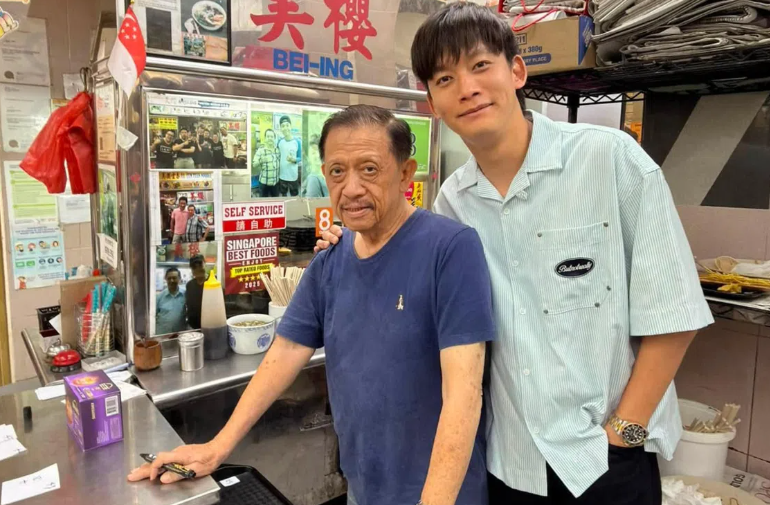
Singaporean actor Noah Yap has firmly rejected accusations that his visit to an injured elderly hawker was motivated by a desire for public attention and to secure the spotlight before other public figures. The actor addressed social media critics who had alleged he staged the encounter at Roxy Square specifically to generate favourable publicity and demonstrate false concern for the vendor's wellbeing.
Yap's response provides crucial context that reframes the nature of his involvement in the incident. Far from a calculated media move, the actor revealed that he had been a loyal patron of Bei-Ing Wanton Noodle for more than two decades, maintaining his connection to the stall since his primary school years. This long-standing relationship underscores the personal dimension of his visit and suggests genuine attachment to the establishment and its proprietor rather than opportunistic engagement.
The elderly hawker in question, identified as Yeo, had reportedly experienced a confrontation at the coffee shop that resulted in injury. According to accounts from Yeo and his family members, the incident occurred when Yeo patted a young child on the head after noticing the girl, whom he found endearing. The girl's father subsequently became confrontational, leading to a physical altercation that resulted in Yeo being pushed to the ground. Security camera footage that circulated online appeared to corroborate these accounts, showing the younger man engaging in aggressive physical contact with the elderly vendor.
The police have formally confirmed receiving a report related to the incident and stated that investigations are continuing. This official acknowledgement of the confrontation lends weight to the accounts provided by Yeo and his family members. The incident, which occurred on August 15, prompted significant online discussion and scrutiny regarding the appropriateness of the father's response and broader questions about public behaviour and respect for elderly members of the community.
Yap visited Yeo the afternoon following the incident on August 16 to assess his condition personally. Despite the physical nature of the altercation, the actor found the elderly hawker maintaining good spirits. However, Yeo had initially shown reluctance toward pursuing medical treatment, a response not uncommon among older generations who may downplay injuries or harbour concerns about medical procedures. Yap's presence appeared to provide both moral support and an opportunity to encourage proper care.
The actor's decision to document his visit through social media posting was explicitly motivated by a desire to amplify awareness about the incident rather than to aggrandise himself. By sharing details of his encounter, Yap aimed to ensure that the event received broader public attention and that the circumstances surrounding the confrontation became more widely understood. This approach reflects a growing recognition among public figures that leveraging social platforms can serve community awareness functions beyond self-promotion.
In his response to critics, Yap emphasised several overarching messages that transcended the specific incident. He stressed that violence is fundamentally incompatible with civil society and that individuals should collectively strive to demonstrate increased kindness and compassion toward one another. These statements address the broader context of public behaviour and social responsibility rather than merely defending his own actions. The comments suggest concerns about escalating physical confrontations in public spaces and the need for cultural recalibration toward gentler interpersonal interactions.
Yap's sharp retort to detractors—"Get a life la. I'm not as free as you think"—reflects the frustration that public figures frequently experience when their motivations are questioned by anonymous commentators. The comment cuts to the heart of a broader dynamic in social media discourse where critics often attribute negative intentions to public actions without sufficient information or understanding of underlying relationships and contexts. For Malaysian and regional observers familiar with similar dynamics in their own entertainment industries, this exchange resonates as a common pattern of online criticism and celebrity response.
The incident and its aftermath illuminate several important considerations for Southeast Asian societies. First, it highlights the vulnerability of elderly service workers and the workplace safety concerns they navigate daily. Second, it demonstrates how quickly incidents can become subject to competing narratives and public judgment through social media. Third, it reflects the tension between celebrities engaging with their communities and the suspicion that such engagement may be performative. Yap's case suggests that even genuine civic participation by public figures faces skepticism and reinterpretation through cynical lenses.
The relationship between Yap and Yeo—spanning more than twenty years and rooted in genuine patronage—provides the most compelling counter to accusations of opportunism. The hawker and his family had maintained personal investment in Yap's life throughout his formative years and beyond, creating reciprocal bonds that transcend transactional restaurant interactions. When Yeo suffered injury, Yap's response flowed naturally from this established relationship rather than emerging from calculated consideration of public relations advantages.
For Malaysian audiences and others across Southeast Asia, this incident resonates with broader discussions about how public figures should engage with their communities and the unrealistic expectations placed upon celebrities. The region has seen numerous instances where entertainers' charitable or civic activities have been questioned or dismissed as publicity seeking. This case provides a useful reminder that social media's amplification of events can obscure genuine human connections and motivations, and that context—particularly long-standing relationships—matters significantly when evaluating the authenticity of public engagement.

