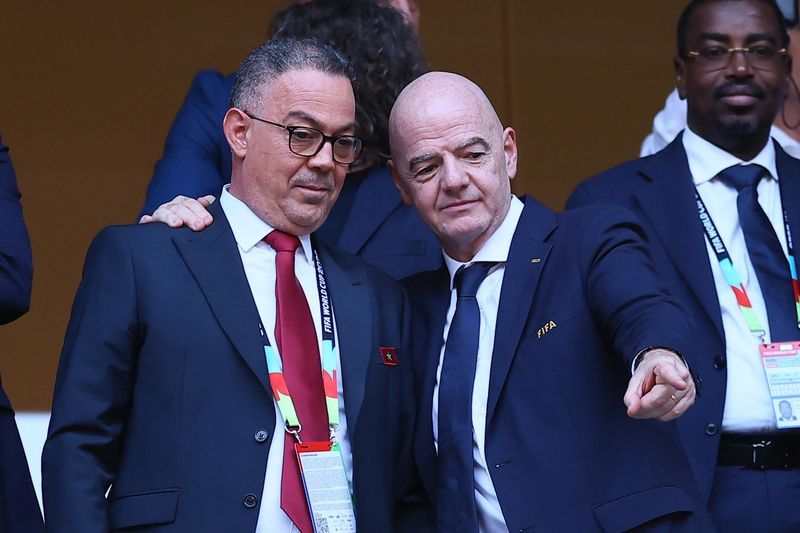
Gianni Infantino's grip on the FIFA presidency faces its stiffest challenge yet, with football administrators across Asia, Europe, and the Americas declaring lost confidence in his leadership. Yet in a significant show of support, leading African football officials have thrown their weight behind the embattled FIFA boss, offering him a crucial lifeline as he prepares for the March presidential election. The backing from Africa's football establishment represents a striking divergence from the global criticism that forced Infantino to abandon his contentious plan to generate $4.2 billion through a new commercial entity controlling future World Cup broadcasting rights.
The contrast in regional responses reveals a fundamental fracture in global football governance. While continental confederations across Europe, Asia, and the North American and Caribbean region signalled they no longer backed Infantino's leadership, the Confederation of African Football has remained strategically silent on the broader question of his future—a silence that amounts to tacit acceptance. This calculated restraint provides Infantino with genuine hope that Africa's 54 member nations, representing the largest single bloc within FIFA's voting structure, could prove decisive in his re-election bid. The political mathematics favour him: with such substantial continental support mobilised, Infantino may yet survive the storm.
Prominent African football figures have been remarkably vocal in their endorsement. CAF Vice President Fouzi Lekjaa of Morocco, along with FIFA Council members Hany Abo Rida from Egypt, Hamidou Djibrilla from Niger, and Ahmed Yhaya from Mauritania, have all issued statements welcoming Infantino's decision to scrap the World Cup revenue initiative while simultaneously affirming their personal backing. The messaging has been notably consistent across these statements, suggesting either coordination or aligned thinking among Africa's football elite. Additionally, Veron Mosengo-Omba, the newly elected president of the Democratic Republic of Congo's football federation and a former CAF general secretary who studied in Switzerland alongside Infantino, has also expressed support, lending his considerable influence to the FIFA president's cause.
Understanding why African football administrators have rallied to Infantino's side requires examining the financial architecture that underpins contemporary African football. Since his election in 2016, Infantino has dramatically expanded the FIFA Forward programme—an evolution of predecessor Sepp Blatter's earlier Goal Project—funnelling substantially increased resources to member associations across the continent. Every FIFA member receives a baseline guarantee of $8 million across a four-year cycle, while CAF additionally provides annual grants to its constituent nations. For many African football federations operating in resource-constrained environments, this FIFA money represents an essential revenue stream, often exceeding income from domestic sponsorships or government allocations.
The financial dependency of African nations on FIFA's generosity cannot be overstated. Saïd Ali Athouman, president of the Comoros Football Federation, articulated this reality with blunt honesty, noting that without external funding his nation cannot compete internationally. The fundamental inequality between wealthy European nations with established infrastructure, corporate sponsors, and government support, and poorer African countries lacking these advantages, creates a structural imbalance that FIFA money partially—though never adequately—addresses. Fleetwood Haiya, president of Malawi's Football Association, similarly highlighted how his government's limited resources force impossible choices between funding healthcare and investing in football development, making FIFA's financial assistance absolutely critical to maintaining competitive national programmes.
Infantino's strategic approach to African football administrators mirrors tactics employed by his predecessor, Sepp Blatter, who first introduced guaranteed financial grants to member associations when standing for election against Lennart Johansson in 1998. Blatter's promise of systematic financial support proved transformative, securing African backing that proved decisive in his election victory despite UEFA's formal endorsement of the Swedish alternative. Infantino has refined and substantially expanded this model, understanding that the promise of sustained financial commitment translates into political loyalty among administrators operating under severe budgetary constraints.
The CAF executive committee meeting scheduled for Thursday represents a crucial moment in the unfolding drama, with the abandoned World Cup revenue plan remaining formally on the agenda. However, the organisation's calculated silence suggests African football administrators have already resolved their internal position: they will neither condemn Infantino nor actively campaign against him. This neutrality, combined with the outspoken support from influential individual members, effectively constitutes a political endorsement that could prove decisive when FIFA member nations vote next March. The absence of African condemnation, contrasted with explicit rejection from other continental confederations, fundamentally reshapes the political battlefield.
The broader implications of this African-FIFA alignment extend beyond Infantino's immediate political survival. It underscores a persistent dynamic in global sport governance where economically dependent nations gravitate toward leaders who deliver tangible financial benefits, regardless of governance controversies. The World Cup revenue scheme that prompted global criticism represented Infantino's attempt to create a secondary revenue stream—essentially acknowledging FIFA's need for diversified income sources. African leaders' willingness to forgive this misstep, coupled with their appreciation for his willingness to retreat, demonstrates how financial distribution decisions fundamentally shape international sporting politics.
Infantino's personal connections within African football leadership also reinforce these institutional relationships. His university education in Switzerland alongside figures like Veron Mosengo-Omba created bonds that transcend the transactional nature of institutional support, introducing personal loyalty dimensions to what might otherwise be purely pragmatic calculations. When CAF President Patrice Motsepe declared days before the scandal broke that he would never betray a loyal friend, he articulated a value system where reciprocal loyalty carries profound weight—a cultural framework distinctly different from the more institutional, procedurally focused governance traditions of Europe.
The contrast between African and European responses to Infantino's crisis illuminates fundamental differences in how continental confederations prioritise governance concerns versus financial pragmatism. European and Asian confederations, representing wealthier member nations less dependent on FIFA's discretionary funding, could afford to voice governance concerns about the World Cup revenue scheme. African administrators, representing nations where FIFA money funds essential development initiatives, calculated differently. This divergence does not necessarily indicate African leaders' indifference to governance standards, but rather reflects different institutional priorities when facing trade-offs between maintaining access to critical funding streams and pursuing abstract governance principles.
As the March presidential election approaches, Infantino's political position has been partially rehabilitated by African backing. Though significantly damaged globally, his candidacy remains viable if African nations vote as a bloc while opposition from other confederations remains fragmented. The abandonment of the World Cup revenue plan removed the focal point of organised resistance, while his proven willingness to increase financial support to member associations provides ongoing insurance against organised campaigns against his re-election. For African football administrators, maintaining Infantino's presidency represents continuity in a financial relationship that has transformed how African football operates—a calculation that appears to have outweighed whatever reservations they might harbour about his governance approach.

