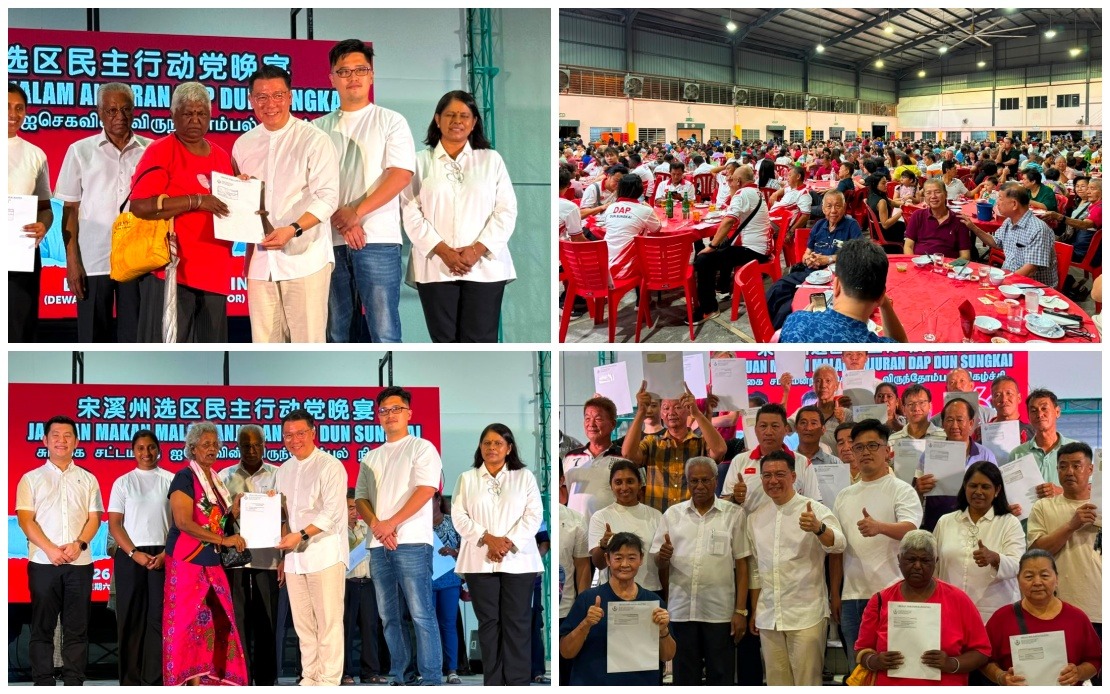
A landmark resolution to one of Perak's longest-running land disputes has finally materialised, with 120 squatter families in the Sungkai and Kuala Bikam areas receiving formal land grants from the government. Housing and Local Government Minister Nga Kor Ming made the announcement at a DAP Sungkai divisional dinner in Ipoh, presenting the titles to recipients before an audience exceeding 1,200 community members drawn from various ethnic and social backgrounds. The conclusion of this four-decade impasse represents a significant policy victory for the MADANI administration and reflects a deepening commitment to resolving long-standing housing inequities across Malaysia's urban and semi-urban fringes.
The granting of these land titles carries substantial implications for the affected families, whose precarious tenure had persisted through multiple political administrations and numerous promises of resolution. For four decades, these residents existed in legal limbo, unable to secure formal property ownership despite establishing homes and livelihoods in these settlements. The land grants now provide families with documented proof of ownership, enabling them to access credit facilities, plan infrastructure improvements, and establish a sense of permanence previously denied to them. This tangible outcome addresses not merely the physical housing need but the deeper psychological security that comes with recognised legal standing in Malaysian society.
Nga framed the resolution within the broader MADANI Government's philosophical commitment to inclusive development, emphasising that the resolution demonstrated the administration's willingness to prioritise citizen welfare irrespective of ethnic identity or socioeconomic standing. He positioned the initiative as evidence of the government's dedication to the foundational principle that no Malaysian should experience marginalisation or exclusion from development opportunities. This rhetoric resonates particularly within Indian Malaysian communities, where questions of equitable access to government resources and development initiatives have historically generated political debate and community concern.
The minister's statements also highlighted complementary initiatives directed toward Indian Malaysian communities and settlers. The government has allocated RM20 million specifically for Indian settlements across the country, RM50 million earmarked for Tamil vernacular schools, and increased the Malaysian Indian Transformation Unit budget to RM150 million. These concurrent investments suggest a coordinated policy approach rather than isolated gestures, indicating substantive governmental redirection of resources toward communities that have historically received proportionally less development attention. The timing of these announcements alongside the land grant presentation creates a narrative of sustained commitment beyond single initiatives.
Sungkai state assemblyman Datuk A. Sivanesan, who chairs the state's committee overseeing human resources, health, Indian community affairs and national integration, received ministerial commendation for his instrumental role in facilitating the resolution. This acknowledgment underscores how local political representation bridges administrative machinery with grassroots needs, and how persistent advocacy by elected representatives can eventually translate abstract policy commitments into concrete outcomes. Sivanesan's involvement demonstrates that despite centralised land administration in Malaysia, state-level politicians remain crucial intermediaries in resolving localised property disputes.
Nga's broader commentary during the event extended beyond the immediate land grant matter to address what he characterised as concerning political trends within Malaysian discourse. He urged voters to evaluate government performance on measurable achievements rather than allow themselves to be influenced by racialised political messaging or sentiment-based campaigning. His invocation of this distinction between "performance and perception" signals acknowledgment that despite substantive policy outcomes, competing political narratives continue to shape public opinion across demographic divides. This rhetorical move suggests awareness that delivering tangible results alone may prove insufficient if opposition parties successfully frame such initiatives through alternative interpretative lenses.
The minister's call for a transition toward what he termed "constructive politics" rooted in "unity, performance-driven service, development and the wellbeing of the people" represents an implicit critique of opposition political strategies he perceives as divisive or obstructionist. By positioning MADANI governance within a modernising framework that transcends what he characterises as "outdated, destructive" politics, Nga attempts to establish moral and strategic superiority for the government's approach. This positioning particularly resonates in Perak, where multi-ethnic constituencies require political messages emphasising shared development benefits across communal lines.
The Sungkai land grant announcement carries particular salience within broader regional patterns of squatter settlement resolutions across Southeast Asia. Malaysia's approach—eventually formalising tenure through state-sanctioned land grants rather than pursuing eviction or indefinite legal exclusion—represents a pragmatic middle path increasingly adopted across the region. This contrasts with more coercive approaches in some neighbouring jurisdictions and highlights how Malaysian policymakers have gradually recognised that incorporating informal settlements into formal property systems generates superior economic and social outcomes compared to perpetual criminalisation of settlement residents.
For Malaysian readers, the resolution exemplifies how administrative capacity and political will, when combined, can address decades-old grievances. However, it also underscores the patience required: four decades represents a considerable timespan during which affected families navigated legal uncertainty and social marginalisation. The resolution suggests that while the MADANI Government possesses genuine commitment to addressing such issues, the sheer magnitude of Malaysia's squatter populations—estimated at hundreds of thousands across urban areas—means numerous similar disputes likely remain unresolved. The Sungkai and Kuala Bikam outcome provides template and precedent, yet systematic resolution of comparable disputes throughout Malaysia's housing sector would require substantially expanded resource allocation and administrative coordination.
The attendance of multiple Perak politicians at the event—including Ipoh Timur Member of Parliament Howard Lee Chuan How and several state assemblymen representing constituencies within the Sungkai region—reflects how housing resolution initiatives generate political benefit across party lines. This multi-partisan participation suggests that despite Malaysia's polarised national politics, local housing issues retain capacity to unite political representatives around shared constituent interests. The 60th anniversary celebration of DAP Sungkai provided an established community gathering that offered logical venue for the announcement, demonstrating how political party structures facilitate policy implementation and public communication at grassroots level.

