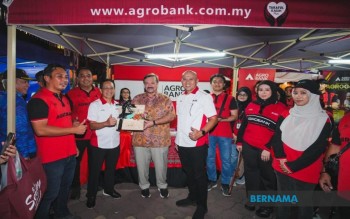
Agrobank's strategy of taking its services directly to the ground has yielded substantial traction, with financing applications totalling more than RM8 million collected through face-to-face engagement sessions held across multiple locations. The initiative reflects a deliberate pivot by the bank towards a more accessible, community-centred approach to lending that prioritises small business owners who traditionally navigate complex banking processes. This on-the-ground methodology appears to be paying dividends, indicating that traders and hawkers respond positively when financial institutions demonstrate a willingness to meet them where they operate rather than requiring them to enter formal banking halls.
The bank recently expanded its engagement drive to Sabah, conducting separate sessions at two strategically important commercial hubs: the Api-Api Night Market along Jalan Gaya in Kota Kinabalu and the Tamu Papar Farmers' Market. These venues were deliberately selected because of their significance as engines of grassroots economic activity, particularly in rural and semi-urban settings where formal financial services have historically been less accessible. The Api-Api session alone engaged 153 hawkers and entrepreneurs, while the Tamu Papar gathering brought together 95 traders, suggesting substantial community interest in exploring financing options that could unlock capital for working capital needs and business expansion.
This expansion represents a notable geographic diversification for Agrobank, bringing its initiative beyond the Klang Valley into East Malaysia for the first time. The move carries symbolic importance, demonstrating that developmental financial initiatives targeting small enterprises are not confined to peninsular Malaysia's urban centres. Borneo's trading communities, which operate under distinct economic conditions and market dynamics compared to their western counterparts, have long faced disproportionate challenges in accessing structured financing. By establishing a presence in both Sabah's night market and farmer markets, Agrobank is acknowledging that regional economic diversity requires tailored approaches to financial inclusion.
Finance Minister II Datuk Seri Amir Hamzah Azizan's attendance at one of the sessions underscores the government's commitment to this initiative, signalling that small business financing remains a priority within the current administration's economic agenda. The ministerial presence also sends a message to other financial institutions that ground-level outreach efforts to underserved communities align with broader national policy objectives. This bureaucratic-level endorsement can encourage other lenders to adopt similar community engagement models rather than relying solely on conventional branch-based operations.
Agrobank Group president and chief executive officer Datuk Tengku Ahmad Badli Shah Raja Hussin framed the Sabah expansion as essential to the bank's mission of democratising access to capital beyond major urban hubs. His commentary emphasised a crucial insight: different business communities across Malaysia operate under divergent circumstances, facing context-specific challenges that generic lending solutions cannot adequately address. A hawker operating a stall in Api-Api Night Market confronts operational realities fundamentally different from those facing a trader in the Klang Valley, whether regarding seasonal demand patterns, customer demographics, or supply chain structures. By establishing direct contact and dialogue, Agrobank positions itself to develop financing products that genuinely align with these on-ground realities rather than imposing standardised templates.
The initiative directly responds to Prime Minister Datuk Seri Anwar Ibrahim's directive requiring financial agencies to intensify outreach activities and accelerate disbursement of RM5 billion in dedicated small trader financing. This government mandate provides critical context: the current administration has identified small business access to capital as a binding constraint on economic activity, particularly for hawkers and micro-entrepreneurs operating outside formal corporate structures. By mobilising Agrobank to conduct these engagement sessions, the government is attempting to convert policy intention into operational reality, testing whether direct engagement can overcome informational asymmetries and trust deficits that sometimes discourage small traders from pursuing institutional financing.
The financing applications solicited during these sessions focus primarily on working capital requirements and business expansion ambitions, addressing two fundamental needs that small traders consistently identify. Working capital constraints—insufficient cash to purchase inventory, restock supplies, or manage seasonal fluctuations—frequently represent the binding constraint on trader operations, forcing many to rely on informal credit sources at punitive rates. By offering structured financing for working capital, Agrobank addresses what many perceive as the most immediate constraint on business growth. Similarly, financing for expansion enables traders to scale operations, whether through increasing inventory, extending operating hours, or diversifying product offerings.
The engagement approach also encompasses non-financial support mechanisms, with Agrobank offering financial advisory services alongside capital provision. For many small traders operating with minimal formal accounting or financial planning infrastructure, professional guidance on cash management, pricing strategies, and financial projections can prove transformative. This holistic approach—combining accessible capital with business advisory—recognises that capital alone is insufficient; traders require complementary support to deploy capital effectively and establish sustainable, growth-oriented business practices.
From a regional perspective, this initiative carries implications extending beyond Agrobank's immediate operations. The evident success in generating substantial financing applications suggests market demand for accessible, trader-friendly financing mechanisms throughout Southeast Asia. As regional economies increasingly rely on informal sectors and small-scale enterprises as employment engines and social stabilisers, financial institutions across the region face pressure to develop more inclusive lending methodologies. Malaysia's experiment with direct trader engagement could provide instructive lessons for counterpart institutions throughout Indonesia, Thailand, and the Philippines, where analogous populations of micro-entrepreneurs face comparable financing constraints.
The initiative also highlights broader questions about financial inclusion and regional equity. By consciously extending engagement beyond peninsular Malaysia to Sabah, Agrobank implicitly acknowledges historical disparities in developmental financial services provision between regions. East Malaysian traders have often reported difficulty accessing working capital financing relative to peninsular peers, contributing to persistent regional economic disparities. If the Sabah sessions generate sustained financing flows and facilitate measurable business expansion, this could incrementally improve regional balance in economic opportunity and demonstrate that thoughtful institutional design can help narrow geographical inequalities in financial access.
Looking forward, the scale of applications generated—over RM8 million to date—suggests the model possesses genuine traction and scalability potential. Should subsequent disbursements of approved financing translate into observable business growth and trader success stories, these outcomes could justify expanded versions of the engagement initiative across additional locations throughout Malaysia. The fundamental insight animating this approach—that many capable, creditworthy traders lack access to capital primarily because of accessibility barriers rather than genuine credit risk—appears validated by the responsiveness demonstrated to date.

