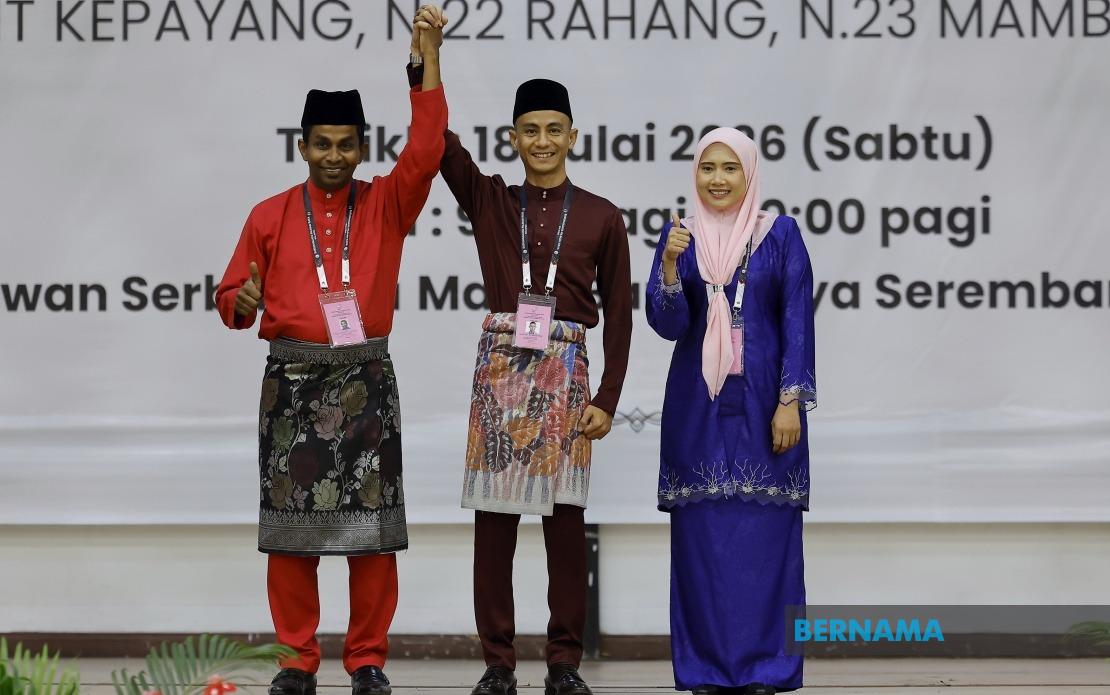
Datuk Ahmad Faez Abdul Razak of PKR is making his electoral debut in what many observers regard as a pivotal contest for Pakatan Harapan's ambitions in Negeri Sembilan. Standing as the coalition's candidate for the Labu state seat in the imminent 16th state election, Ahmad Faez has framed his candidacy as an opportunity to return the constituency to PH control while navigating the complex demands of a rapidly transforming district. His entry into the political arena represents a generational shift in how the opposition seeks to recapture ground it previously held, with an emphasis on professional credentials and ground-level engagement rather than purely partisan appeals.
Speaking after the nomination process in Seremban, Ahmad Faez acknowledged the psychological weight of contesting his first election, describing himself as experiencing simultaneous enthusiasm and apprehension. Yet this candour about his nervousness appears calculated to humanise his candidacy while emphasising his commitment to the constituency. He has spent nearly three years building relationships with residents, a period he credits with generating measurable shifts in public sentiment toward PH's prospects in Labu. This extended groundwork distinguishes his approach from conventional campaign strategies, suggesting a long-term perspective on constituency building rather than episodic electoral engagement.
The timing of Ahmad Faez's candidacy coincides with what political analysts view as growing momentum for the ruling state administration. He has attributed strengthened public confidence partly to the synchronisation between state government initiatives and federal policy priorities, implying that voters increasingly perceive institutional coherence rather than friction between Kuala Lumpur and Seremban. This framing attempts to neutralise one traditional vulnerability for incumbent governments—the narrative of policy misalignment—by presenting integrated governance as evidence of effective stewardship.
As a property developer, Ahmad Faez positions his professional background as a distinctive asset in a constituency experiencing transformative growth. Labu's development trajectory positions it among Negeri Sembilan's fastest-evolving constituencies, a distinction that brings both opportunity and tension. He frames his expertise not as an endorsement of unfettered development but rather as a technical capability to mediate between growth imperatives and community stability. This distinction matters considerably, as it allows him to appeal to both pro-development voters seeking employment and prosperity alongside community-oriented voters concerned about preservation of local character.
Central to Ahmad Faez's manifesto is the establishment of dedicated youth infrastructure—a community centre and recreational facility designed to address an acknowledged gap in services. This proposal resonates with particular demographic segments within the electorate and reflects broader national concerns about youth engagement and amenity provision in developing areas. By identifying this specific shortfall early in his campaign, he demonstrates both policy specificity and apparent attentiveness to constituency needs, contrasting with vaguer pledges that characterise many electoral contests.
The Malaysia Vision Valley development corridor, encompassing between 11,000 and 12,000 hectares of Labu territory, represents both the constituency's economic potential and its governance challenge. This massive industrial and residential project promises substantial employment generation and economic transformation, yet Ahmad Faez's emphasis on "careful management" of such development acknowledges legitimate community anxieties about infrastructure strain, environmental impact, and social displacement. His positioning suggests awareness that rapid development without corresponding civic planning generates political backlash—a lesson evident across fast-growing Southeast Asian constituencies where infrastructure deficits and demographic shock have undermined incumbent support.
The electoral mathematics in Labu present a complex landscape requiring careful analysis. The 2023 state election saw incumbent Mohamad Hanifah Abu Baker of Bersatu-Barisan Nasional secure victory with a narrow majority of merely 1,640 votes, defeating PH-PKR's Datuk Ismail Ahmad, who garnered 10,021 votes. This razor-thin margin suggests substantial voter volatility and a constituency where electoral outcomes remain genuinely competitive. The current three-cornered contest introduces further unpredictability, as the presence of BN candidate Siti Nur Umaira Hasim creates potential for vote fragmentation that could benefit either major challenger depending on how strategic voting unfolds.
With 32,884 registered voters as of the most recent electoral roll update in May 2026, Labu represents a medium-sized constituency where individual constituency work and personal networks retain considerable salience. The electorate comprises 32,869 ordinary voters and 15 police personnel and dependents, demonstrating the constituency's relatively limited military-security workforce presence. This profile suggests that Ahmad Faez's emphasis on community engagement and visible presence in local spaces carries particular weight, as voters in constituencies of this size often prioritise personal familiarity with candidates and demonstrated commitment to local issues.
The electoral calendar structures Ahmad Faez's campaign strategy, with early voting scheduled for July 28 and polling day set for August 1. This compressed timeframe requires intensive mobilisation, yet also concentrates voter attention during a defined period. For PH, the urgency of recapturing Labu and similar constituencies remains strategically significant, as the 16th Negeri Sembilan election provides an opportunity to test coalition cohesion and refresh its state representation prior to what analysts anticipate will be a consequential national electoral cycle.
Ahmad Faez's framing of his candidacy emphasises reconciling seemingly contradictory imperatives—fostering development while protecting community interests, pursuing modernisation while respecting local identity. Whether this balance-seeking orientation resonates with voters or appears evasive remains to be determined. His approach contrasts with more ideological positioning by some political contenders, instead appealing to technocratic competence and pragmatic problem-solving. Should he succeed, his victory would suggest that Malaysian voters in developing constituencies reward candidates offering concrete local solutions alongside affiliation with larger political movements.

