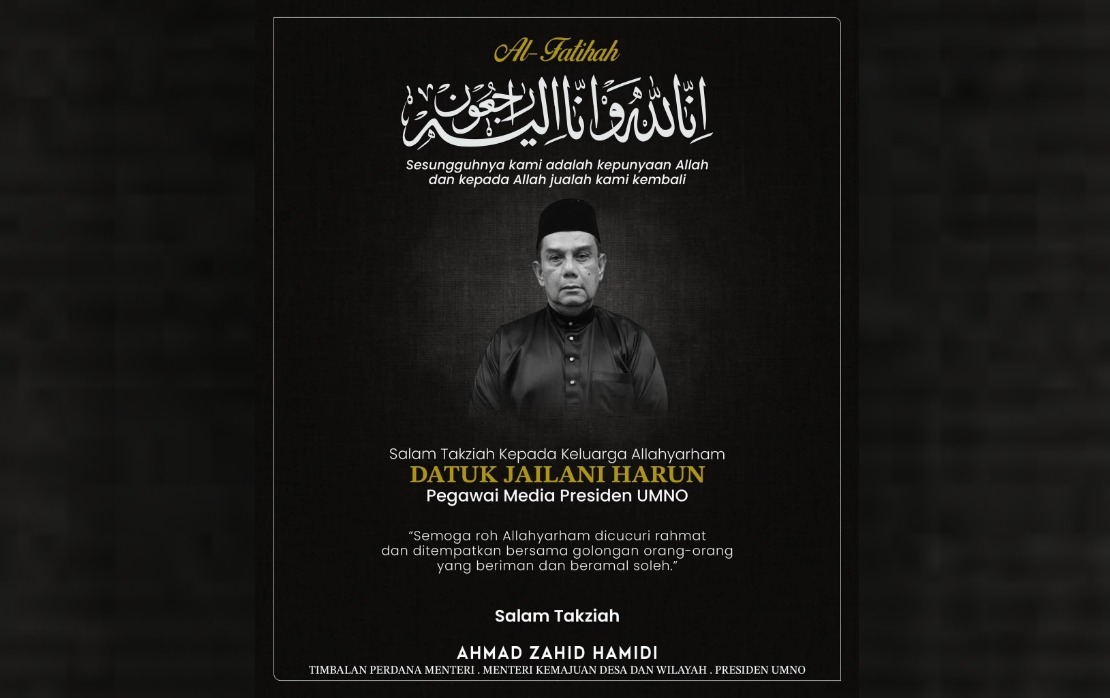
Deputy Prime Minister Datuk Seri Dr Ahmad Zahid Hamidi has offered his deepest condolences following the passing of Datuk Jailani Harun, a long-serving journalist and media officer at the UMNO President's Office. The 66-year-old died on July 7 at Serdang Hospital after a period of illness, marking the loss of a figure who had dedicated much of his career to serving the party and the broader Malaysian media landscape.
In his public statement, Ahmad Zahid, who also holds the position of UMNO president, reflected on a personal visit he had made to Jailani at Serdang Hospital earlier that morning. The Deputy Prime Minister described the encounter as emotionally challenging, noting that he had travelled to the hospital in hopes that circumstances might improve. His account painted a portrait of concern for a colleague whose contributions to the party and media had earned him respect across political and professional circles.
Ahmad Zahid characterised Jailani as an individual distinguished by kindness, humility, and widespread regard within the community. These qualities, the Deputy PM suggested, had defined Jailani's approach to his work as a media professional and his interactions with those around him. Such recognition from a senior political figure underscores the personal relationships that often develop within Malaysia's long-established institutions, where decades of service create bonds that transcend ordinary professional associations.
The funeral arrangements reflect the traditional practices observed within UMNO circles and the broader Malaysian Muslim community. Jailani's burial was scheduled to take place at the Alam Damai Muslim cemetery in Cheras following asar prayers on the day of his death. These ceremonies, conducted with the dignity afforded to individuals of standing, typically draw attendance from party members, media colleagues, and members of the wider community who wish to pay their final respects.
Jailani's career as a journalist preceded his role within UMNO's communications apparatus, positioning him as someone who understood both the dynamics of newsrooms and the mechanics of political messaging. This dual experience would have made him a valuable advisor and coordinator during his tenure as a media officer at the President's Office. In Malaysia's political environment, where media relations and message management remain critical functions, individuals like Jailani who bridged these worlds have historically played quietly consequential roles.
The passing of media professionals of Jailani's generation marks a transition point within Malaysian political institutions. As figures who entered their careers during earlier eras of the country's development navigate their final years, they represent repositories of institutional memory and experience. The loss of such individuals sometimes prompts reflection within organisations about succession planning and the transmission of knowledge to newer cohorts of staff and advisors.
Ahmad Zahid's public expression of grief, articulated through social media and formal statements, illustrates how Malaysian political leaders acknowledge losses within their immediate circles. The invocation of religious faith in his condolences—including prayers for forgiveness and divine mercy—reflects the Islamic framework that shapes much of Malaysia's political discourse and personal expressions during moments of mourning. Such statements serve both as genuine expressions of sorrow and as cultural reinforcement of shared values within the political community.
The timing of Jailani's death and the circumstances of his final hospitalisation, while not extensively detailed in public statements, nonetheless became a moment for colleagues to pause and acknowledge the fragility of life and the importance of the bonds forged through shared professional endeavour. Within tightly-knit political organisations like UMNO, which has maintained continuity across multiple decades, the departure of long-serving members carries particular weight.
Jailani's legacy within UMNO and Malaysian journalism reflects a generation of professionals who navigated the country's media landscape across transformative periods. His contributions to party communications and his reputation for integrity and humility serve as testament to the role that technical professionals play in supporting Malaysia's political institutions. While his passing removes one more link to earlier chapters of the party's history, the respect expressed by current leadership suggests his contributions will be remembered within institutional memory.

