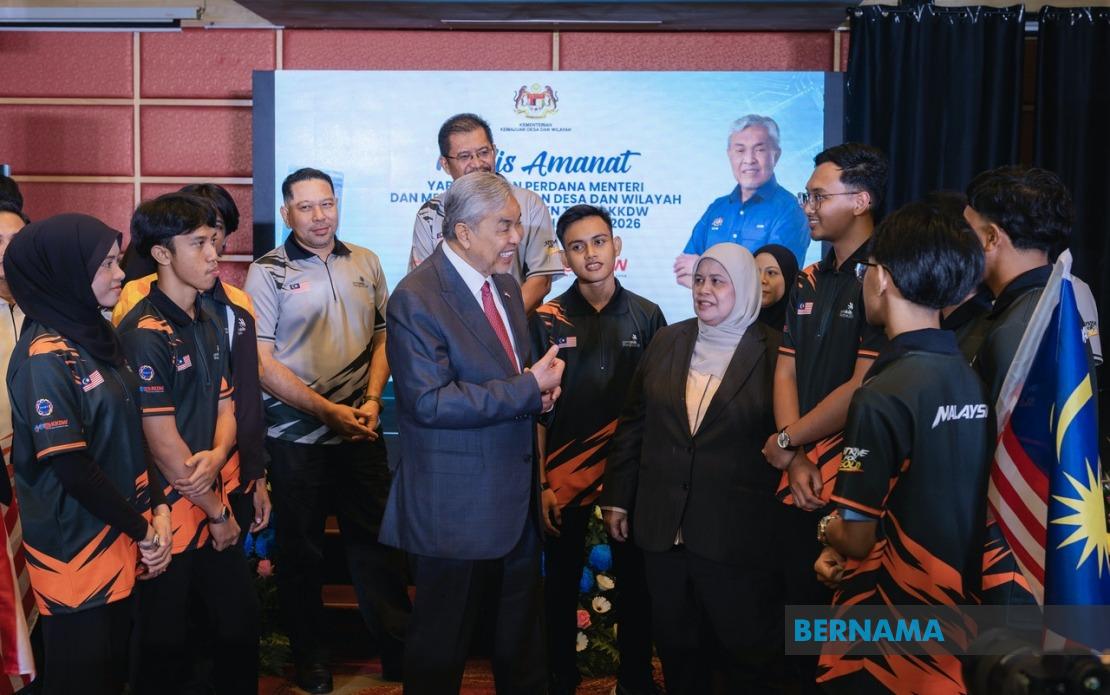
Deputy Prime Minister Datuk Seri Dr Ahmad Zahid Hamidi has made a significant personal pledge to reward excellence in vocational training, committing his own funds to sponsor umrah pilgrimages for gold medalists competing at the WorldSkills Competition 2026 in Shanghai, China, scheduled for September 22 to 27. The initiative targets participants from Technical and Vocational Education and Training (TVET) institutions operating under the Ministry of Rural and Regional Development, underscoring the government's emphasis on recognising and rewarding vocational achievement at the international level.
Ahmad Zahid, who serves concurrently as Rural and Regional Development Minister, framed the sponsorship as a token of appreciation for participants who excel on the global skills stage. His commitment extends beyond the individual competitors, encompassing family participation in the religious journey—a gesture that reflects the interconnected nature of achievement within Malaysian society. The pledge was articulated during his address to the TVET@KKDW contingent assembled for the competition, where he outlined the scope of his personal investment in recognising medal-winning performances.
The specific terms of the pledge are comprehensive. Ahmad Zahid stated unequivocally that gold medalists would receive fully funded umrah sponsorships, and that parental participation in the pilgrimage would also be covered by his personal resources. Should the entire Malaysian delegation achieve gold standard results—a best-case scenario involving all nine participants—Ahmad Zahid indicated his willingness to sponsor the complete contingent of eighteen individuals, comprising the nine competitors and their nine parents, for umrah pilgrimages.
Malaysia's representation at WorldSkills Shanghai 2026 comprises a carefully selected cohort of nine competitors, each specializing in distinct technical and vocational disciplines. The delegation spans multiple sectors critical to the nation's economic development and infrastructure modernisation. Nadratulliyana Ab Malek will compete in Fashion Technology, representing the creative and design industries, while Haziq Syahmi Nazri enters the Automobile Painting category, reflecting Malaysia's automotive manufacturing heritage. Amirul Sharif Sharifudin's participation in Electronics addresses the technology sector's demand for skilled practitioners.
The contingent also includes participants in emerging fields reflecting broader economic shifts. Mohammad Ezaly Iman Ramli competes in Cyber Security, addressing the digital economy's critical infrastructure protection needs. Wan Hamiz Ozai Wan Hamidzi represents Rail Vehicle Technology, aligning with Southeast Asia's expansion of modern rail transport networks. This diversity in skill categories demonstrates Malaysia's commitment to developing expertise across traditional manufacturing, emerging technologies, and infrastructure development.
Further representation comes from specialists in trades essential to Malaysia's construction and development sectors. Khairul Idham Bahari enters the Cabinetmaking competition, preserving traditional craftsmanship skills within modern vocational frameworks. Muhamad Nashrul Zulkifli competes in Digital Construction, bridging conventional building practices with contemporary digital design and execution methodologies. Muhammad Haziq Lailla Zamri's entry in Electrical Installations addresses the critical need for properly trained electrical professionals.
The delegation rounds out with Muhammad Huzairy Mohamad Thes, competing in Mechanical Engineering CAD, a discipline fundamental to Malaysia's manufacturing and industrial sectors. This breadth of representation positions Malaysia to showcase technical competency across multiple domains that directly impact economic productivity and professional workforce quality. WorldSkills platforms provide international benchmarking opportunities where national standards can be measured against global excellence.
The WorldSkills Competition itself represents one of the world's premier vocational skills showcases, drawing competitors from numerous nations to demonstrate proficiency in their respective technical disciplines. Success at this level carries significant implications for individual career trajectories and national reputation regarding vocational education quality. Ahmad Zahid's personal sponsorship initiative signals governmental recognition of the competition's importance as a platform for advancing Malaysia's international standing in technical and vocational excellence.
The pledge also reflects broader policy considerations within Malaysia's TVET sector. As the nation seeks to position itself as a hub for skilled technical professionals in Southeast Asia, initiatives that reward and celebrate vocational achievement become instrumental in attracting interest toward these career pathways. Many Malaysian students traditionally gravitated toward academic rather than vocational tracks; initiatives demonstrating societal esteem for technical excellence can shift perceptions and encourage broader participation in TVET programmes.
The involvement of Deputy Rural and Regional Development Minister Datuk Rubiah Wang at the contingent's briefing underscores institutional support for the initiative at ministerial levels. This multi-level governmental backing, from the Deputy Prime Minister through ministry leadership, sends consistent messaging about the administration's commitment to technical skill development and international competitiveness. The sponsorship pledge transforms individual achievement into a nationally celebrated milestone with tangible recognition.
For participants themselves, the prospect of umrah sponsorship adds meaningful dimension to their competitive motivation. Beyond medals and professional recognition, the promise of a religious pilgrimage to Islam's holiest sites creates deeper personal significance for Muslim competitors and their families. This integration of professional achievement with spiritual fulfilment reflects Malaysian society's values while acknowledging that success extends beyond technical metrics.
The WorldSkills 2026 Shanghai competition will provide Malaysia with international visibility regarding its vocational training standards and human resource capacity. Gold medal outcomes would validate Malaysia's TVET investment and demonstrate that the nation produces technically proficient professionals capable of competing at elite international levels. Conversely, strong performances, regardless of medal outcomes, would establish baseline comparisons for continuous TVET quality improvement. Ahmad Zahid's personal financial commitment reinforces that the stakes and significance of this international competition extend well beyond routine participation.

