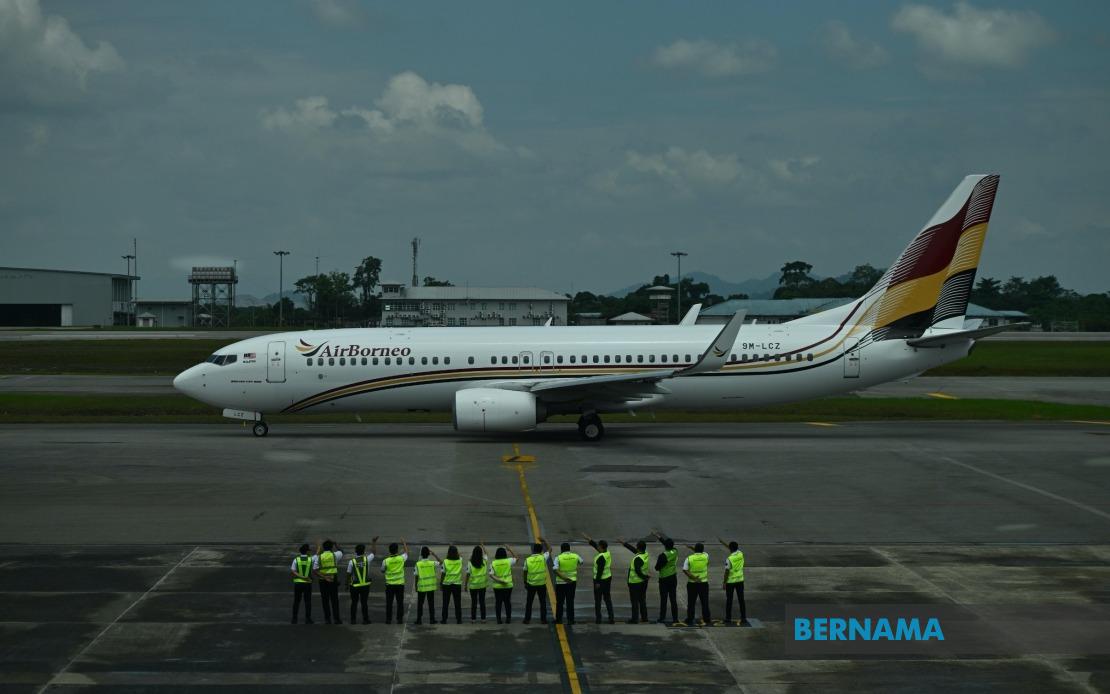
AirBorneo marked a significant milestone on July 20 when it commenced jet-powered operations, fundamentally transforming connectivity between Sarawak and the rest of Malaysia. The inaugural Boeing 737-800 service, flight MY5005, departed Kuching International Airport at 1.20 pm bound for Kuala Lumpur International Airport, carrying Sarawak Premier Tan Sri Abang Johari Tun Openg among its passengers. The flight represented more than a routine commercial launch; it symbolised the Sarawak government-owned carrier's strategic expansion into Peninsular Malaysia following its acquisition of MASwings Sdn Bhd's operations at the beginning of the year.
The timing of this expansion underscores Sarawak's deliberate effort to strengthen economic linkages beyond its traditional sphere. By assuming MASwings' route network and fleet assets on January 1, AirBorneo inherited an established operational foundation that permitted rapid scaling into jet operations. The shift from the smaller turboprop aircraft typically associated with regional carriers to the wide-body capability of the Boeing 737-800 reflects confidence in sustained demand for air travel connecting Borneo's capital with Malaysia's primary business and administrative hub. This transition also signals AirBorneo's positioning as a full-service carrier capable of competing on premium routes traditionally dominated by larger Malaysian operators.
At the launch ceremony, Abang Johari articulated a compelling strategic rationale for the investment in airline infrastructure. Drawing historical parallels to Japan's post-war reconstruction, the Premier emphasised that island economies require robust transportation networks to overcome geographic isolation and facilitate trade. Japan Airlines' foundational role in that nation's economic transformation served as his touchstone for understanding how aviation infrastructure catalyses broader industrial development. For Sarawak, where geographic separation from Peninsular Malaysia has historically constrained economic integration, reliable air connectivity represents a critical enabler for exporting goods and services into larger regional and global markets. The Premier's framing repositioned the airline not merely as a transportation operator but as a strategic asset supporting Sarawak's economic diversification objectives.
AirBorneo's service design reflects careful attention to market demand and pricing strategy. The carrier announced on July 7 that it would operate twice-daily services on the Kuching-KLIA route, acknowledging substantial passenger flows in both directions. Economy fares of RM375 for one-way tickets position the service competitively within the regional market while maintaining healthy margins necessary for sustainable operations. The Business Class offering at RM736 targets corporate travellers and frequent business professionals for whom schedule reliability and in-flight service quality command premium valuations. Both price points incorporate airport taxes and fuel surcharges, providing transparency to consumers evaluating their travel options against competing carriers on this route.
The route itself carries significant economic importance for Sarawak's development agenda. Kuala Lumpur serves as Malaysia's primary gateway for international commerce, home to critical government ministries, major corporate headquarters, and the country's largest financial institutions. For Sarawak-based entrepreneurs and professionals, regular access to the capital facilitates business development, government engagement, and participation in national economic policy discussions. Conversely, the route enables Malaysian companies operating in Peninsular Malaysia to establish or expand operations in Sarawak, supporting the state's efforts to attract foreign and domestic investment into manufacturing, energy, and resource-based industries. The frequency of twice-daily service accommodates day-trip commuting for urgent business purposes while enabling multi-day visits requiring overnight accommodation.
AirBorneo's expansion into jet operations reflects broader trends in Southeast Asian aviation dynamics. Regional carriers have increasingly invested in larger, more efficient aircraft to capture market share on trunk routes previously dominated by full-service network carriers. The operating economics of the Boeing 737-800 support this strategy; the aircraft's fuel efficiency, passenger capacity, and range optimise returns on moderate-distance routes where demand exists to support at least twice-daily frequencies. For AirBorneo, this acquisition supplements its existing turboprop network serving smaller regional airports across Sarawak and Sabah, creating a hierarchical route structure where larger cities benefit from jet service while smaller communities retain regional connectivity.
The MASwings acquisition mechanism deserves examination as a policy instrument. Rather than launching an entirely new carrier or attempting to force expansion through an existing operator, Sarawak's government engineered asset transfer that preserved existing route authorisations, frequent flyer loyalty, and operational relationships. This approach minimised disruption to travelling public while consolidating state control over aviation infrastructure. For stakeholders accustomed to MASwings' service standards, AirBorneo's assumption of those operations under a state ownership structure provides continuity, though the carrier's enhanced financial capacity and equipment investments signal service improvements ahead. The transition also exemplifies how Malaysian state governments can leverage aviation policy to advance economic development without destabilising existing market structures.
Market implications extend beyond Sarawak's borders. The emergence of a credible competitor on the Kuching-KL route introduces competitive dynamics that may benefit consumers through improved service offerings or pricing pressure on incumbent carriers. Malaysia Airlines and AirAsia both operate on this route, and their responses to AirBorneo's entry will shape competitive outcomes. The twice-daily frequency suggests AirBorneo is not simply testing market viability but committing to sustained operations, signalling confidence in long-term demand sustainability. For passengers, increased service frequency and potential competitive pricing create tangible benefits through improved scheduling flexibility and cost competitiveness compared to previous monopolistic or duopolistic conditions on this essential route.
Looking forward, AirBorneo's jet operations launch establishes a foundation for further expansion into Peninsular Malaysia routes. Cities such as Johor Bahru, Penang, and Kuala Terengganu represent potential candidates for future service, particularly if demand studies support viability. The successful integration of jet operations with existing regional turboprop services positions AirBorneo as a multi-tier carrier capable of serving both major metropolitan markets and smaller regional communities. This network architecture mirrors successful Southeast Asian carriers that combine hub-and-spoke dynamics with point-to-point regional service, creating complementary operational efficiencies. For Sarawak's government, the airline increasingly represents a strategic asset capable of supporting state development objectives while operating on commercial principles.
The broader Southeast Asian context underscores why this development matters. Across the region, government-owned and government-backed carriers have reasserted strategic roles in national aviation markets, complementing market-driven operators by ensuring connectivity to less commercially attractive destinations while supporting development objectives. AirBorneo's evolution reflects this regional pattern, where policy-makers increasingly recognise aviation infrastructure as essential to economic competitiveness and regional integration. The airline's success in establishing credible jet operations may influence thinking in other Malaysian states or ASEAN neighbours considering similar aviation sector strategies. For Malaysia specifically, the emergence of regional carriers operating major routes challenges the dominance of established national carriers and distributes aviation sector development benefits across multiple entities and geographic communities.
The inaugural flight's symbolic significance cannot be overstated. Sarawak Premier Abang Johari's decision to board the maiden service personally demonstrated governmental commitment to the airline's success and confidence in its operational readiness. This public backing signals that AirBorneo enjoys political support necessary for long-term viability, including potential future capital injections or policy accommodations should operational challenges arise. For the broader Sarawak community, the airline represents tangible progress toward reducing geographic isolation and integrating more fully with Malaysian and regional economic structures. The July 20 inauguration thus constitutes not merely an operational milestone but a statement of intent regarding Sarawak's aviation future and its role in national economic development.

