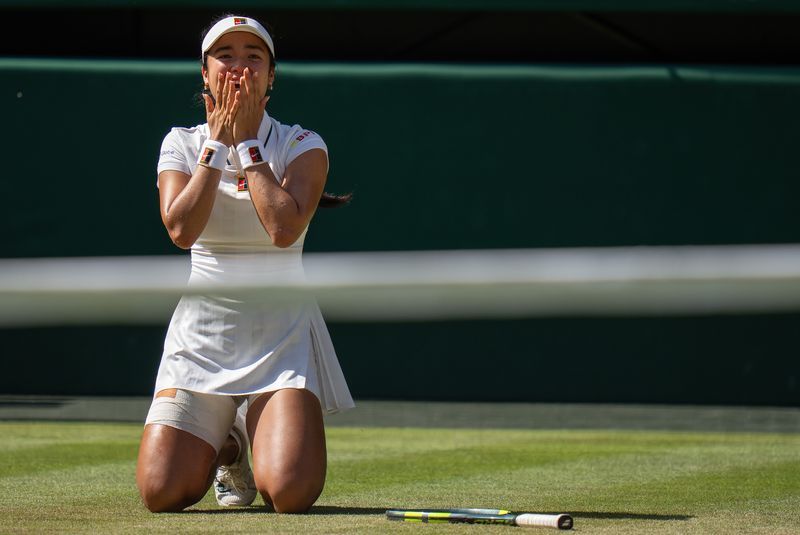
Alexandra Eala's breakthrough at Wimbledon represents far more than a single match victory for the 21-year-old Filipino athlete. In defeating Poland's Iga Swiatek on Saturday, the world No. 29 seed has thrust herself into conversations about sports leadership in the Philippines and Southeast Asia, offering a vision of possibility for young athletes in a region where traditional sporting heroes remain few and far between.
The significance of Eala's run at the Championships extends beyond the grass courts of London. Her emergence on the professional tennis circuit has captivated audiences across Asia, with spectators packing into stadiums to witness her uncompromising style of play and her composed demeanour away from competition. This combination of on-court excellence and personal authenticity has created a compelling narrative that transcends the sport itself, positioning her as a potential generational icon in her home country.
In the Philippines, where boxer Manny Pacquiao has long dominated the landscape of sporting achievement and national pride, Eala's rise through the tennis ranks represents an opportunity for a new chapter in the country's athletic story. Unlike Pacquiao's singular dominance in boxing, Eala is competing at the highest levels of a global sport where opportunities for international success have traditionally been limited for Filipino athletes. Her presence on the world stage signals that pathways exist beyond conventional expectations, opening conceptual space for young Filipinos to aspire toward sports beyond those with established national infrastructure.
When discussing her remarkable ascent, Eala has been careful to articulate a specific vision of inspiration that avoids the pitfall of idol worship. Rather than positioning herself as a template for emulation, she has emphasised the importance of individual authenticity and personal discovery. In her post-match comments, Eala articulated a philosophy centred on genuine self-expression and values-driven decision-making, suggesting that young athletes should draw motivation from her example without seeking to replicate her exact trajectory.
This distinction carries profound implications for how emerging athletes approach their development. By encouraging others to discover their own path rather than follow hers, Eala is advocating for a model of sporting development that prizes originality and individual agency. Such an approach could fundamentally reshape how young Southeast Asians engage with athletic pursuits, encouraging them to view their circumstances and unique attributes as sources of strength rather than limitations.
Eala's emotional response to her victory over Swiatek—dropping to the ground in tears before composing herself for the next challenge—revealed the psychological complexity underlying her measured public persona. Yet she was notably cautious about interpreting her visible emotion as evidence of complacency. Instead, she framed her celebration as a necessary part of her mental preparation, suggesting that acknowledging significant achievements actually strengthens her capacity to refocus on subsequent objectives.
This psychological framework addresses a common challenge facing young athletes in high-pressure environments: the difficulty of balancing celebration with ambition. Eala's insistence that enjoying victories enhances rather than undermines future performance suggests a maturity beyond her years, and potentially offers a model for athlete wellness that acknowledges emotional authenticity rather than demanding suppression of feeling.
The 29th seed now faces 2024 Wimbledon runner-up Jasmine Paolini in the Round of 16, presenting an immediate test against an opponent who has already demonstrated her capacity to perform at the tournament's highest levels. This matchup carries significance not merely for Eala's tournament prospects, but for the broader narrative surrounding her development as a competitor capable of sustained excellence rather than occasional breakthrough performances.
Eala's approach to the transition between matches reveals a disciplined mindset that distinguishes emerging talent from established champions. She has described a capacity to acknowledge significant achievements while maintaining the psychological distance necessary for focused preparation, framing this as a learnable skill rather than an innate gift. This perspective democratises the mental aspects of elite sport, suggesting that subsequent generations can develop similar competencies through deliberate practice and reflection.
For Malaysia and other Southeast Asian nations, Eala's progress carries implications for how sports development might be approached. Her success emerged largely through individual determination and family support rather than the comprehensive infrastructure available to athletes in traditional tennis powerhouses. This trajectory suggests that pathways to international athletic achievement need not depend entirely on government investment in facilities and coaching, though such resources certainly accelerate progress.
The international attention surrounding Eala has created a platform that extends beyond tennis itself. Her deliberate choices about authenticity, her articulate communication with media, and her emphasis on individual agency have made her a compelling figure for audiences who follow sport as a window into human aspiration and character development. In doing so, she has established a template for how emerging athletes might leverage visibility not merely for personal advancement, but for broader cultural influence.
Eala's continuation through the tournament will test both her capacity for sustained excellence and the durability of the narrative momentum she has generated. However, regardless of her ultimate outcome at Wimbledon, her statement about inspiring others to forge their own paths has already transcended the sport. For young athletes across Southeast Asia encountering systemic limitations or unconventional circumstances, Eala's example demonstrates that distinctiveness can become a source of advantage rather than disadvantage, provided athletes maintain clarity about their values and commitment to their chosen pursuits.

