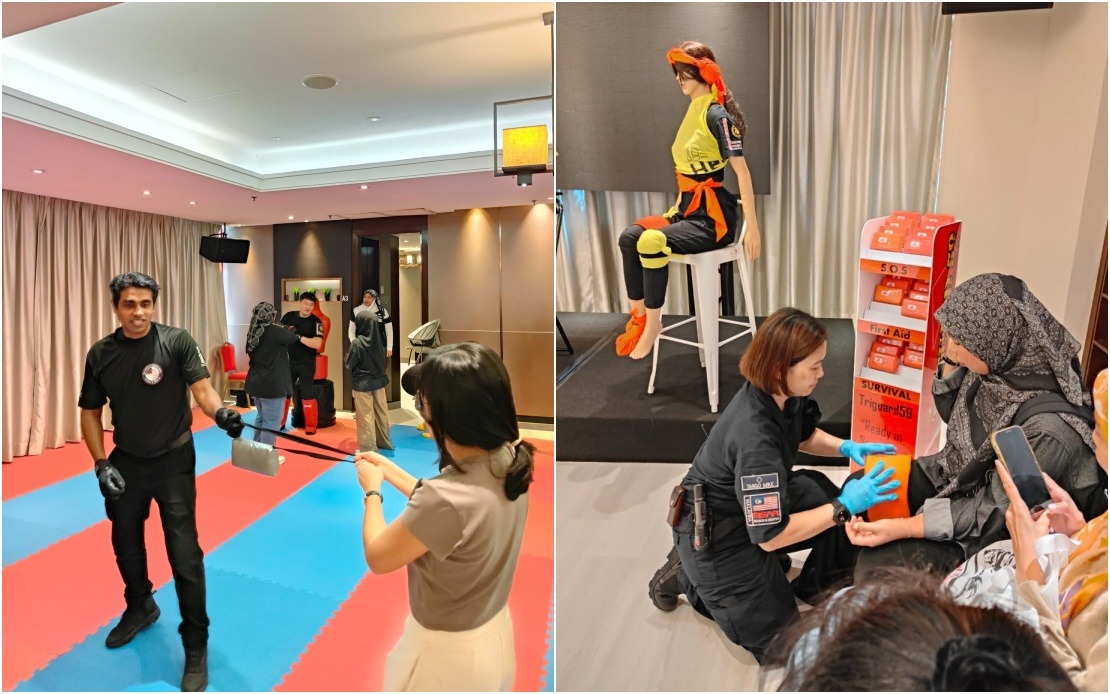
Allianz Malaysia Berhad has deepened its commitment to community safety by partnering with Kelab Marshal Keselamatan Jalan Raya Kuala Lumpur (RSMC) to deliver the ninth iteration of its Women's Street Crime Awareness Campaign, an initiative reflecting growing corporate investment in grassroots crime prevention across Malaysia. The campaign, held at Wisma Huazong YTL Hall in Seri Kembangan, Selangor, brought together 200 women aged 16 and above for a programme designed to translate theoretical knowledge about personal safety into practical skills that participants can deploy in their daily lives.
The session structure departed from traditional awareness-only formats by combining educational presentations with hands-on demonstrations and interactive dialogue with safety experts. Women participants engaged with content addressing home security vulnerabilities, techniques used in handbag snatching incidents, strategies fraudsters employ in road-related scams, stalking behaviour recognition, carjacking prevention, appropriate responses to traffic accidents, basic self-defence movements, and structured emergency preparedness planning. This multi-topic approach acknowledges that street crime affecting women in Malaysia spans diverse scenarios requiring different defensive knowledge and situational awareness.
A notable innovation in this year's campaign was the introduction of a dedicated awareness and dialogue session that allowed participants to move beyond passive learning. Rather than simply absorbing information from presenters, attendees could raise personal concerns and seek tailored guidance from RSMC experts based on their own neighbourhoods and circumstances. This interactive element transforms the campaign from a one-directional knowledge transfer into a collaborative problem-solving space where community members become active participants in identifying and addressing safety challenges specific to their environments.
The ripple effects of the campaign extend significantly beyond the 200 women who attended. Allianz Malaysia chief executive officer Sean Wang highlighted that community leaders demonstrated substantial interest in replicating the initiative within their respective neighbourhoods and residential areas. This organic demand indicates that the campaign has resonated sufficiently with local stakeholders to generate momentum for decentralised implementation, potentially multiplying its reach across Selangor and beyond without requiring equivalent resource investment from the organisers.
Wang's emphasis on measuring success not merely through headcount but through the propagation of safety knowledge beyond the event venue reflects a sophisticated understanding of how community awareness campaigns generate sustainable impact. When participants become advocates within their own social networks—discussing street crime risks with family members, sharing self-defence tips with colleagues, or introducing safety protocols within their residential compounds—the campaign's influence extends exponentially. This multiplication effect transforms a single event involving 200 people into a potential community-wide movement.
RSMC founder and president Captain K. Balasupramaniam framed the campaign's purpose as empowerment rather than fear-mongering. His statement that street crime awareness should equip individuals with knowledge, skills and confidence to make informed decisions when confronted with uncertainty distinguishes this initiative from campaigns that emphasise threat narratives without offering corresponding agency. Women who leave the programme with practical takeaways—whether specific self-defence techniques, recognition of common scam patterns, or emergency response protocols—possess tangible tools rather than merely heightened anxiety.
The campaign's focus on women reflects demographic and socioeconomic realities in Malaysia where women report distinct vulnerability patterns in street crime statistics. Handbag snatching, sexual harassment, carjacking and home invasion represent persistent concerns that disproportionately affect female safety perception and mobility patterns. By designing a programme specifically for women, Allianz Malaysia and RSMC acknowledge that generic safety advice often fails to address contextualised risks that shape women's daily experiences navigating public and semi-public spaces.
The corporate social responsibility dimension of Allianz Malaysia's involvement signals how insurance companies increasingly position community safety as aligned with their business interests. A population equipped with crime prevention knowledge and emergency preparedness skills generates fewer claims, experiences better health outcomes, and demonstrates higher confidence in community institutions. Insurance companies funding such initiatives thus invest in loss prevention while simultaneously building brand reputation and community goodwill—a convergence of profit motive and public benefit that characterises modern CSR strategy in Malaysia.
The programme's emphasis on accident response and road-related scams reflects RSMC's foundational mission around traffic safety. Rather than treating road incidents as isolated events, the campaign situates them within a broader safety continuum where women must navigate both street crime threats and vehicle-related hazards. This holistic approach acknowledges that a woman walking to her car faces potential mugging, faces risks while driving, and encounters distinct vulnerabilities in parking environments—requiring integrated safety literacy across multiple scenarios.
Participant enthusiasm and community leader interest recorded at the event underscore sustained demand for such initiatives across Malaysia's urban centres. As Selangor experiences continued population growth and urbanisation, safety concerns typically intensify without corresponding increases in police resources or formal community policing capacity. Corporate-civil society partnerships filling this gap provide scalable alternatives to government-only approaches, distributing responsibility for community safety across multiple sectors and institutions.
The ninth iteration of this campaign indicates institutionalisation of the partnership between Allianz Malaysia and RSMC, suggesting confidence from both organisations in the programme's effectiveness and relevance. Repeat engagement at this scale distinguishes the initiative from one-off corporate events, establishing it as a fixture in Malaysia's community safety landscape. The stated objective of translating awareness into action—converting knowledge participants absorb into behavioural changes they implement—remains the campaign's most challenging and consequential metric, one that future iterations will need to assess through follow-up evaluation with participants.

