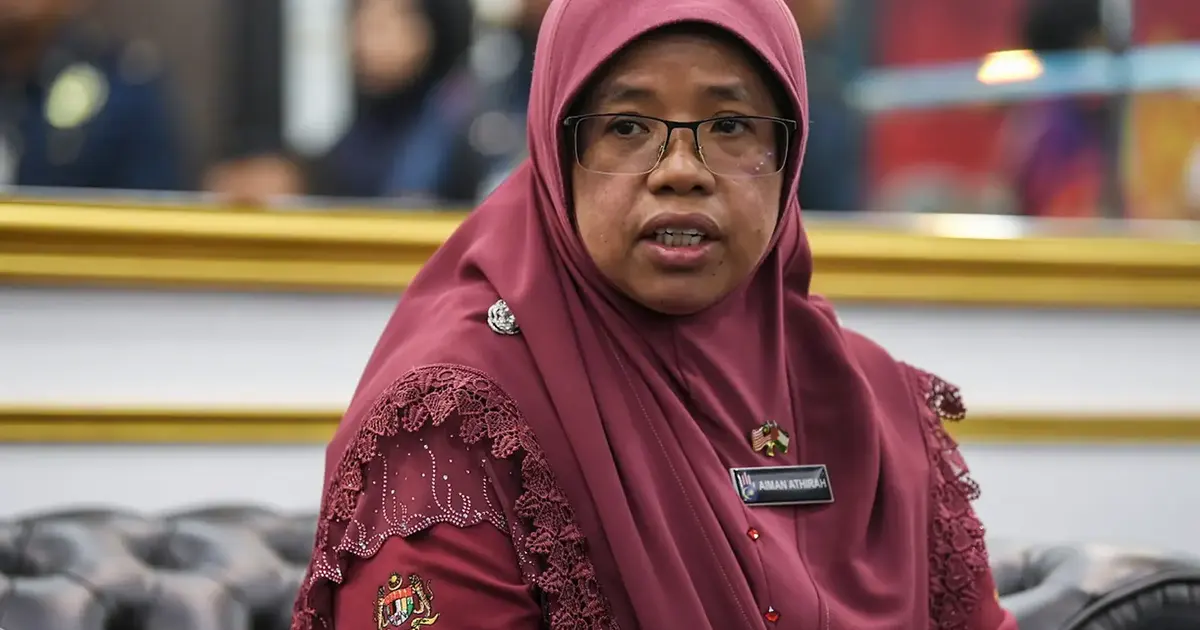
Amanah deputy president Aiman Athirah Sabu has escalated tensions within Malaysia's opposition coalition by directly confronting PAS president Hadi Awang over inflammatory rhetoric regarding the Democratic Action Party. The challenge issued by Aiman Athirah represents a significant moment in the fraught relationship between Pakatan Harapan's Islamic-focused component and its more secular-leaning members, signalling growing frustration with what opposition parties view as baseless allegations that undermine coalition cohesion.
The controversy centres on Hadi's repeated characterisations of DAP as an entity fundamentally opposed to Islam and Islamic principles. Rather than responding through backdoor negotiations or accepting such accusations as standard political theatre, Amanah has taken the unusual step of publicly demanding accountability, effectively calling the PAS leader's bluff by asking him to either produce verifiable evidence substantiating these claims or file legal challenges if he genuinely believes they constitute actionable wrongs. This confrontational approach marks a departure from the typically muted responses opposition parties have historically offered to accusations from their rivals.
The timing of Aiman Athirah's intervention reflects broader anxieties within Pakatan Harapan regarding the sustainability of its political alliance. DAP's presence within the coalition has long been a lightning rod for criticism from conservative Islamic parties and Malay-majority voter segments, with opponents consistently framing the party as hostile to Islam despite DAP's repeated assertions that it advocates for secular governance rather than anti-Islamic positions. Amanah, which positioned itself as a moderate Islamic alternative when it split from PAS in 2015, finds itself navigating the delicate terrain of defending coalition partners while maintaining credibility with its own base of religiously-conscious voters.
PAS, under Hadi's leadership, has made deliberate political calculations in recent years that emphasise ideological distance from DAP and other secular-oriented parties. The party's decision to shift its electoral strategy and accept posts in the Perikatan Nasional federal government alongside Umno demonstrated a willingness to prioritise participation in government over coalition loyalty. This strategic repositioning has given PAS increased political leverage and allowed it to position itself as the guardian of Islamic interests against what it portrays as secularising forces within Malaysian politics.
The DAP, for its part, represents Malaysia's primary non-Malay and non-Muslim political representative body, drawing its support predominantly from Chinese and Indian communities. While the party's secular governance framework is fundamentally distinct from Islamic-centred politics, DAP has consistently argued that its non-religious approach to policy does not constitute opposition to Islam itself. The party has supported various Islamic causes and accommodated religious sensibilities in areas where federal law permits state-level Islamic governance, though this nuanced position often struggles against simplified political messaging that conflates secularism with anti-Islam sentiment.
Aiman Athirah's challenge strikes at a fundamental weakness in PAS's rhetorical strategy. By demanding evidence or legal action, Amanah essentially forces the conversation from abstract ideological positioning into concrete factual claims. Should Hadi attempt to provide specific instances, he risks engaging in a detailed substantive debate where the distinctions between secular governance and opposition to Islam become difficult to maintain. Conversely, retreating from the allegations would undermine the party's carefully cultivated image as Islam's defender and might be interpreted as capitulation to coalition pressure.
The broader implications for Malaysian politics warrant close attention. The health of Pakatan Harapan as a governing alternative depends partly on whether its component parties can maintain sufficient cohesion to present voters with a credible policy platform. Unresolved tensions between Islamic and secular components create vulnerabilities that opposing coalitions can exploit, particularly in campaigns directed at Malay-Muslim voters who may view internal coalition disputes as evidence of fundamental incompatibility. The 2024 political landscape has already seen PAS's strategic repositioning influence election outcomes and parliamentary arithmetic.
Amanah's intervention also reflects its own political positioning challenge. As a self-identified Islamic party aligned with Pakatan, Amanah must regularly demonstrate that Islamic values and secular governance are not mutually exclusive. By defending DAP against what the party views as unfair characterisations, Amanah risks alienating conservative supporters who may view such defence as insufficient commitment to Islamic causes. Yet failing to challenge PAS would tacitly accept divisions that damage opposition cohesion and weaken Pakatan's collective bargaining position.
The historical context matters considerably. Amanah's emergence as a splinter from PAS was specifically motivated by disagreements over the party's increasingly rigid ideological stance and its willingness to abandon principles for political convenience. The current challenge to Hadi thus carries additional symbolic weight, potentially reopening questions about which party more authentically represents Islamic values combined with democratic governance. Amanah's assertion that substantiated claims or legal recourse should back serious accusations implicitly critiques PAS for relying on inflammatory rhetoric rather than documented evidence.
For Malaysian voters and observers monitoring opposition dynamics, Aiman Athirah's statement indicates that internal coalition disagreements are becoming increasingly difficult to manage through quiet diplomacy. The public nature of this challenge suggests either a breakdown in behind-the-scenes mediation efforts or a calculated decision by Amanah to demonstrate strength and principle to its own constituency. Either interpretation suggests deepening fissures that may influence the coalition's electoral prospects and governing capacity should it return to power.

