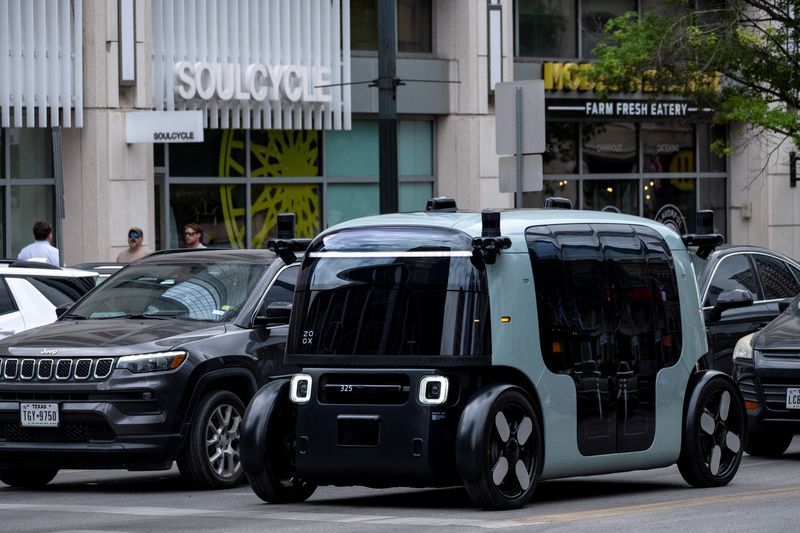
Amazon's autonomous vehicle subsidiary Zoox is launching paid robotaxi rides in Las Vegas starting Monday, capitalizing on a landmark regulatory green light that makes it the first fully autonomous ride-hailing operator to receive clearance for commercial deployment without human safety drivers. The company's decision to monetize its services marks a significant inflection point in the race to commercialize autonomous transportation, a sector that has long promised revolutionary changes to urban mobility while facing persistent safety and regulatory hurdles.
Zoox's entry into the paid market comes just days after the National Highway Traffic Safety Administration granted the company an exemption from federal safety standards that typically mandate human controls in vehicles. This regulatory breakthrough represents a watershed moment for the autonomous vehicle industry, distinguishing Zoox from competitors like Waymo and Tesla that have adapted conventional vehicles or operated under different regulatory frameworks. The NHTSA determination that Zoox's purpose-built electric carriage—featuring two rows of inward-facing seats and no steering wheel—meets safety equivalency standards reflects years of development and testing in real-world conditions across multiple cities.
The Las Vegas launch pricing strategy positions Zoox within the premium segment of ride-hailing services, with fares comparable to the "comfort" tier offered by conventional ride-hailing platforms. This tier typically commands 20 to 40 percent premiums over standard services, reflecting both the novelty of the autonomous experience and the vehicle's designed capacity for passenger comfort. Zoox's transparent pricing model, which calculates charges based on a base fare plus time and distance metrics along the optimal route, with airport and destination-specific fees disclosed upfront, attempts to address customer concerns about cost unpredictability that plague some autonomous services.
However, the NHTSA approval carries meaningful constraints that will shape Zoox's expansion trajectory. The exemption limits commercial deployment to 2,500 vehicles annually for each of the next two years, creating a controlled rollout that reflects regulatory caution despite the safety determination. This ceiling effectively prevents aggressive scaling and gives regulators time to monitor real-world performance and gather data on safety outcomes. The agency simultaneously imposed additional reporting requirements specifically addressing crashes, emergency responses, and inappropriate road stopping, signaling that approval does not mean unrestricted operation.
The competitive landscape surrounding Zoox's market entry reveals an industry at an inflection point. Waymo, owned by Alphabet and operating in multiple cities, has already established paid driverless services and accumulated significant operational data. Tesla has begun rolling out its autonomous ride-hailing service, leveraging its existing vehicle fleet and brand recognition. Zoox's entry introduces a competitor with purpose-built vehicles designed from the ground up for autonomous operation rather than adapted from conventional car designs, theoretically offering advantages in safety, efficiency, and passenger experience. This diversity in approaches—from retrofit retrofitting to purpose-built design—suggests the eventual autonomous ride market may accommodate multiple competing business models and vehicle architectures.
Zoox's decision not to disclose timing for paid service launches in other markets where it has conducted free testing—including San Francisco, Austin, and Miami—suggests a cautious expansion strategy. This measured approach contrasts with the aggressive scaling typical of technology startups and reflects both the regulatory environment's restrictive nature and the company's status as a subsidiary of Amazon, which can absorb ongoing operational losses while building long-term market position. The company's free-ride testing across multiple cities has provided crucial operational experience and allowed data collection on vehicle performance in diverse traffic and weather conditions.
Safety challenges continue to shadow the autonomous ride-hailing sector despite regulatory approvals. Zoox has issued multiple software recalls over the past two years, with July's recall particularly notable because it involved a robotaxi's failure to detect heavy smoke during an emergency scene. This incident illustrates the edge cases and complex scenario recognition that remain unresolved challenges for autonomous systems. Emergency response handling represents a critical gap in autonomous vehicle capabilities, as these situations demand human judgment, rapid decision-making, and coordination with first responders—functions that current artificial intelligence systems struggle to execute reliably.
For Malaysian and Southeast Asian observers, Zoox's Las Vegas milestone carries important implications for the regional transportation landscape. While autonomous ride-hailing has received less focus in Southeast Asian markets compared to the United States, the regulatory frameworks and safety outcomes emerging from North American deployments will inevitably influence how regional governments approach autonomous vehicle policy. Malaysia's own transportation modernization ambitions, including the development of autonomous capability through initiatives like the Automotive High-Tech Valley, will benchmark against international developments and regulatory precedents established in mature markets like the United States.
The pricing premium that Zoox commands through its "comfort" tier positioning raises questions about market segmentation that resonate across Southeast Asia, where ride-hailing penetration remains concentrated among cost-conscious consumers. If autonomous vehicles command lasting price premiums due to genuine safety and comfort advantages, they may initially serve affluent urban populations rather than the mass-market segments that currently drive ride-hailing growth in cities like Kuala Lumpur, Jakarta, and Bangkok. This could create a bifurcated transportation market where autonomous services cater to premium segments while human-driven services dominate mass transit.
Regulatory frameworks remain a critical variable determining whether autonomous ride-hailing proliferates across multiple jurisdictions or remains confined to pioneering markets like California and Nevada. The NHTSA's conditional approval approach—granting permission while imposing performance monitoring and reporting requirements—offers a template for thoughtful regulation that other countries, including those in Southeast Asia, may adopt. This measured regulatory approach balances innovation incentives against public safety imperatives, avoiding both blanket prohibition and unrestricted deployment. The three-year window created by the exemption's 2,500-vehicle-per-year cap provides time for safety data accumulation that could inform more confident regulatory decisions at larger scales.
Zoox's technical architecture choices, particularly its purpose-built vehicle design with inward-facing seats, also merit consideration for how autonomous ride-hailing services might eventually be tailored to regional contexts. The vehicle's physical form reflects design thinking about what autonomous ride-hailing passengers actually need—comfort, safety, and efficient routing—rather than adapting conventional car designs. Southeast Asian automotive manufacturers watching these developments may eventually develop locally-designed autonomous platforms optimized for regional traffic conditions, road infrastructure, and customer preferences, rather than importing purpose-built vehicles from North American suppliers.
The financial sustainability question surrounding Zoox remains unresolved and critical to the autonomous ride-hailing industry's future. Amazon's ability to fund Zoox's operations despite ongoing losses provides competitive advantage against other autonomous operators lacking equally deep corporate backing. This financial dimension will likely determine which competitors survive to maturity, particularly if regulatory constraints on vehicle deployment limit near-term scaling. The Las Vegas paid service launch represents both a milestone victory and the beginning of a lengthy profitability challenge that will test whether autonomous ride-hailing can achieve unit economics superior to human-driven alternatives, or whether it remains perpetually dependent on venture capital or corporate subsidies for viability.

