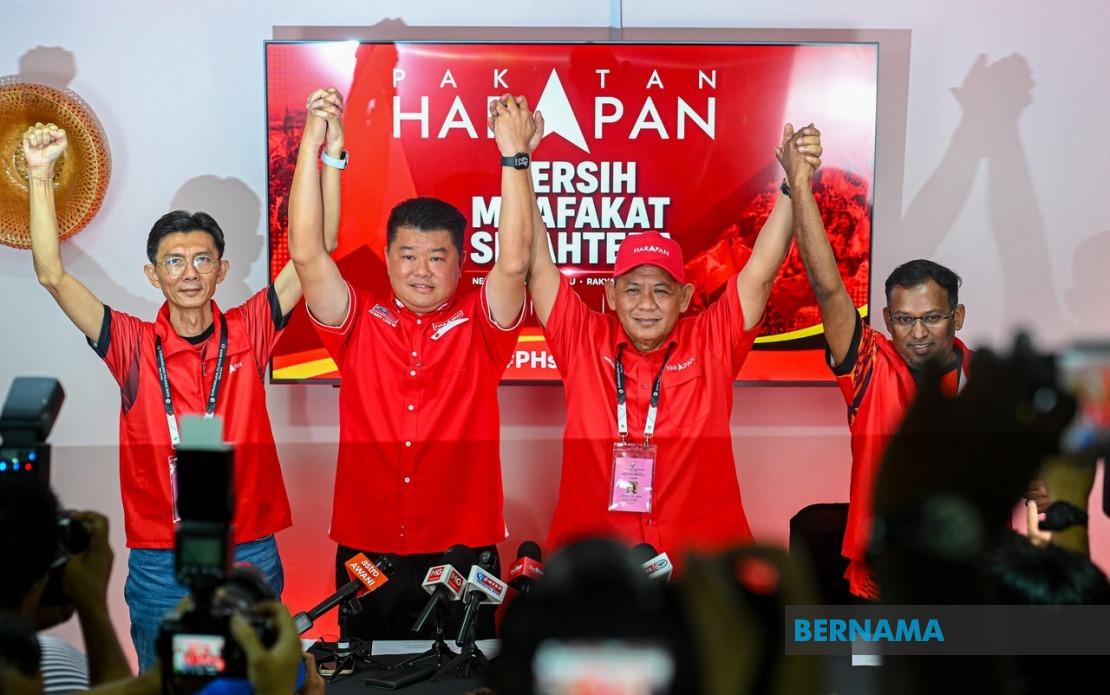
Negeri Sembilan's Pakatan Harapan machinery is presenting a united front as the state election approaches, with coalition leaders rejecting claims that internal tensions are destabilising the organisation in constituencies surrounding Port Dickson. Datuk Seri Aminuddin Harun, who holds the position of menteri besar and also leads both the state PH chapter and PKR's state branch, made the clarification in remarks to journalists in Port Dickson on July 20, stating that speculation about divisions had been deliberately amplified to undermine public confidence in the coalition.
The controversy centred on the re-nomination of Chuah incumbent Datuk Yew Boon Lye, a decision that generated discussion on social media platforms and appeared to involve Port Dickson PKR deputy division chief Datuk Kenny Chiew Chi Kin. Rather than allowing such matters to fester, Aminuddin indicated that leadership had handled the situation through internal dialogue, resulting in a resolution satisfactory to all parties. This approach signals an attempt by PH to prevent routine candidate selection processes—which naturally disappoint some aspirants—from becoming weaponised against the coalition during what is traditionally a sensitive campaign period.
Chiew's position within the organisational hierarchy made his response particularly significant. As deputy division chief, his backing would carry weight among grassroots members in Port Dickson, and his public commitment to support all five PH candidates contesting across Chuah, Lukut, Sri Tanjung, Bagan Pinang and Linggi demonstrates an effort to preserve party cohesion. Aminuddin characterised Chiew's stance as reflecting maturity and party discipline, emphasising that disappointment over candidacy decisions need not translate into reduced campaign effort. The menteri besar explicitly acknowledged Chiew's contributions to party-building work, framing the episode as a test of loyalty that had ultimately strengthened rather than fractured the coalition.
The timing of these remarks is strategically important given the compressed election schedule. With early voting scheduled for July 28 and polling day set for August 1, PH cannot afford the energy drain that would accompany public perceptions of internal discord. In Malaysian electoral contests, particularly at state level, the perception of unity often matters as much as actual organisational strength, influencing both volunteer mobilisation and swing voter calculations. Aminuddin's willingness to address the issue head-on, rather than allowing speculation to circulate unchecked, suggests the coalition recognises the vulnerability created by candidate selection disputes.
Yew Boon Lye's position as the incumbent in Chuah provides context for understanding why his re-nomination attracted attention. In the 2023 state election held just two years prior, Yew successfully defended the seat against Perikatan Nasional's Tang Jay Son with a margin of 6,298 votes, establishing himself as an asset to the PH campaign machinery. His selection for another term therefore represented a decision to build on demonstrated electoral appeal. However, this election presents a different competitive environment, as Yew will now face Barisan Nasional's Pau Jeou Ching, requiring recalibration of campaign strategy and messaging. The absence of details about why Chiew was not selected as a candidate in his own right leaves room for interpretation, though Aminuddin's framing suggests the party made calculated assessments about candidate placement across the five constituencies.
Aminduin's own candidacy in Linggi adds another dimension to his role in managing coalition dynamics. As both a state-level leader and a candidate himself, he has direct stake in PH's performance across the Port Dickson parliamentary zone, which encompasses the five state seats. This dual positioning can be advantageous when resolving internal disputes, as it allows him to invoke shared electoral interest—the collective goal of securing all five seats—as an overriding principle transcending individual grievances. His invocation of deliberate sabotage by unnamed actors is a familiar rhetorical move in Malaysian politics, suggesting that critical voices may themselves be compromised rather than raising legitimate concerns.
The five constituencies in question represent a substantial concentration of electoral firepower for the coalition. Controlling all five seats would provide PH with significant representation in what has traditionally been a competitive state assembly. Conversely, losing any seat to either BN or Perikatan Nasional would dent claims of coalition strength and potentially shift momentum toward opposition parties in other constituencies. This high-stakes arithmetic explains why PH leadership is so invested in suppressing narratives of internal weakness during the campaign phase. The party's track record in 2023—when it successfully defended these seats—provides a foundation of confidence, though the political environment has shifted, with Perikatan Nasional's ascendancy adding complexity to Negeri Sembilan's electoral landscape.
From a broader Southeast Asian perspective, the Port Dickson situation illustrates enduring patterns in opposition-coalition politics across the region. Managing diverse partner organisations, each with their own membership expectations and candidate aspirations, creates perpetual tension between meritocratic selection principles and internal party politics. Malaysia's experience demonstrates that even relatively well-established coalitions can encounter friction points during candidate selection, particularly when sitting representatives command strong personal followings. How efficiently leadership navigates these moments often determines whether the coalition maintains momentum or allows opponents to exploit divisions.
The election itself will ultimately provide the verdict on whether PH's unity messaging carries weight with voters. The compressed campaign schedule means that Aminuddin's efforts to contain the narrative around Chiew and candidate selection will need to prove resilient against further provocations or disclosures. If PH successfully retains all five Port Dickson-area seats on August 1, the episode will likely be forgotten as merely routine internal management. Conversely, should the coalition lose ground, the Chuah nomination dispute will almost certainly be resurrected as evidence of organisational dysfunction, regardless of its actual significance in voters' decision-making. For now, PH's leadership is banking on rapid problem-resolution, explicit loyalty pledges from senior figures, and voter focus on broader policy concerns rather than internal mechanics.

