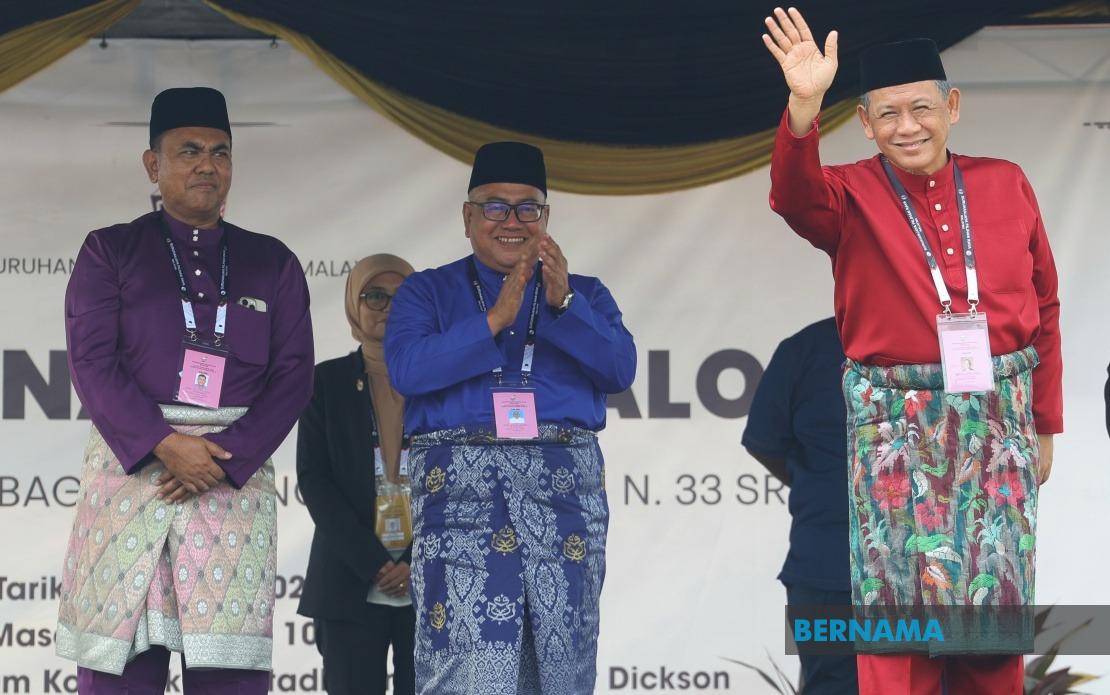
The race for Linggi in the upcoming Negeri Sembilan state election has crystallised into a competitive three-cornered contest, with Menteri Besar Datuk Seri Aminuddin Harun of Pakatan Harapan seeking to retain or capture the seat while facing stiff opposition from both the ruling coalition and Bersatu. Returning officer Nurhazelin Makli confirmed the candidate lineup after the nomination period closed at Port Dickson District Administration Complex, setting the stage for what observers anticipate will be one of the state's most closely watched battles given Aminuddin's prominent role as the state's chief executive.
The incumbent who currently represents Linggi is Datuk Mohd Faizal Ramli, a Barisan Nasional stalwart whose challenge to Aminuddin reflects the broader fragmentation of Malaysia's political landscape. Competing alongside both is Bersatu candidate Datuk Zamri Md Said, whose participation underscores the party's sustained efforts to establish itself as a significant force in Negeri Sembilan despite being outside both the Pakatan Harapan coalition and Perikatan Nasional. This triangular configuration means none of the candidates can afford complacency, as vote-splitting scenarios could prove decisive in what may ultimately be decided by narrow margins.
Beyond Linggi, the state election encompasses five other constituencies where similar competitive dynamics are playing out. In Sri Tanjung, PH incumbent Dr G. Rajassekaran must defend his position against BN's A. Achutan and Bersatu newcomer Leevineshwaraan Murugan in another three-way contest that mirrors the broader pattern of fragmented opposition politics. The Lukut seat presents a different configuration, with PH incumbent Choo Ken Hwa squaring off against Perikatan Nasional candidate Sathes Kumar Nilameham and independent candidate Teo Seng Lee, highlighting how cross-coalition competition and independent candidacies are reshaping electoral contests across the state.
The Bagan Pinang constituency features yet another three-cornered battle, this one involving PAS incumbent Abd Fatah Zakaria, who will contend against Nasir Raman representing Pakatan Harapan and Bersatu's Sheikh Junaidy Jamaludin. This contest is particularly significant given the historical importance of the Bagan Pinang seat and the complex interplay between PAS, which is part of Perikatan Nasional, and the other competing coalitions. Meanwhile, Chuah presents the election's only straight two-way fight between PH incumbent Yew Boon Lye and Barisan Nasional's Pau Jeou Ching, offering a clearer ideological and political choice for voters in that particular constituency.
The Election Commission has designated August 1 as polling day for the 16th Negeri Sembilan state election, with early voting scheduled for July 28 to accommodate military personnel, police officers, and their spouses who are registered voters. This timeline provides candidates and political parties with approximately two weeks to mobilise supporters and campaign across their respective constituencies. The early voting mechanism reflects growing recognition of the need to facilitate voter participation among uniformed personnel and their families, though questions about turnout and its potential impact on overall election results remain pertinent for analysts observing the contest.
The state's electoral roll encompasses 889,490 eligible voters, a figure comprising 867,151 ordinary citizens eligible to vote, along with 16,884 military personnel and their spouses, and 5,455 police personnel and their spouses. This electorate size underscores Negeri Sembilan's significance as a moderately populated state whose outcome could carry implications for national political trends, particularly regarding voter sentiment toward incumbent administrations and the viability of various political coalitions. The inclusion of substantial numbers of uniformed personnel voters adds another dimension to campaign considerations, as these demographics may respond to different messaging compared to the broader civilian electorate.
The Linggi battleground specifically deserves close attention from Malaysian political observers because it represents an intersection of several broader themes in contemporary Malaysian politics. Aminuddin's participation in a three-way contest rather than a straight fight against a single opposition candidate reflects the reality that Malaysia's political space is no longer dominated by two monolithic blocs but instead features multiple competing centres of gravity. The presence of Bersatu, which emerged from the Mahathir-era political realignment, indicates that the party continues its strategy of competing independently rather than formally aligning with either Perikatan Nasional or Pakatan Harapan, despite various political affiliations at the federal level.
From a Negeri Sembilan governance perspective, the outcome of Aminuddin's race carries particular weight since Menteri Besars who lose their own seats often face complicated positions within state administrations, even if their coalitions retain overall majorities. This reality adds personal stakes to the Linggi contest beyond the typical incumbent-versus-challenger dynamic. The distribution of votes across all three candidates in Linggi will therefore be watched carefully not just for its bearing on the overall state election composition but for its implications regarding Aminuddin's personal political future and the state leadership landscape.
The broader election represents the first major state-level poll since recent shifts in Malaysian political coalitions and federal arrangements, making the Negeri Sembilan results potentially indicative of voter sentiment patterns relevant to other states and the peninsula's political direction. How constituencies like Linggi, Bagan Pinang, and Sri Tanjung resolve their three-way contests will provide insights into whether voters are consolidating support around traditional coalitions, fragmenting support across multiple alternatives, or responding to local and candidate-specific factors rather than national political narratives. The concentration of three-cornered races in this election distinguishes it from previous contests and suggests that Malaysian electoral politics continues its evolution away from simpler binary competition frameworks toward more complex multi-candidate scenarios.

