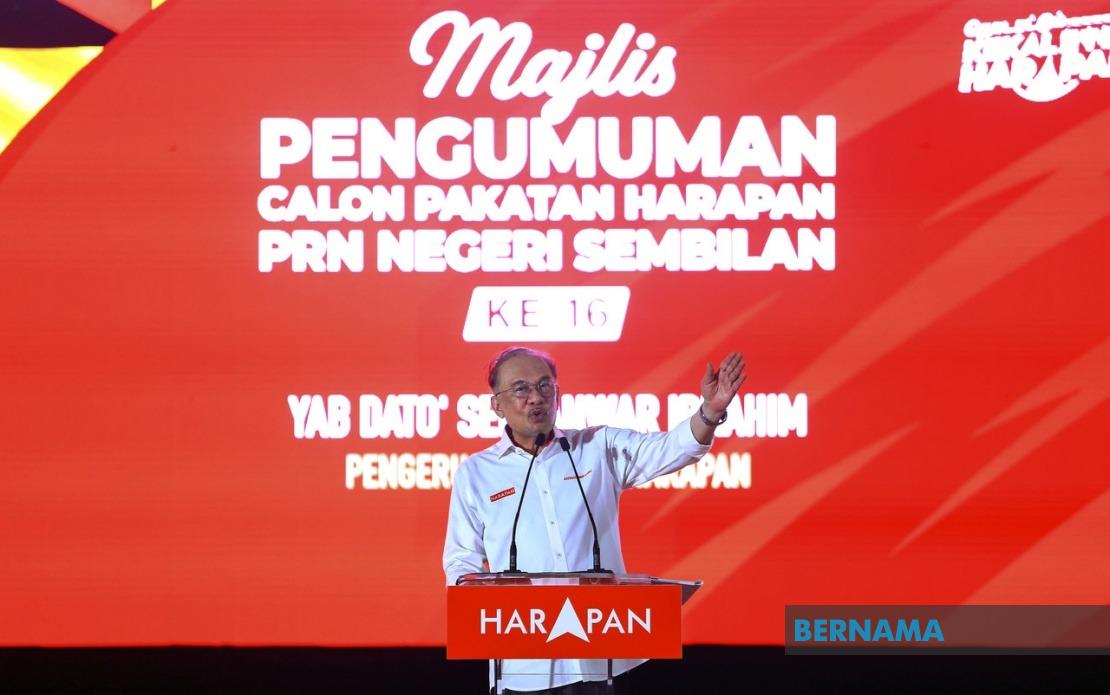
Pakatan Harapan has formally unveiled its candidate lineup for the 16th Negeri Sembilan State Election, with Menteri Besar Datuk Seri Aminuddin Harun stepping up to contest the Linggi seat in what represents a strategic shift for the coalition's leadership in the state. The announcement, made by PH chairman and Prime Minister Datuk Seri Anwar Ibrahim during a packed candidate declaration ceremony in Kuala Pilah on July 14, signals the coalition's intent to consolidate strength in key constituencies as it prepares for state-level contests.
Aminuddin's move to Linggi marks a notable transition from his previous electoral stronghold. The Negeri Sembilan PH chairman has successfully retained the Sikamat state seat across four consecutive election cycles since 2008, establishing himself as a durable political presence in the state legislature. His shift to the Linggi division reflects broader strategic calculations within the coalition about where senior leadership should be concentrated to maximise electoral prospects and secure crucial parliamentary terrain.
Running alongside Aminuddin in the party's carefully planned slate is DAP secretary-general Anthony Loke, who will seek to maintain his hold on the Chennah constituency. Loke represents continuity and consolidation for the coalition in a seat he has represented since 2013, spanning nearly a decade of incumbent advantage. The decision to field both men underscores PH's confidence in retaining these divisions and protecting its ground strength ahead of polling day.
The candidate announcement drew substantial participation from the coalition's upper echelons, reflecting the political significance attributed to the Negeri Sembilan contest. Amanah president Datuk Seri Mohamad Sabu, PH communications director Datuk Seri Fahmi Fadzil, and the coalition's election operations chief Datuk Seri Amirudin Shari all attended the ceremony, joining thousands of party supporters in a public display of unity and mobilisation.
Negeri Sembilan occupies a particular position within Malaysia's political landscape as a traditionally competitive state where elections often turn on narrow margins and local personality factors. The state has historically been a bellwether for broader political trends, and PH's selection of Aminuddin for Linggi and retention of Loke reflects strategic thinking about which constituencies offer the most defensible and winnable terrain. Both men bring established track records and voter familiarity within their respective divisions.
For Loke specifically, maintaining his Chennah seat would represent an important personal and party achievement, as DAP's parliamentary representation at state level remains a critical component of its overall influence within PH and its ability to shape coalition policy directions. His decade-long tenure in the constituency has allowed him to build institutional knowledge and local networks that typically benefit incumbent candidates in state-level contests.
Aminuddin's elevation to champion the Linggi fight carries additional weight given his role as PH chairman at the state level. His candidacy effectively positions the Menteri Besar as the coalition's leading electoral soldier in what is widely anticipated to be a competitive contest. This personalisation of the leadership at constituency level is a common tactic employed by ruling coalitions seeking to leverage executive authority and administrative resources to secure electoral victory.
The timing of the candidate announcement in mid-July suggests the coalition is moving swiftly toward formalising its electoral machinery and completing internal processes ahead of the official election schedule. In Malaysian politics, early candidate declaration often provides parties with additional weeks or months to campaign and consolidate voter support before nomination day arrives and the formal campaign period commences.
For regional observers and Malaysian political analysts, the composition of PH's candidate slate in Negeri Sembilan offers insights into the coalition's strategic priorities and confidence levels across different electoral segments. The retention of established incumbents like Loke alongside the repositioning of senior figures like Aminuddin suggests a coalition balancing consolidation of existing strength with calculated repositioning to address potential vulnerabilities or to contest previously difficult terrain.
The public spectacle of the candidate announcement, staged with substantial party machinery on display, also serves an important internal function for PH, reinforcing party discipline and demonstrating to members and supporters that the coalition maintains coherence and strategic direction despite the pressures and disagreements that inevitably accompany multi-party alliances at state and federal levels.

