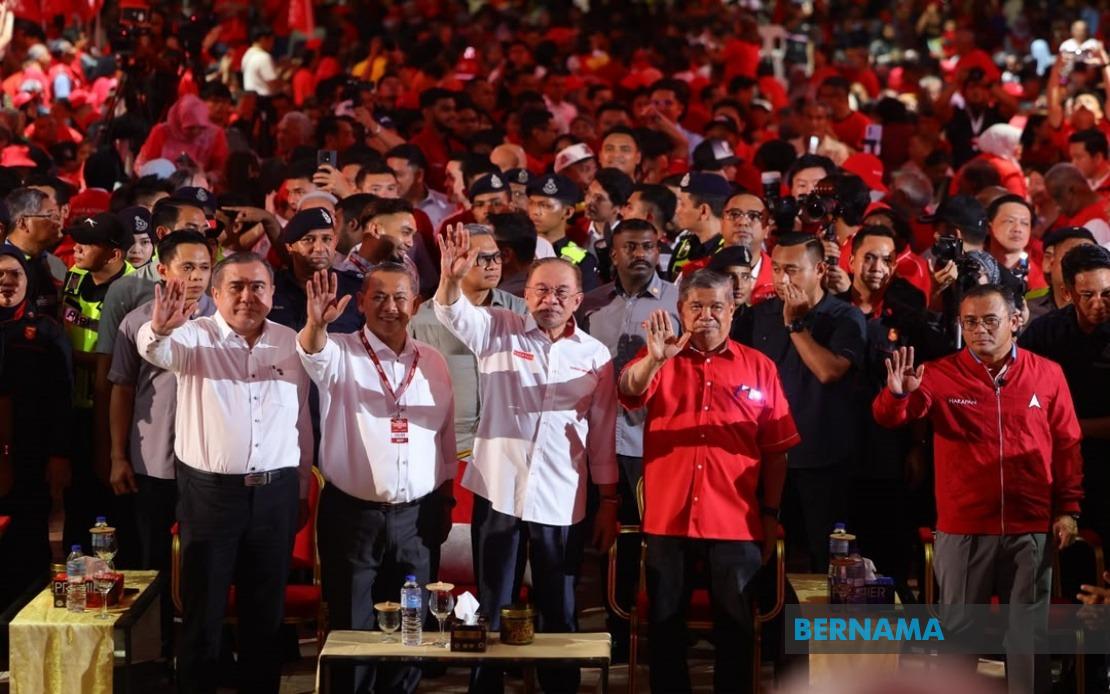
Datuk Seri Aminuddin Harun, chairman of Pakatan Harapan in Negeri Sembilan, has made an appeal to the state's electorate to provide the coalition with a renewed mandate during the forthcoming 16th state election. Speaking at a candidate announcement ceremony in Kuala Pilah on July 14, Aminuddin stressed that maintaining a stable state government is essential for sustaining investor confidence and ensuring that development initiatives and public assistance programmes continue without disruption.
The PH leader highlighted the party's track record since assuming power in 2018, pointing to the fulfilment of numerous manifesto commitments and the continuation of incentive schemes that have contributed to measurable improvements in the state's overall performance. According to Aminuddin, this sustained progress is a direct result of political stability, underscoring the coalition's argument that electoral continuity will benefit Negeri Sembilan's residents. The state government has committed to expanding welfare initiatives, including educational assistance programmes and the distribution of complimentary tablets to students, while working closely with federal authorities to accelerate development projects across the state.
A notable indicator of Negeri Sembilan's economic health under PH governance is the RM19.1 billion in investments the state has successfully attracted, a figure Aminuddin cited as evidence of investor confidence in the administration's capabilities. Beyond economic metrics, the state has experienced significant growth in zakat collection, rising from approximately RM80 million to nearly RM200 million during Aminuddin's tenure. This expansion in religious taxation revenue has enabled the government to channel increased financial assistance to vulnerable segments of the population, reflecting the administration's commitment to social welfare alongside economic development.
During the event, attended by prominent figures including DAP secretary-general Anthony Loke and Amanah president Datuk Seri Mohamad Sabu, Aminuddin called upon the party's election machinery and supporters to intensify their campaign efforts. He emphasised the necessity of reaching all eligible voters, including those who have relocated outside Negeri Sembilan's boundaries, to communicate the coalition's message and policy achievements effectively throughout the campaign period.
Anthony Loke characterised the Negeri Sembilan election as Pakatan Harapan's opportunity for recovery and momentum-building following the coalition's setback in the recent Johor state election. He described the forthcoming contest as PH's "second round," signalling the coalition's determination to reverse recent electoral challenges and demonstrate resilience within a key traditional stronghold. Loke acknowledged that Johor did not yield favourable results for the coalition but stressed that there is insufficient time to dwell on that disappointment, instead pivoting toward a focused recovery strategy centred on Negeri Sembilan.
Loke's remarks reflected a broader strategy within Pakatan Harapan to treat Negeri Sembilan as a testing ground for rejuvenated campaign approaches and internal reforms identified during the Johor campaign analysis. The DAP leader reiterated that Aminuddin would remain the coalition's candidate for Menteri Besar and serve as the "commander" for the state-level election campaign, ensuring unity of purpose across all component parties within Pakatan Harapan.
A particularly significant dimension of Loke's address involved establishing guidelines for campaign conduct that respect local customs and the constitutional monarchy. He urged all party members and campaign workers to maintain proper decorum and demonstrate respect for Negeri Sembilan's royal institution throughout the election period, cautioning that any breach of this protocol could provide ammunition for political opponents to exploit. The DAP secretary-general reaffirmed his party's commitment to upholding the Federal Constitution, Malaysia's constitutional monarchy framework, and the Rukun Negara principles.
Loke further emphasised that all DAP members operating in Negeri Sembilan would continue pledging loyalty to the Yang Dipertuan Besar and respecting the state's traditional institutions, including the Undang Yang Empat and the Tunku Besar of Tampin. This public commitment to constitutional and institutional respect addresses longstanding sensitivities regarding DAP's relationship with Malaysia's hereditary rulers and reflects broader efforts within Pakatan Harapan to project an image of institutional orthodoxy and deference to traditional power structures.
The 16th Negeri Sembilan state election represents a critical juncture for Pakatan Harapan's regional standing, arriving at a moment when the coalition is reassessing its electoral viability in key states following the Johor loss. For Malaysian voters in Negeri Sembilan, this election will effectively serve as a referendum on the coalition's administrative competence and capacity to deliver economic benefits, particularly given the economic growth metrics and investment figures the state government has promoted.
Moreover, the election holds broader implications for Pakatan Harapan's national trajectory and its ability to function as a coherent governing coalition at the state level. The coalition's performance in Negeri Sembilan will likely influence perceptions of its electoral strength heading into potential federal-level contests and other state elections. Success would provide momentum and renewed legitimacy, while another setback could intensify internal pressures and questions about the coalition's viability as a nationwide political force.
For investors and business interests, the stability argument advanced by Aminuddin and Loke carries practical significance. Political continuity can reduce policy uncertainty and facilitate long-term commercial planning, considerations that resonate particularly strongly in an economic environment marked by regional and global uncertainties. The incoming administration's commitment to federal-state cooperation on development projects also signals an intent to leverage national resources for state-level initiatives, a message designed to appeal to both established commercial interests and ordinary voters seeking tangible improvements in infrastructure, employment, and public services.

