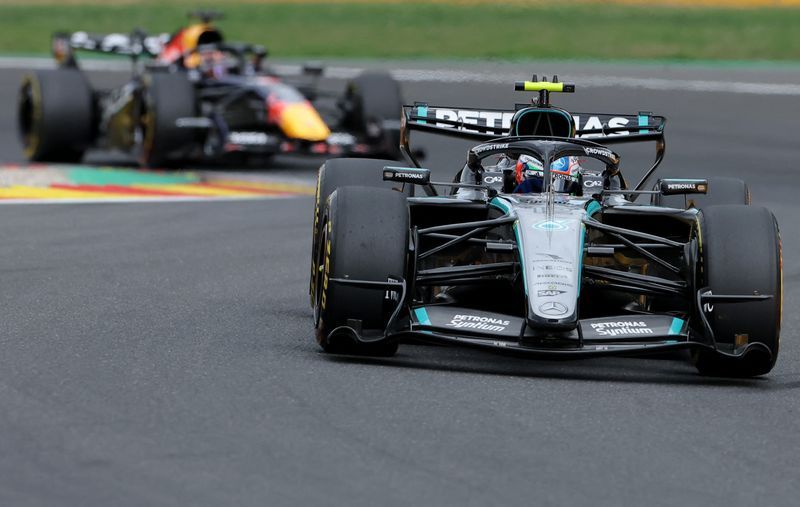
Mercedes' Kimi Antonelli extended his commanding grip on the Formula One championship with a commanding performance at Spa-Francorchamps on Sunday, winning the Belgian Grand Prix to open up a 45-point cushion over Ferrari's Lewis Hamilton. The 19-year-old Italian, who had secured pole position to continue Mercedes' flawless qualifying dominance this season, delivered under pressure despite a race interrupted by safety car deployments and punctuated by a dramatic championship collision between his own teammates.
The most consequential moment came on the opening lap when George Russell, entering the race as Antonelli's closest rival in the championship standings, found himself caught in an incident with Hamilton while attempting to recover lost ground following a poor start. Russell's spin into the gravel effectively ended his afternoon and dealt a significant blow to his title ambitions, which had brought him within touching distance of the championship before the weekend. The collision not only removed one of Antonelli's primary challengers from contention but also illustrated the intensity of the battle unfolding within Mercedes itself as the season progresses.
Ferrari's Charles Leclerc emerged as the principal threat during the race itself, capitalising on strategic positioning relative to a virtual safety car deployment to assume the lead and ultimately finish second, crossing the line 1.952 seconds adrift of Antonelli after a hard-fought 44-lap contest. The Monegasque's ability to convert track position into a podium finish demonstrated Ferrari's consistent competitive pace, though the gap to Mercedes remains substantial. Red Bull's Max Verstappen rounded out the top three, a result that awarded the team their 300th podium finish in Formula One's illustrious history, an milestone that underscores their sustained excellence across multiple regulation eras.
Hamilton's afternoon proved complicated despite securing fourth place on the road. The Mercedes driver faced immediate investigation for an unsafe release from his pitstop that could potentially drop him a position, which would further inflate Antonelli's championship advantage and create additional distance between the championship leader and those pursuing him. Beyond regulatory complications, Hamilton also served a five-second penalty stemming from his opening-lap collision with Russell, a sanction that reflected the stewards' assessment of his responsibility in the incident. The cumulative effect of these penalties and the ongoing investigation underscored how marginal elements and strategic decisions can significantly alter championship mathematics across a single afternoon.
Antonelli's victory represented his sixth triumph in the opening ten races of the season, a ratio of success that positions him as the dominant force in this championship campaign. The margin of 50 points he now holds over Russell following this race reflects not merely a string of victories but a consistency in performance that has defined Mercedes' campaign. The Italian driver acknowledged the fortune inherent in Sunday's outcome, particularly regarding the championship implications of Russell's exit, demonstrating maturity in recognising that while execution matters greatly, circumstance occasionally plays a decisive role in determining outcomes across a competitive field.
In post-race comments, Antonelli reflected on the complexities of the afternoon, noting that Mercedes had temporarily surrendered the lead following the virtual safety car period but managed to strategically manoeuvre back into contention. His remarks highlighted the operational sophistication required in modern Formula One, where pit strategy, tyre management, and tactical positioning across safety car windows can prove as decisive as pure pace. The driver's acknowledgement that results matter more than isolated stretches without victories suggests a pragmatic approach to championship building, understanding that consistency across a season ultimately determines outcomes.
McLaren's Oscar Piastri secured fifth place to add modest points to his team's championship tally, while teammate Lando Norris claimed seventh despite starting from 13th following a ten-place grid penalty. Norris's recovery drive demonstrated McLaren's capability to extract points from disadvantageous starting positions, though the team's overall championship position relative to Mercedes remains substantially behind. Red Bull's Isack Hadjar scored a sixth-place finish from the back of the grid, a testament to the underlying performance of his machinery and his driving proficiency in exploiting opportunities when they arose during the 44-lap contest.
Audi, continuing its return to Formula One as a power unit supplier, earned points through Gabriel Bortoleto's eighth-place finish, indicating that the team's restructuring efforts are yielding measurable on-track results. Racing Bulls' Arvid Lindblad and Alpine's Franco Colapinto completed the points-scoring positions in ninth and tenth respectively, spreading the championship rewards across the grid's competitive spectrum. The distribution of results across multiple teams, from Mercedes' dominance through Ferrari's competitiveness to the supporting cast beyond, illustrates the complex hierarchy that currently characterises the championship.
As the season progresses with Antonelli holding such a commanding lead, Mercedes appears positioned to secure both driver and constructor championships should current form continue. However, the Belgian Grand Prix equally demonstrated that championships remain dynamic, with single races capable of dramatically reshaping the competitive landscape through incidents, penalties, and strategic execution. Russell's sudden exit from contention following his collision with Hamilton serves as a potent reminder that consistency and avoiding catastrophic errors prove as important as raw pace in securing championship honours across a full season's campaign.

