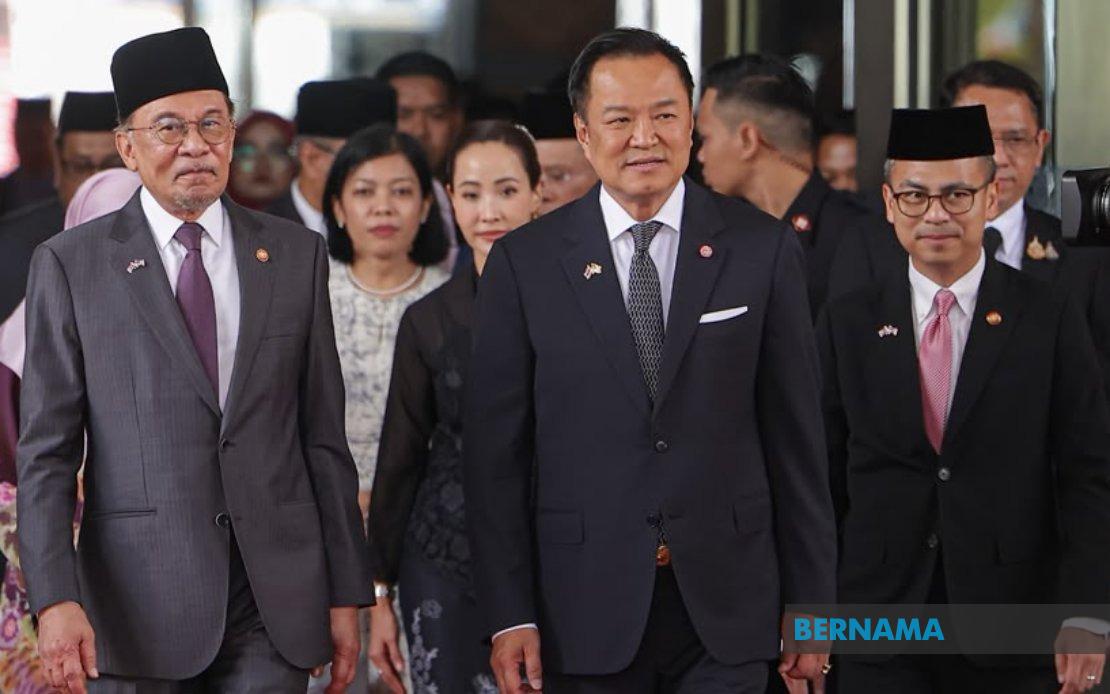
Prime Minister Datuk Seri Anwar Ibrahim and his Thai counterpart Anutin Charnvirakul convened at the Perdana Putra Complex in Putrajaya on July 9 to assess the state of Malaysia-Thailand relations and chart pathways for strengthened engagement across multiple sectors. The bilateral gathering represented a strategic reaffirmation of ties between two neighbouring Southeast Asian economies at a time when regional cohesion and cross-border collaboration have become increasingly vital to both nations' economic and security interests.
Anutin arrived at Kuala Lumpur International Airport at 11.11 am to commence a two-day official visit, having been invited by Anwar. The Thai Premier was formally received by the Malaysian leader at the Bunga Raya Complex before both delegations proceeded to the capital's administrative headquarters for substantive discussions. The ceremonial protocol and high-level attendance underscored the diplomatic weight both governments attached to the engagement.
The meeting agenda encompassed a comprehensive sweep of bilateral concerns. Trade and investment frameworks featured prominently, reflecting the two nations' interdependent supply chains and the potential for deepened commercial ties. Border connectivity dominated discussions as well, an issue of particular relevance given the land frontier that physically links Peninsular Malaysia with Thailand and the imperative to facilitate seamless movement of goods and people across checkpoints. Security cooperation, spanning law enforcement collaboration and transnational crime prevention, represented another critical dimension given shared challenges around human trafficking, drug smuggling, and maritime piracy affecting the region.
Agricultural partnership emerged as a focal point of the dialogue, with both countries recognising mutual advantages in harmonising farming practices, technology transfer, and food security initiatives. The prominence given to agriculture reflected Thailand's position as a regional agricultural heavyweight and Malaysia's strategic interest in securing supply chain resilience for staple commodities. Tourism and people-to-people exchanges rounded out the substantive agenda, acknowledging the cultural and economic benefits of enhanced visitor flows and academic or professional mobility between populations.
Beyond bilateral matters, the two leaders engaged on the broader regional architecture shaping Southeast Asian geopolitics. Discussion of developments within ASEAN and associated mechanisms—including responses to Myanmar's political turmoil, tensions in the South China Sea, and pandemic-related recovery efforts—demonstrated that Malaysia and Thailand view their relationship not in isolation but as integral to ASEAN's collective positioning. This perspective carries weight as both nations wield significant influence within the bloc and are expected to contribute to consensus-building on contentious regional questions.
The Malaysian delegation's composition signalled comprehensive governmental engagement. Deputy Prime Minister Datuk Seri Fadillah Yusof brought energy and water expertise to discussions, while Foreign Minister Datuk Seri Mohamad Hasan offered diplomatic acumen. Transport Minister Anthony Loke addressed cross-border logistics; Agriculture and Food Security Minister Datuk Seri Mohamad Sabu brought sectoral knowledge; Home Minister Datuk Seri Saifuddin Nasution Ismail oversaw security dimensions; Investment, Trade and Industry Minister Datuk Seri Johari Abdul Ghani managed commercial aspects; Human Resources Minister Datuk Seri Ramanan Ramakrishnan handled labour mobility; and Economy Minister Akmal Nasrullah Mohd Nasir contributed macroeconomic perspective. This ministerial breadth mirrored the multifaceted nature of modern bilateral relations.
Thailand's delegation similarly reflected institutional depth. Deputy Prime Minister and Foreign Affairs Minister Sihasak Phuangketkeow anchored diplomatic engagement; the Deputy Prime Minister for Transport, Phiphat Ratchakitprakarn, addressed infrastructure connectivity; Finance Deputy Prime Minister Ekniti Nitithanprapas brought fiscal expertise; Tourism and Sports Minister Surasak Phancharoenworakul represented tourism interests; Defence Minister Lt. General Adul Boonthumjaroen addressed security cooperation; Agriculture and Cooperatives Minister Suriya Juangroongruangkit spearheaded agricultural discussions; and Labour Minister Julapun Amornvivat addressed workforce matters. The parallel seniority and sectoral coverage of both delegations indicated serious intent to generate substantive outcomes.
A key symbolic deliverable emerged from the talks: the two prime ministers were scheduled to witness the signing and exchange of a Memorandum of Understanding on agricultural cooperation. This formal agreement crystallised both governments' commitment to elevating collaboration in farming, food production, and related value chains. For Malaysia, deepening agricultural ties with Thailand carries strategic implications given regional supply vulnerabilities and the need to stabilise commodity prices affecting domestic consumers and producers alike. For Thailand, access to Malaysian markets and opportunities for joint ventures in food processing and export represent valuable economic expansion.
The agricultural MOU carries particular relevance for Malaysian policymakers navigating inflationary pressures on food costs and supply chain vulnerabilities exposed during the pandemic. Structured cooperation with Thailand—a major regional supplier of rice, rubber, cassava, and aquaculture products—could improve price stability and resilience. Conversely, Thai producers benefit from Malaysian market access and potential technology partnerships in areas like agricultural biotechnology and sustainable farming practices where Malaysia has developed comparative strengths.
Anwar's hosting of an official luncheon for Anutin and the Thai delegation extended the engagement beyond formal negotiation, allowing leaders and ministers informal space to build personal rapport and explore informal channels for future problem-solving. Such bilateral visits, when carefully orchestrated at the prime ministerial level, generate momentum for implementation of agreed frameworks and signal to business communities and civil society that cross-border cooperation carries high-level political backing.
The timing of Anutin's visit also reflected broader currents in Southeast Asian politics. Both Malaysia and Thailand have faced domestic challenges—ranging from economic pressures to political transitions—that make regional cooperation a stabilising force. By demonstrating commitment to substantive bilateral engagement, Anwar and Anutin signalled to their populations that forward-looking regional partnerships complement domestic reform efforts and position their nations to benefit from broader Asian economic dynamism.
For Malaysia and Thailand specifically, and for Southeast Asia broadly, such high-level bilateral engagement matters as these two economies navigate post-pandemic recovery, geopolitical repositioning in a multipolar world, and the imperative to maintain ASEAN relevance amid competition between major powers. The breadth of cooperation discussed—spanning trade, security, agriculture, and regional affairs—underscores that bilateral relations today operate across multiple dimensions simultaneously, requiring coordinated whole-of-government approaches rather than compartmentalised diplomacy. The substantive agenda and ministerial depth evident in this engagement suggest both countries are positioning themselves to deepen integration and address shared challenges collaboratively.

