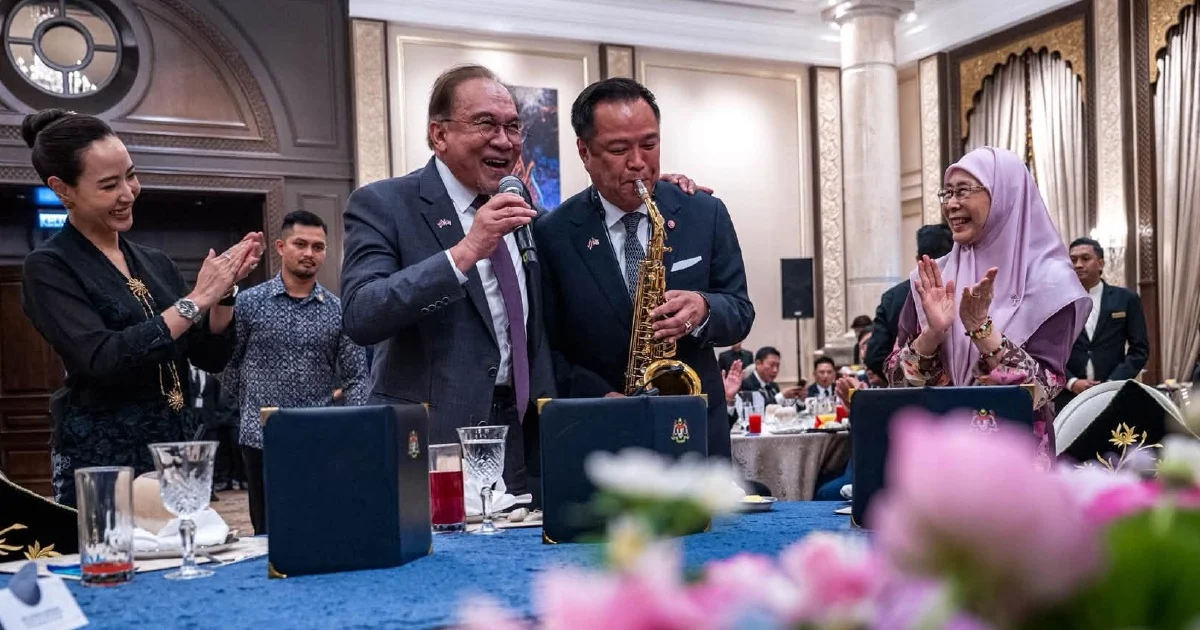
Prime Minister Datuk Seri Anwar Ibrahim and his Thai counterpart Anutin Charnvirakul set aside the formalities of high-level diplomacy to share an unexpectedly convivial moment, with the Malaysian leader performing an impromptu rendition of Frank Sinatra's iconic 'My Way' while his guest provided live saxophone accompaniment. The performance took place during an official luncheon in Putrajaya, following substantive bilateral discussions between the two nations—a setting that underscored the increasingly personable nature of modern regional diplomacy and the leaders' apparent rapport.
The spontaneous entertainment highlighted a growing trend among Southeast Asian heads of government to humanise state visits through cultural exchange and informal bonding. Rather than confining their engagement to sealed meeting rooms and prepared statements, Anwar and Anutin chose to demonstrate the warmth of Malaysia-Thailand relations through a musical collaboration that engaged their audience directly. The choice of Sinatra's 'My Way', with its themes of independence and personal conviction, may have carried subtle symbolic weight, reflecting each leader's distinct political journey and current positioning within regional geopolitics.
Anutin Charnvirakul's involvement in the performance, particularly his willingness to accompany the Malaysian Prime Minister on saxophone, demonstrated both his personal musical ability and his commitment to deepening bilateral ties through personal connection. For Thai observers, the moment reinforced Anutin's public image as a accessible, modern figure in Thai politics, comfortable engaging across cultural and diplomatic boundaries. His musical participation suggested a comfort level between the two leaders that extends beyond transactional diplomatic exchanges.
The luncheon setting itself carried diplomatic significance beyond the musical performance. Such occasions typically occur after preliminary discussions have concluded, providing an opportunity for leaders to consolidate agreements reached and explore potential areas of expanded cooperation in a more relaxed environment. The injection of entertainment and personal interaction at this juncture served a dual purpose: it humanised both leaders for their respective domestic audiences while simultaneously signalling to regional observers that Malaysia-Thailand relations remain on an upward trajectory despite periodic tensions.
For Malaysia, the visible camaraderie between Anwar and Anutin addresses longstanding concerns about bilateral stability. The two nations share a complex history marked by maritime boundary disputes, cross-border criminal activities, and periodic flare-ups over water rights and refugee flows. When diplomatic relations are strained, such informal moments become rare. Their occurrence during this particular visit therefore carried weight as an indicator of current governmental priorities and the state of bilateral engagement at the highest level.
Thailand's position within Southeast Asia has evolved considerably under Anutin's influence within successive Thai governments, shifting toward greater economic integration with ASEAN partners and reduced reliance on extra-regional powers. Malaysia, similarly navigating complex regional positioning, has benefited from strengthened engagement with Bangkok. The luncheon performance thus represented not merely a moment of levity, but a public statement reinforcing both nations' commitment to bilateral cooperation and the personal investment their leaders have made in maintaining positive relations.
The cultural dimension of diplomatic engagement has gained particular importance in Southeast Asia as governments increasingly recognise that soft power and people-to-people connections can achieve objectives that formal negotiations sometimes cannot. By choosing to perform together, Anwar and Anutin demonstrated understanding of this principle. Music transcends language barriers and political differences, making it an effective vehicle for conveying friendship and good faith to both immediate audiences and broader publics following diplomatic events through media coverage.
For Malaysian media and social networks, the moment provided welcome content that portrayed government leadership in a positive, relatable light. The infectious nature of such imagery—leaders performing popular classics together—travels far beyond official government communications, reaching populations who may not typically follow diplomatic developments. This organic engagement with government personalities through entertainment contexts can subtly influence public perceptions of national leadership and bilateral relationships in ways that formal state communications struggle to achieve.
The broader implications of this visit extended beyond musical performance to substantive issues affecting both nations. Malaysia and Thailand share concerns regarding maritime security, cross-border smuggling operations, and the management of irregular migration flows along their extensive border. They also collaborate on counter-terrorism efforts and seek to coordinate responses to transnational organised crime. The appearance of personal warmth between their leaders can facilitate more productive technical discussions among lower-level officials tasked with implementing bilateral agreements.
Regionally, Malaysia's cultivation of stronger relations with Thailand serves broader ASEAN cohesion objectives. With Myanmar experiencing ongoing internal conflict and some ASEAN members maintaining fraught relations with others, bilateral partnerships that function smoothly become valuable ballast for regional stability. When major Southeast Asian economies like Malaysia and Thailand demonstrate functional, friendly relations reinforced by high-level personal connections, it sends positive signals about ASEAN's internal health and its capacity to present unified positions on regional matters.

