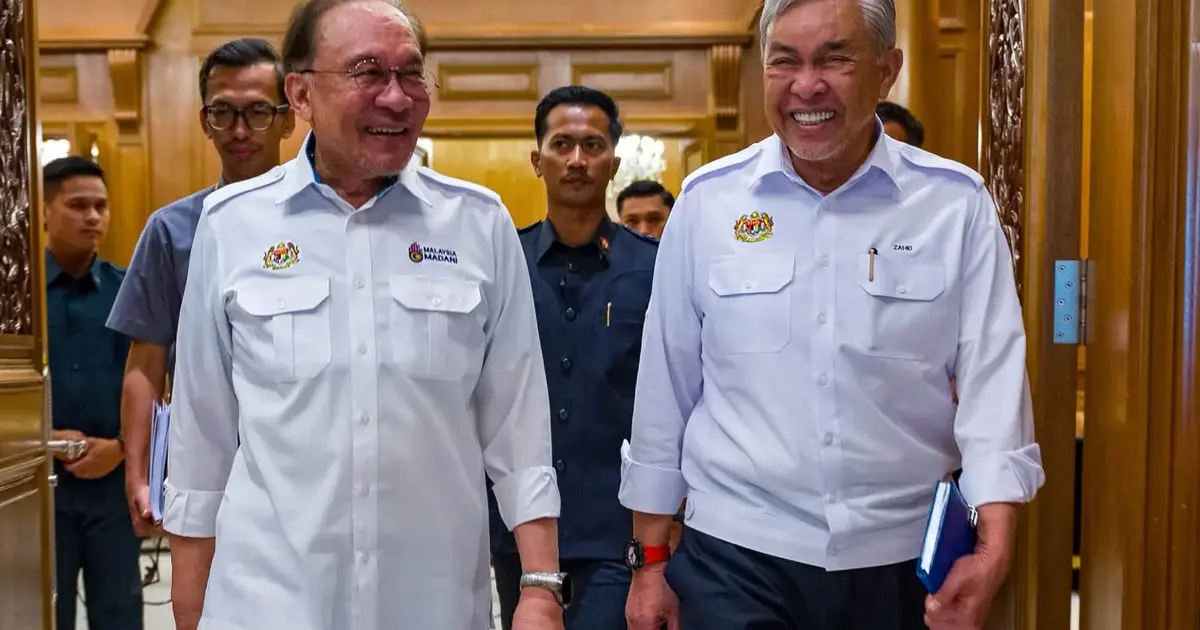
Prime Minister Anwar Ibrahim and Barisan Nasional chairman Ahmad Zahid Hamidi presented a facade of political camaraderie on Wednesday, trading pleasant exchanges that appeared designed to defuse mounting friction within Malaysia's fragile coalition administration. The carefully orchestrated display of goodwill followed a day of pointed rhetoric that had exposed cracks in the partnership binding the two largest components of the federal government.
The underlying cause of the tension centred on the status of eight BN ministers serving in Anwar's cabinet. Zahid had issued a provocative statement suggesting that the prime minister possessed the authority to remove any of these ministers if their performance or conduct failed to meet expectations. The remark, while ostensibly straightforward, carried unmistakable overtones of defiance and suggested that BN retained leverage over the composition of the cabinet despite Anwar's formal appointment as head of government.
This particular disagreement reflects a broader structural vulnerability within Malaysia's current political arrangement. The Pakatan Harapan-led administration relies on support from Barisan Nasional, a coalition of predominantly Malay and Muslim-based parties that historically dominated Malaysian politics for nearly seven decades. The transition from Barisan's dominance to a junior partnership role has proven psychologically and strategically difficult for the bloc's leadership, creating recurrent friction points that threaten governmental stability.
The eight ministers from Barisan Nasional occupy strategically important portfolios across the federal government. Their positions provide Zahid and the coalition's leadership with tangible influence over policy implementation and resource allocation, making them reluctant to accept any suggestion that Anwar might unilaterally determine their fate. The implied threat of removal, even if procedurally legitimate, therefore struck at BN's sense of political consequence within the coalition arrangement.
Anwar's subsequent friendly demeanour towards Zahid appeared calculated to reassure the BN chairman that no immediate action regarding ministerial appointments was contemplated. By exchanging smiles and cordial remarks, both leaders signalled to their respective party members and to the broader Malaysian public that the disagreement, however real, posed no threat to the government's functioning or coherence. Such gestures carry outsized importance in Malaysian politics, where public displays of unity or discord frequently determine investor confidence, civil service morale, and the government's capacity to pass legislation.
The strategic importance of maintaining coalition harmony cannot be overstated given Malaysia's parliamentary structure. Anwar's administration commands a narrow working majority that depends on retaining support from multiple blocs and independent lawmakers. The loss of BN's parliamentary backing, should the coalition rupture over ministerial disputes or other grievances, would immediately place the government's survival in jeopardy. This structural vulnerability forces both Anwar and Zahid to manage their differences carefully, even when fundamental disagreements exist regarding power distribution.
For Barisan Nasional specifically, the challenge of accepting a subordinate role within government remains acutely uncomfortable. The coalition governed Malaysia uninterruptedly from independence until 2018, developing institutional cultures and practices premised on dominance. The return to office in 2023 through Anwar's coalition offered Zahid and other BN figures a path back to ministerial positions and government resources, but without the commanding authority they had previously exercised. This adjustment has generated repeated tensions, with BN occasionally threatening withdrawal or demanding enhanced influence over policy direction.
The broader Malaysian electorate has demonstrated limited patience with coalition instability. The rapid succession of governments and leadership changes between 2018 and 2022 left many voters sceptical of political arrangements that prioritise elite power-sharing over policy delivery and economic management. Anwar's administration faces considerable pressure to demonstrate competence in managing inflation, unemployment, and fiscal consolidation. Such performance concerns mean that both he and Zahid understand that constant public bickering risks undermining public confidence in the government's capacity to function effectively.
The resolution of this particular disagreement through smiles and cordial remarks rather than substantive concessions suggests that neither Anwar nor Zahid viewed the conflict as fundamental. Rather, both leaders appeared to interpret the exchange as a necessary negotiation over the distribution of prestige and influence—matters that are symbolically important in Malaysian politics but ultimately subordinate to the overriding imperative of keeping the government intact. Zahid's reminder that ministers serve at the prime minister's pleasure contained an implicit acknowledgement of Anwar's formal constitutional authority, while Anwar's friendly response acknowledged Barisan's continued political significance.
Looking forward, this pattern of surface-level reconciliation following tense exchanges will likely recur regularly throughout the coalition's tenure. The underlying structural imbalance—BN's diminished role coupled with its continued electoral and parliamentary significance—creates recurring opportunities for friction. Both leaders will periodically need to reaffirm their commitment to the arrangement while subtly jockeying for advantage within it. Malaysian political observers and international investors monitoring governmental stability should expect periodic episodes of apparent tension followed by hastily arranged reconciliations, a rhythm that has become characteristic of modern Malaysian coalition politics.

