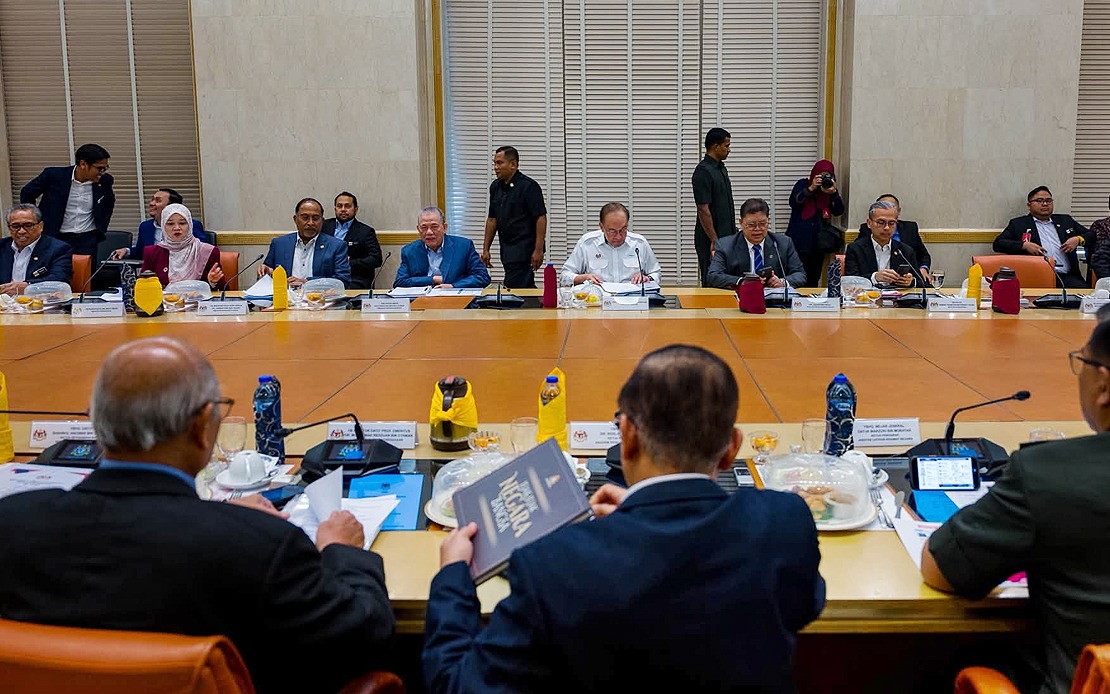
Prime Minister Datuk Seri Anwar Ibrahim has placed renewed emphasis on the cultivation of nationhood values as a cornerstone of Malaysia's long-term development and social cohesion. Speaking during the Dewan Kenegaraan Board of Governance Meeting, Anwar articulated his vision for a society where citizens are bound by shared principles of identity, integrity and moral fortitude—values he characterised as fundamental to elevating the nation's standing both domestically and internationally.
The Prime Minister's remarks reflect a broader strategic pivot within government circles toward institutional reinforcement of national consciousness. Rather than treating nationhood values as abstract ideals, Anwar positioned them as active mechanisms for fostering genuine patriotism rooted in everyday citizenship. He emphasised that the continuous strengthening of these values would produce individuals whose personal conduct and public engagement reflect a commitment to the collective good, thereby creating a more resilient and cohesive society capable of navigating contemporary challenges.
Central to Anwar's vision is the National Service Training Programme (PLKN), which he highlighted as showing encouraging momentum following its rollout. The programme has garnered positive feedback from both participants and their families, indicating growing acceptance of its premise that structured national service serves as a crucible for forging stronger national identity. Anwar characterised PLKN not merely as a training initiative but as a platform specifically designed to cultivate discipline, resilience and a deep sense of belonging among Malaysia's younger generations—demographics whose formative experiences will shape the nation's trajectory for decades to come.
The government's investment in PLKN reflects recognition that nationhood values cannot simply be transmitted through top-down directives or classroom instruction alone. The programme's experiential approach, which places participants in shared environments and common purpose, creates conditions under which abstract principles take on tangible meaning. By fostering camaraderie across ethnic, religious and socioeconomic lines, PLKN addresses a persistent challenge in plural societies: the cultivation of unity without uniformity, where citizens maintain their individual identities whilst embracing overarching national commitments.
Anwar's comments also highlighted the role of the Nationhood Fellows, a cohort of distinguished figures and statesmen drawn from diverse professional and ideological backgrounds. This initiative underscores an important strategic recognition that nation-building cannot be monopolised by any single political party or government apparatus. By assembling prominent figures from various walks of life to contribute ideas and expertise toward reinforcing nationhood, the government signals openness to broad-based input whilst maintaining coherent policy direction. The Nationhood Fellows model represents an attempt to depoliticise national identity by positioning it as a concern transcending partisan divisions.
The timing of Anwar's emphasis on nationhood values carries particular significance within Malaysia's contemporary political context. The nation has experienced periodic cycles of communal tension, political fragmentation and questions about national direction over recent decades. By elevating nationhood values to prominence within high-level governance discussions, Anwar appears to be signalling that institutional recommitment to foundational unifying principles constitutes an essential prerequisite for addressing more specific policy challenges, whether economic, administrative or sectoral.
The connection Anwar drew between nationhood values and love for country demonstrates an understanding that patriotism requires more than symbolic gestures or mandatory flag-waving. Instead, he framed genuine love for Malaysia as something that must be continuously cultivated through deliberate institutional effort and personal development. This formulation acknowledges that in multicultural, multi-religious societies, patriotism functions most effectively when it provides space for diverse expressions of national belonging rather than imposing conformity to a single national narrative.
For Malaysian citizens, the policy implications are substantial. PLKN's continued strengthening means broader sections of the youth population will experience structured exposure to national service principles, potentially influencing patterns of civic engagement and political participation for decades. Similarly, the framework established through the Nationhood Fellows could influence how future policy initiatives are framed, emphasising their connection to deeper national values rather than presenting them as purely technical or administrative matters.
Regionally, Malaysia's institutional emphasis on nationhood values also carries significance. Southeast Asia comprises multiple plural societies grappling with similar tensions between national unity and ethnic, religious and ideological diversity. Malaysia's experience with attempting to forge nationhood values across deep communal lines offers lessons—both cautionary and instructive—for neighbouring countries facing comparable challenges. The success or difficulties of initiatives like PLKN and the Nationhood Fellows will likely be observed closely by policymakers across the region.
Looking forward, the sustained integration of nationhood values into governance frameworks represents a long-term commitment requiring institutional consistency beyond electoral cycles. The challenge will be ensuring that such values do not become hollow catchphrases deployed for political convenience but rather function as genuine guides to policy formulation and implementation. If successfully institutionalised, however, the emphasis on nationhood values could contribute to addressing some of Malaysia's most persistent social and political challenges, particularly those rooted in questions of national identity and shared purpose in an increasingly complex world.

