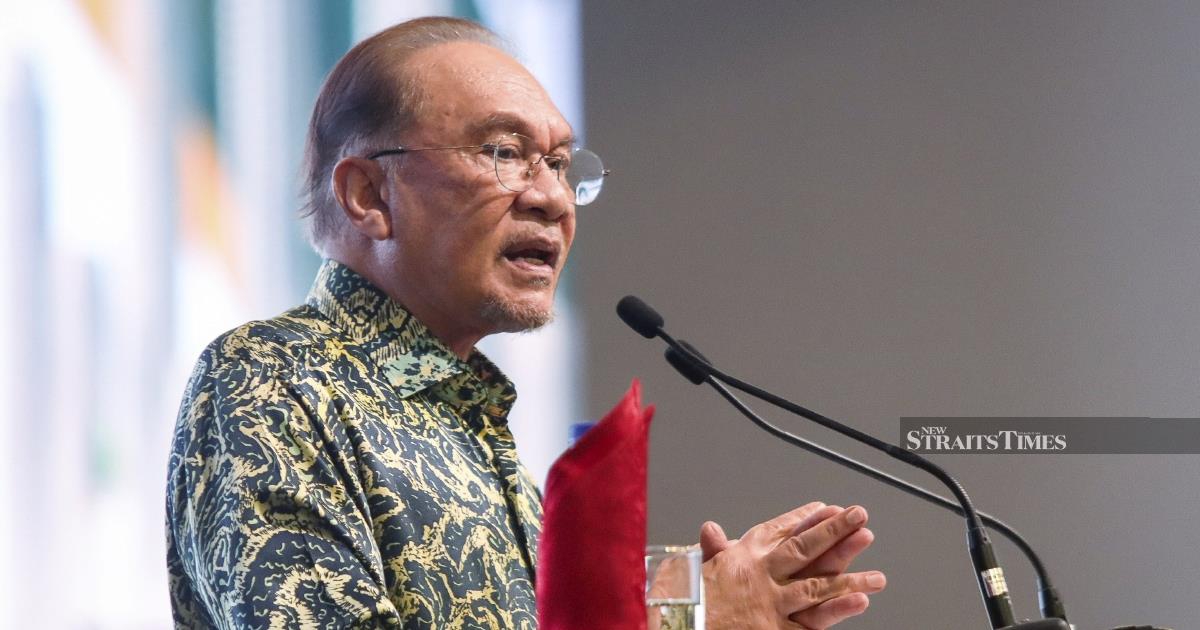
Prime Minister Datuk Seri Anwar Ibrahim has sought to reassure young Malaysians that their voices matter to the government, while simultaneously cautioning them against embracing divisive narratives that fragment society. The message, delivered in his Permatang Pauh constituency, underscores the administration's ongoing effort to position itself as responsive to generational concerns even as it grapples with managing competing ideological pressures within the country.
Anwar's remarks reflect broader tensions within Malaysian society regarding how young people engage with both government and alternative movements that have gained traction through digital platforms. The appeal to reject divisive ideologies carries implicit acknowledgment that such narratives circulate widely among Malaysia's youth demographic, who constitute a significant voting bloc and increasingly shape national discourse through social media. The Prime Minister's direct engagement on this issue suggests the government views youth disaffection as a strategic concern warranting sustained attention.
The emphasis on government responsiveness serves a dual purpose: it positions the administration as progressive and attuned to younger voters' demands, while simultaneously creating space for dialogue that might redirect youthful energy toward institutional channels rather than alternative movements or extra-parliamentary activism. For a government navigating coalition complexities and managing diverse coalition partner expectations, maintaining youth engagement through narrative control and perceived accessibility becomes crucial to sustaining political legitimacy across generations.
Malaysia's young population has demonstrated willingness to challenge establishment positions on various fronts, from governance transparency to educational policy to economic opportunity. Previous rallies and online movements have mobilised substantial youth participation, often organised around grievances related to cost of living, employment prospects, and political accountability. Anwar's exhortation represents an attempt to channel this energy into constructive engagement with government mechanisms rather than allowing it to accumulate within parallel structures.
The reference to divisive ideologies likely encompasses multiple phenomena: communal polarisation along religious and ethnic lines, partisan extremism, and potentially disinformation narratives that exploit genuine socioeconomic anxieties. By framing rejection of such ideologies as a patriotic duty, the government seeks to delegitimise alternative framings of national challenges while presenting its own approach as unifying and in youth interests. This rhetorical strategy faces the challenge that many young Malaysians perceive institutional politics as insufficiently responsive to their material concerns.
Regionally, Malaysia's approach mirrors efforts by other Southeast Asian governments to maintain youth political engagement within formal systems. Thailand, Indonesia, and the Philippines have similarly invested in youth outreach programmes while simultaneously monitoring or restricting extra-institutional political mobilisation. The sophistication of such efforts varies considerably, and Malaysia's emphasis on assurance and dialogue arguably places it on the more inclusive end of the regional spectrum, though critics contend that genuine institutional responsiveness remains limited.
The Permatang Pauh venue carries symbolic weight as Anwar's own parliamentary constituency, a location from which he has historically projected political messages directly to constituents. Speaking from this platform allows him to address national youth from a position of proximity to a specific community, lending the message localised authenticity while maintaining national resonance. The choice of venue suggests strategic communication planning intended to enhance the message's credibility and reach among target audiences.
For young Malaysians navigating choices about political participation, the government's appeal presents a particular calculus. Those frustrated with institutional pace or concerned about establishment commitment to transformative change may view such appeals as insufficient, particularly if accompanied by limited concrete policy shifts addressing youth-specific challenges. Conversely, young citizens already disposed toward engagement with government institutions may interpret the Prime Minister's remarks as validation of their participation choices and evidence of official responsiveness to generational input.
The government's concurrent emphasis on rejecting divisive narratives and remaining open to youth concerns attempts to establish parameters for acceptable engagement: young people should support the government's vision while avoiding movements, ideologies, or critiques deemed divisive by establishment criteria. This framework contains inherent tension, as youth movements historically emerge from perspectives that challenge existing elite consensus and thus may be classified as divisive by incumbent power structures. Managing this tension requires either genuine institutional flexibility or sufficiently persuasive messaging to convince young people that their interests align with government-defined parameters.
Moving forward, the effectiveness of Anwar's outreach will depend partly on government capacity to demonstrate tangible responsiveness to youth concerns beyond rhetorical acknowledgment. Economic policies affecting youth employment, educational accessibility, digital space governance, and political inclusion mechanisms will all signal whether the government's openness extends to substantive policy adjustment or remains primarily discursive. Young Malaysians have shown themselves increasingly sophisticated in evaluating government claims against material outcomes, particularly where generational economic opportunities appear constrained relative to previous cohorts.
The Prime Minister's message also carries implications for coalition management, as different coalition partners hold varying positions on youth engagement, ideological boundaries, and appropriate political discourse. Anwar's balanced formulation—affirming government listening while drawing boundaries around acceptable narratives—attempts to retain coalition cohesion while responding to generational political demands. Whether this centrist positioning proves sustainable as particular coalition members push for more restrictive approaches to youth activism remains an open question for Malaysian political development.

