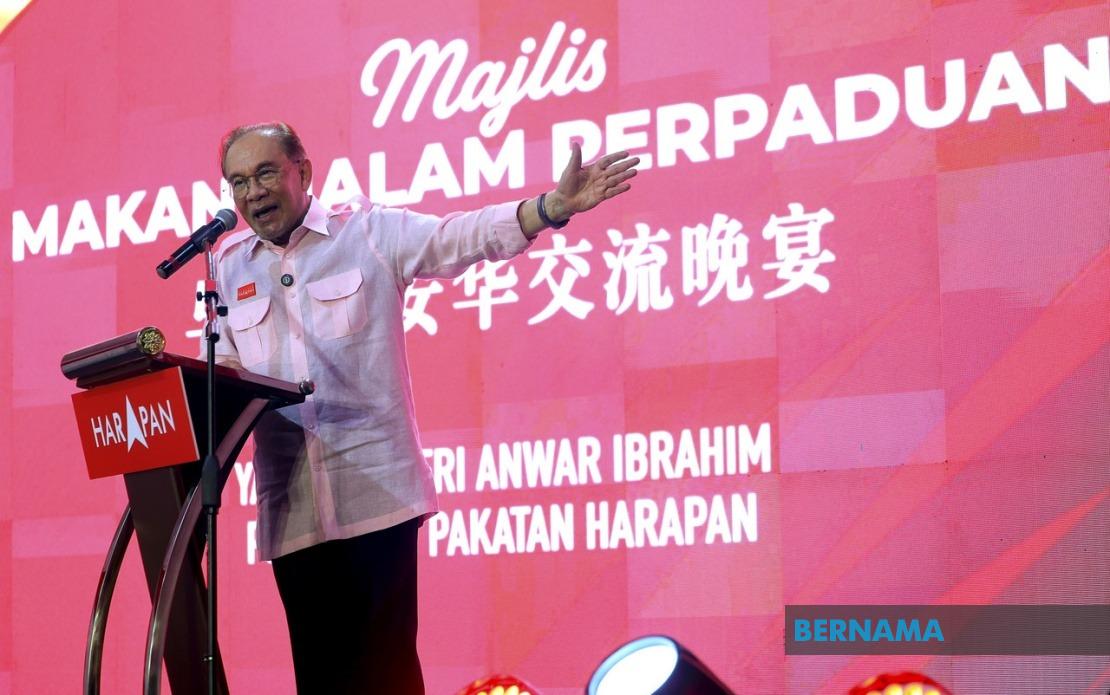
At a campaign event in Seremban on July 22, Prime Minister Datuk Seri Anwar Ibrahim launched a pointed critique of opposition parties, suggesting their internal struggle to secure the menteri besar's position undermines their credibility with voters. Speaking during the 'Perpaduan' Dinner in Taman Sri Penaga, Sikamat, the Pakatan Harapan chairman highlighted what he characterised as the unseemly jostling among rival factions, contrasting this with what he framed as PH's voter-centred approach to the upcoming state election scheduled for August 1.
The prime minister's remarks appear designed to exploit divisions within the opposition ranks ahead of the polls. By drawing attention to rivals' preoccupation with ministerial appointments even before votes are cast, Anwar sought to position PH as the party with genuine commitment to governance rather than personal advancement. He emphasised that the electorate should prioritise competence and integrity in its voting decisions, arguing that capable administration and protection of citizens' interests should supersede factional posturing.
Anwar's strategy reflects a broader campaign tactic aimed at consolidating PH's support base by portraying the opposition as fragmented and self-interested. He explicitly invited voters to observe how opposition parties are already engaging in internal competition, predicting this conflict would persist beyond the election result. This framing suggests that electing opposition parties would inevitably lead to administrative instability caused by ongoing leadership disputes, potentially affecting public service delivery and resource allocation.
Central to PH's campaign narrative is the performance record of incumbent Menteri Besar Datuk Seri Aminuddin Harun, who was present at the event alongside PH candidates Nor Azman Mohamad for Sikamat and Datuk Muhammad Nazri Kassim for Ampangan. Anwar specifically called on state voters to retain Aminuddin, commending his administration's track record of financial probity and effective governance. The emphasis on Aminuddin's tenure provides PH with a tangible counterargument to opposition criticism, allowing the ruling coalition to point to institutional outcomes rather than abstract promises.
Beyond the menteri besar question, Anwar took aim at what he termed racially divisive narratives being deployed during the campaign by unspecified quarters. This criticism suggests PH perceives the opposition is attempting to mobilise voters along ethnic lines, a strategy the prime minister characterised as counterproductive to national cohesion. His remarks reveal a deliberate positioning of the Unity Government as transcending communal politics in favour of cross-ethnic inclusive governance.
The prime minister articulated PH's policy commitments in socio-economic terms, citing increased allocations for disadvantaged communities, expanded housing programmes, and salary increases for civil servants as evidence of the government's commitment to equitable resource distribution regardless of ethnicity. These specific policy offerings represent attempts to demonstrate tangible benefits that PH claims extend across demographic lines, providing voters with concrete examples of inclusive governance rather than merely rhetorical claims of unity.
For the Negeri Sembilan contest, PH has adopted an ambitious posture by contesting all 36 state seats. The seat allocation among coalition partners reflects PKR's dominant role with 16 candidates, followed by DAP's 11 and Amanah's nine, a distribution that mirrors PKR's position as the largest party within the coalition structure. This comprehensive contestation indicates PH's confidence in winning decisively and suggests the party does not anticipate surrender of certain constituencies to opposition incumbents.
The timing of Anwar's remarks, approximately one week before early voting on July 28 and nearly a fortnight before the main polling day, reflects the campaign's intensification as election day approaches. The strategic deployment of divisive messaging from the prime minister himself signals that PH leadership views this state election as consequential not merely for Negeri Sembilan's governance but for broader validation of the Unity Government's national legitimacy and policy direction.
The Negeri Sembilan contest carries significance beyond the state's borders, as it represents one of several regional elections determining the political trajectory of Malaysia's peninsular states. A decisive PH victory would strengthen Anwar's position domestically and internationally, demonstrating electoral endorsement of the coalition's governance approach. Conversely, a disappointing result could embolden opposition figures and potentially destabilise internal coalition dynamics, as different parties within PH might attribute underperformance to others' weaknesses.
Anwar's framing of the choice facing Negeri Sembilan voters emphasises competence and unity against what PH characterises as opposition factionalisation and divisive politics. By personalising the campaign around Aminuddin's record and attacking opposition parties' internal dynamics, the prime minister attempted to shift the debate away from potentially damaging critiques of PH's own track record and towards a binary choice between proven governance and opposition chaos. Whether this strategy successfully resonates with voters will become apparent when Negeri Sembilan residents cast their ballots on August 1.

