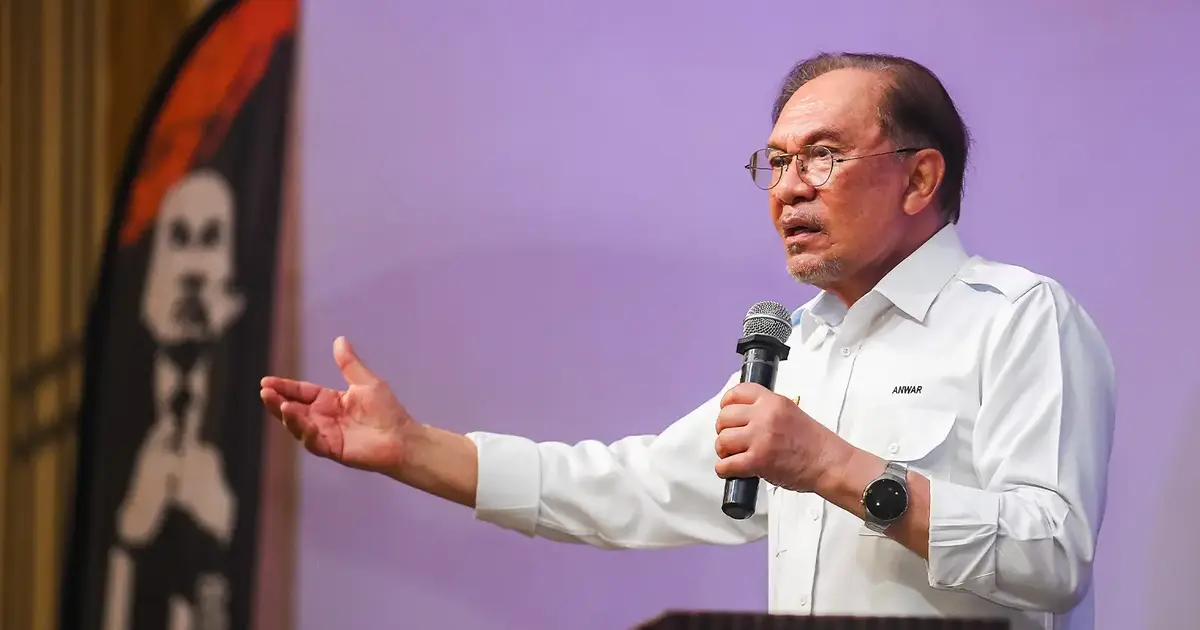
Prime Minister Anwar Ibrahim has levelled accusations that a movement backing imprisoned former Prime Minister Najib Razak deliberately created conditions forcing Pakatan Harapan into contesting the Johor state election ahead of schedule. Speaking in his capacity as chairman of the coalition, Anwar suggested that the early calling of polls in Malaysia's southern stronghold was not organically necessary but rather the result of deliberate political positioning by the so-called 'Free Najib' faction.
The timing of Johor's election has become a focal point in Malaysian political discourse, with interpretations varying sharply across the country's competing factions. Anwar's assertion touches on a broader pattern of jockeying for position within the complex web of Malaysian coalition politics, where the fortunes of individual leaders often carry outsized influence over party strategy and electoral calculations. His comments underscore the degree to which personalities continue to dominate decision-making at the highest levels of governance, even as officials rhetorically emphasise institutional concerns.
Johor represents a particularly sensitive electoral arena for Pakatan Harapan, having been governed by the Barisan Nasional alliance for decades before 2022. The state serves as both a symbolic prize and a practical stronghold that any national coalition must manage carefully. Any perceived forced engagement in elections—whether orchestrated by rival factions or external pressure—threatens to disrupt carefully calibrated strategies that governing coalitions typically prefer to execute on their own timeline. Anwar's willingness to publicly articulate this frustration suggests that internal coalition dynamics remain strained despite Pakatan Harapan's continued control of federal government.
The 'Free Najib' movement has gained increasing salience within certain segments of Malaysian politics, particularly among constituencies sympathetic to the former premier and his economic policies. Najib Razak, who served as Prime Minister from 2009 until 2018, remains imprisoned following conviction in the 1Malaysia Development Berhad scandal, one of the largest financial frauds in Asian history. However, he retains substantial support among grassroots members of UMNO and among voters who view his conviction as politically motivated or who prioritise development-focused governance over corruption concerns. The movement advocating for his release or pardon has become a rallying point for dissidents within the broader opposition camp.
From the perspective of coalition management, Anwar's public comments reveal the calculation that Pakatan Harapan would have preferred to delay Johor engagement. Earlier elections in the state would typically be viewed as disadvantageous to the ruling federal coalition unless carefully orchestrated with overwhelming grassroots preparation. The compressed campaign timeline limits resources available for extensive campaigning and ground organisation, potentially benefiting opponents who command existing institutional machinery in the state. By asserting that external pressure forced Pakatan Harapan's hand, Anwar appears to be laying groundwork for explaining any electoral shortfalls or disappointments.
Such public recriminations between coalition partners and opposition factions also reflect deeper structural vulnerabilities within Malaysia's political ecosystem. When electoral timing becomes subject to accusations of manipulation rather than straightforward legislative procedure, it signals to voters that democratic processes themselves are contested terrain. This perception, whether warranted or merely rhetorical, undermines public confidence in institutions and reinforces cynicism about political motivations across the spectrum. For citizens attempting to evaluate their options, such statements muddy the distinction between legitimate governance disagreements and alleged bad-faith manoeuvrings.
The broader implications for Southeast Asia extend beyond Malaysia's borders, as the region's largest democracy continues to grapple with questions of democratic consolidation and institutional integrity. Malaysia's experience with coalition politics, leadership transitions, and the influence of individual political personalities serves as a case study for other nations navigating multiethnic democracies with strong party systems. The degree to which factional loyalty, personal networks, and historical grievances shape electoral behaviour suggests that purely institutional reforms may prove insufficient without corresponding shifts in political culture.
Anwar's framing of events also carries implications for the Opposition's own coherence. If powerful factions within Malaysia's political system can successfully compel actions by the governing coalition, it raises questions about where authority actually resides and whether electoral outcomes genuinely reflect voter preferences or rather reflect behind-the-scenes negotiations among elite clusters. This dynamic may resonate with Malaysian voters increasingly sceptical of all political players, potentially creating openings for independent candidates or new political movements to gain traction by positioning themselves as alternatives to the established system.
The coming Johor election will provide empirical ground truth against which to assess these political claims. Electoral results will either validate Anwar's assertion that external pressure created unfavourable conditions or demonstrate that Pakatan Harapan successfully navigated the challenge. Irrespective of outcome, however, the precedent of publicly blaming opponents for forcing electoral engagement sets a tone in which political actors increasingly resort to explanations rooted in alleged conspiracies rather than transparent policy debates. This trajectory, if sustained, risks further eroding the institutional foundations upon which stable democratic governance depends.

