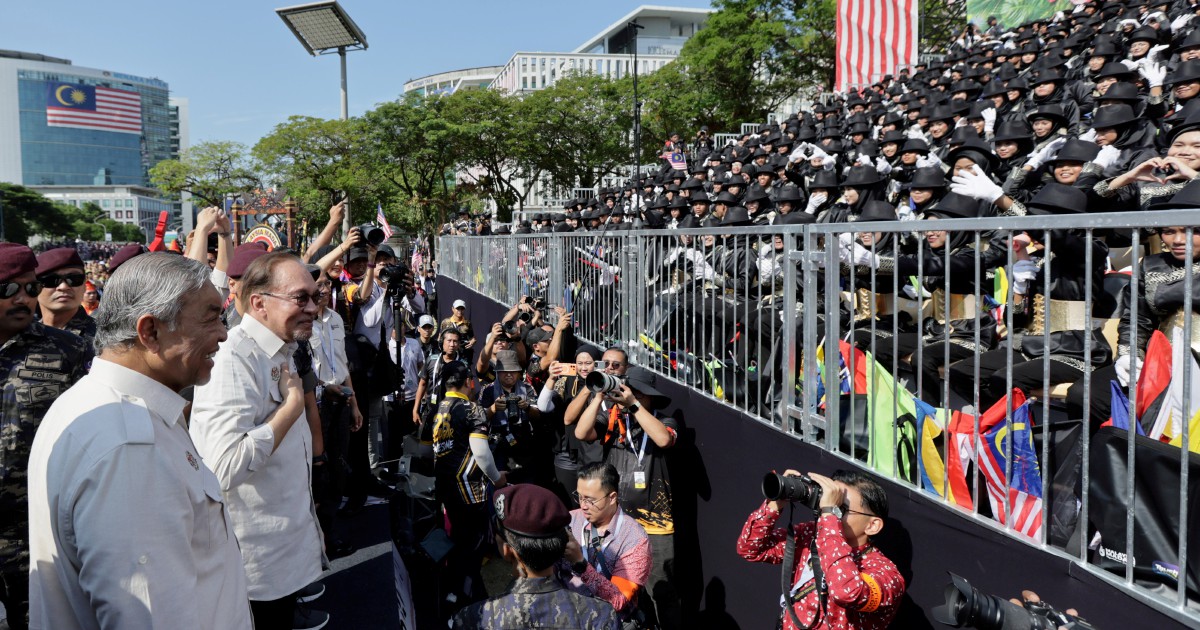
Prime Minister Datuk Seri Anwar Ibrahim seized the opportunity to interact directly with Malaysians gathered at Dataran Putrajaya following the conclusion of the National Day parade celebrations, transforming what might have been a routine ceremonial exit into a series of genuine personal connections with citizens across different ages and backgrounds.
The unscheduled engagement saw the Prime Minister moving through crowds with evident ease, stopping repeatedly to chat with visitors and show particular attention to children present at the venue. These informal moments provided a glimpse of Anwar's approach to public engagement, emphasizing accessibility and direct dialogue with ordinary Malaysians rather than maintaining the formal distance typical of high-level political events.
Such public interactions following major national events carry symbolic weight in Malaysian political culture. They signal a leadership style oriented toward approachability and community connection, qualities that can influence public perception of a sitting government. The walkabout's informal nature distinguished it from the structured protocols usually governing prime ministerial appearances, suggesting a deliberate choice to create space for spontaneous human engagement.
The National Day parade at Dataran Putrajaya serves as Malaysia's premier civic celebration, drawing thousands of spectators who gather to witness displays of national pride and unity. The venue itself holds particular significance as the administrative heart of Malaysian government, making it an especially symbolic location for the Prime Minister's post-celebration engagement with the public.
Children featured prominently in Anwar's interactions during the walkabout, with multiple instances of the Prime Minister embracing younger attendees. This deliberate focus on engaging with the next generation carries both practical and messaging implications. Practically, such interactions often feature prominently in official and media coverage, shaping how citizens perceive their national leadership. More broadly, prioritizing engagement with young people at national celebrations underscores themes of continuity, investment in Malaysia's future, and intergenerational connection.
The spontaneous nature of the gathering distinguished it from pre-planned ceremonial functions. Rather than speaking from a prepared platform or reading from scripted remarks, Anwar engaged in face-to-face conversations, listened to individual citizens, and responded in real time. This style of engagement appeals to many Malaysians who value leaders demonstrating genuine interest in their concerns and perspectives beyond formal state occasions.
Public walkabouts by senior political figures operate within a carefully managed context in Malaysia, where security and crowd control remain paramount considerations. The successful execution of Anwar's impromptu interactions reflects the coordination between security services and event organizers who must balance public accessibility with the protection requirements of high-level officials. Such coordination becomes increasingly complex at large gatherings like the National Day parade.
The timing of these interactions—immediately following the parade itself—places them within the broader context of national celebration and unity messaging. National Day represents one of the few occasions when Malaysians from diverse ethnic, religious, and socioeconomic backgrounds gather collectively to commemorate shared national identity. A Prime Minister's visible engagement with the public at such moments amplifies themes of inclusive governance and shared national purpose.
In Malaysia's contemporary political landscape, where trust in institutions and political leadership faces ongoing scrutiny, direct public engagement serves as a counterbalance to the formalized structures that can sometimes create distance between government and citizens. The walkabout format, by its very informality, suggests transparency and willingness to interact without bureaucratic intermediaries, though such interactions inevitably occur within bounds established by protocol and security.
The presence of media documentation of these interactions reflects the modern political reality where such moments gain significance through digital circulation and public discourse. Official and independent media coverage of the Prime Minister's engagement with citizens amplifies the reach and impact of the encounters far beyond those physically present at Dataran Putrajaya, shaping national conversation about leadership style and government accessibility.
Regional observers often monitor how Southeast Asian leaders engage with their publics, as such interactions can indicate broader governance philosophies and political stability. Malaysia's transition through multiple administrations in recent years has made leadership accessibility and public engagement particularly noteworthy to both domestic and international observers tracking the nation's political trajectory.
The National Day parade itself represents one of Malaysia's most significant annual civic events, combining patriotic display with opportunities for public participation and celebration. By engaging informally with attendees after the formal proceedings concluded, Anwar extended the spirit of the celebration beyond the choreographed elements of the parade, creating space for more organic connection between national leadership and citizenry.

