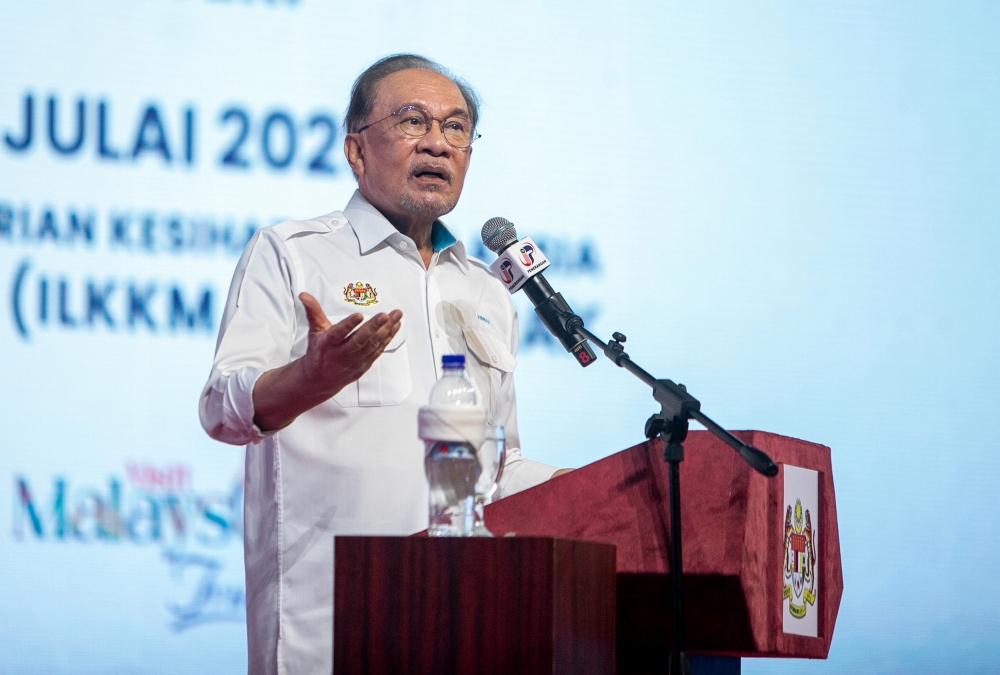
Prime Minister Datuk Seri Anwar Ibrahim has mounted a robust defence of the government's approach to fuel pricing, framing the subsidy system as essential to maintaining living standards for ordinary Malaysians whilst resisting pressure to shift the burden onto public debt. Speaking in Kajang, Anwar articulated the fundamental dilemma facing policymakers: balancing immediate relief for consumers against the longer-term fiscal consequences of leaving fuel prices at artificially depressed levels.
The Prime Minister's intervention represents a calculated response to mounting criticism from fiscal hawks and international observers who argue that Malaysia's fuel subsidies represent an unsustainable drain on government coffers. By positioning the question around who ultimately bears the cost—consumers at the pump or taxpayers financing expanded borrowing—Anwar has reframed the debate away from abstract economic principles and towards tangible consequences for ordinary people. This rhetorical strategy acknowledges the political reality that sudden fuel price increases generate public backlash and electoral consequences across the region, as previous Malaysian governments have discovered through painful experience.
Anwar's defence reflects broader tensions within Southeast Asian governance between short-term electoral imperatives and medium-term fiscal stability. Malaysia's fuel subsidy system, inherited from previous administrations, represents a political consensus that society's poorest members should not bear disproportionate adjustment costs when global oil prices spike. The current administration has inherited both this commitment and its escalating financial consequences, forcing difficult choices about whether to maintain support through higher deficits or implement politically contentious price liberalisation.
The Prime Minister's warning about mounting debt carries particular weight given Malaysia's existing debt trajectory. Government borrowing has expanded significantly in recent years, driven partly by pandemic-related expenditure and infrastructure investment, but also by the ongoing cost of maintaining subsidies when commodity prices gyrate unpredictably. Further accumulation of debt without corresponding revenue increases or expenditure restraint threatens to constrain future governments' policy flexibility and potentially trigger credit rating downgrades that would increase borrowing costs across the economy.
Anwar's framing implicitly acknowledges that fuel subsidy removal cannot be presented merely as technical economic adjustment but must be accompanied by comprehensive social protection measures for vulnerable populations. Malaysia's experience alongside regional neighbours suggests that fuel price liberalisation undertaken without coordinated support for public transport, targeted cash transfers, or adjustments to other social programmes generates sustained political opposition. The government's challenge involves identifying revenue sources sufficient to maintain both current subsidy levels and develop alternative mechanisms to shield the poorest households from commodity price volatility.
The timing of Anwar's comments reflects intensifying pressure from multiple directions. International financial institutions and credit rating agencies consistently identify fuel subsidies as obstacles to achieving medium-term fiscal consolidation targets. Simultaneously, domestic constituencies ranging from transport operators to SME proprietors to ordinary commuters have vested interests in maintaining current fuel prices. Any policy shift requires either external pressure becoming sufficiently acute to override domestic political resistance, or careful construction of coalitional support among affected groups.
Malaysia's position within the ASEAN region adds another dimension to this policy calculus. Neighbouring countries including Indonesia and the Philippines have undertaken their own fuel subsidy reforms, often achieving fiscal savings but at considerable political cost. These precedents inform Malaysia's approach, providing both cautionary tales about implementation risks and evidence that managed transitions remain feasible with adequate preparation and social consensus-building. Yet Malaysia's different revenue base—including petroleum production income—creates distinct policy options unavailable to energy-importing neighbours.
The substantive economic logic supporting Anwar's position rests on recognising that fuel subsidies represent a particular form of government expenditure with specific incidence across society. Unlike targeted social assistance that reaches only identified vulnerable populations, price subsidies benefit all consumers regardless of income level, with wealthier households capturing disproportionate absolute benefits through higher consumption. However, eliminating subsidies without replacement mechanisms would impose immediate hardship on transport-dependent lower-income groups, necessitating compensatory measures that might themselves prove economically inefficient or politically difficult to implement.
Longer-term fiscal sustainability requires reconciling these competing pressures through comprehensive reform rather than incremental adjustment. Anwar's defence of current policy, whilst warning against debt accumulation, implicitly acknowledges that neither maintaining unlimited subsidies nor abrupt removal represents optimal policy. The government's challenge involves charting a transitional pathway that gradually shifts fuel market prices toward international levels whilst simultaneously building revenue-generating capacity and establishing more efficient social protection systems. This requires sustained political commitment beyond current electoral cycles and cross-party consensus that current practices prove ultimately unsustainable.
The broader lesson for Malaysian policymakers extends beyond fuel subsidy mechanics to encompass fundamental questions about the relationship between state capacity, fiscal constraints, and social welfare provision. As regional economies face intensifying pressures from climate transition, demographic ageing, and digital transformation, governments must decide whether existing redistribution mechanisms serve contemporary needs or require fundamental restructuring. Anwar's articulation of the subsidy dilemma reflects this deeper recognition that Malaysian governance faces critical choices about how to balance protecting vulnerable populations against constraints imposed by limited fiscal space and international economic integration.

